
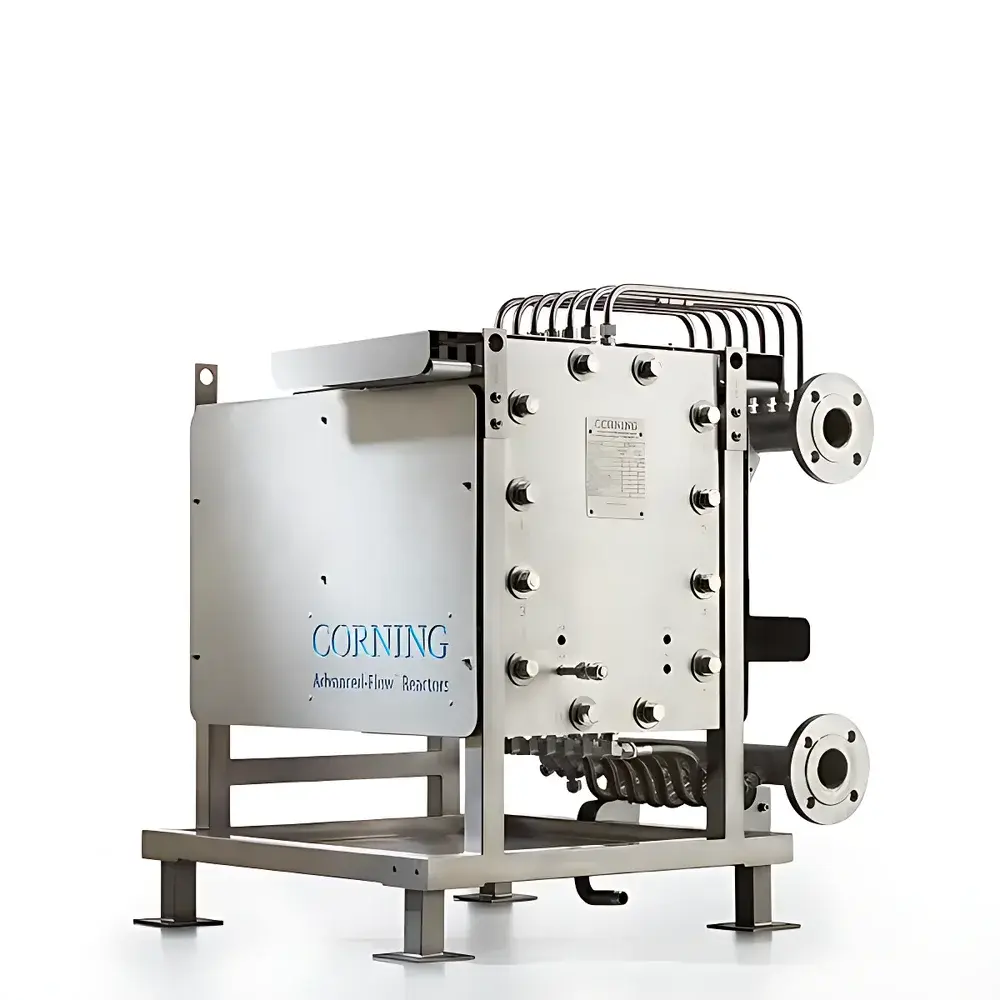
Corning G4 High-Throughput Carbon-Silicon Alloy Ceramic Flow Reactor
| Brand | Corning |
|---|---|
| Origin | USA |
| Model | G4 |
| Fluid Throughput Capacity | Up to 2000 m³/year |
| Operating Temperature Range | –25 °C to 200 °C |
| Maximum Operating Pressure | 18 bar |
| Material | Metal-Free Carbon–Silicon Alloy Ceramic |
| Scalability | Direct G1-to-G4 Geometric and Performance-Scaled Architecture |
| Regulatory Alignment | Designed for GLP/GMP-compliant environments, compatible with ASTM E2500 and ISO 9001 process validation frameworks |
Overview
The Corning G4 High-Throughput Carbon–Silicon Alloy Ceramic Flow Reactor is an engineered platform for continuous-flow chemical synthesis at pilot and early-production scale. Based on Corning’s proprietary carbon–silicon (C–Si) alloy ceramic architecture, the G4 reactor eliminates metallic wetted surfaces—thereby delivering exceptional resistance to corrosion from aggressive reagents including strong acids (e.g., HCl, H₂SO₄), halogenated solvents, oxidizers (e.g., HNO₃, H₂O₂), and high-pH bases. Its fluidic design leverages microstructured channel networks derived from Corning’s G1 and G3 platforms, enabling precise residence time control, laminar-to-moderate turbulent flow regimes, and uniform radial temperature distribution via integrated heat exchange manifolds. The reactor operates across a validated thermal range of –25 °C to 200 °C and supports sustained pressure up to 18 bar (261 psi), making it suitable for exothermic nitrations, hydrogenations, photochemical transformations, and multi-step telescoped syntheses under controlled kinetic conditions.
Key Features
- Metal-free fluid path constructed entirely from sintered carbon–silicon alloy ceramic—certified per ASTM C1161 for flexural strength (>280 MPa) and ISO 14703 for chemical resistance classification (Class A for HF, Class B for concentrated HNO₃)
- Geometrically scalable architecture: G4 maintains identical dimensionless numbers (Reynolds, Péclet, Graetz) relative to G1 and G3 units, ensuring predictive scale-up without re-optimization of mixing or heat transfer coefficients
- Integrated thermal management: Dual-zone jacketed heating/cooling channels with ±0.5 °C temperature uniformity across active reaction volume (1.2 L net internal volume)
- Modular connection interface: Standardized 1/4″ VCR fittings with helium-leak-tested seals (<1×10⁻⁹ mbar·L/s), compatible with Corning’s G-Series pump modules and back-pressure regulators
- Structural footprint reduction: Compact vertical stacking configuration reduces floor space by 40% versus equivalent-capacity tubular stainless-steel systems
Sample Compatibility & Compliance
The G4 reactor accommodates heterogeneous slurries (up to 30 wt% solids), viscous media (μ ≤ 1500 cP), and gas–liquid multiphase streams (e.g., CO₂–MeOH, H₂–THF) without channel fouling or pressure drop escalation. All wetted components comply with USP for extractables profiling and pass FDA 21 CFR Part 11–aligned audit trail requirements when paired with Corning’s FlowManager™ 4.2 software. System qualification follows IQ/OQ/PQ protocols aligned with ASTM E2500–22 and ICH Q5D for biopharmaceutical intermediate synthesis. Documentation packages include material traceability (heat lot certification), as-built P&IDs, and third-party calibration reports for integrated PT100 sensors and pressure transducers.
Software & Data Management
Corning FlowManager™ 4.2 provides deterministic real-time control of flow rates (0.1–500 mL/min per channel), temperature setpoints, and back-pressure profiles. The software logs timestamped process data at 10 Hz resolution with SHA-256 hash integrity verification and stores metadata in encrypted SQLite databases compliant with ALCOA+ principles. Electronic signatures, role-based access control (RBAC), and 21 CFR Part 11–compliant electronic records are enabled out-of-the-box. Export formats include CSV, PDF e-signature-ready batch records, and direct integration with LIMS via ASTM E1467–20-compliant REST API.
Applications
- Continuous API manufacturing: Nitration of aromatic substrates under controlled adiabatic temperature rise (<3 K)
- High-yield Grignard couplings with in-line quench and phase separation
- Photoredox catalysis using integrated UV–Vis LED arrays (365–450 nm) and fiber-optic irradiance monitoring
- Enzymatic synthesis at elevated temperatures (e.g., lipase-catalyzed esterification at 70 °C)
- Process intensification studies supporting Quality by Design (QbD) frameworks per ICH Q8(R3)
FAQ
Is the G4 reactor suitable for reactions requiring cryogenic conditions?
Yes—the system supports operation down to –25 °C using external chiller integration with ethylene glycol/water coolant; low-temperature performance is validated per ASTM D1505 for thermal shock resistance.
Can existing G1 or G3 process parameters be directly transferred to the G4 unit?
Yes—G4 maintains constant dimensionless scaling parameters (Da, We, Bo); residence time distribution (RTD) measurements confirm <±2% variance in mean residence time versus G1 at matched flow Reynolds numbers.
What documentation is provided for regulatory submissions?
Standard delivery includes full 21 CFR Part 11 compliance package, IQ/OQ/PQ execution templates, material certifications, and a Process Validation Master Plan (PVMP) aligned with FDA Guidance for Industry (2011).



