
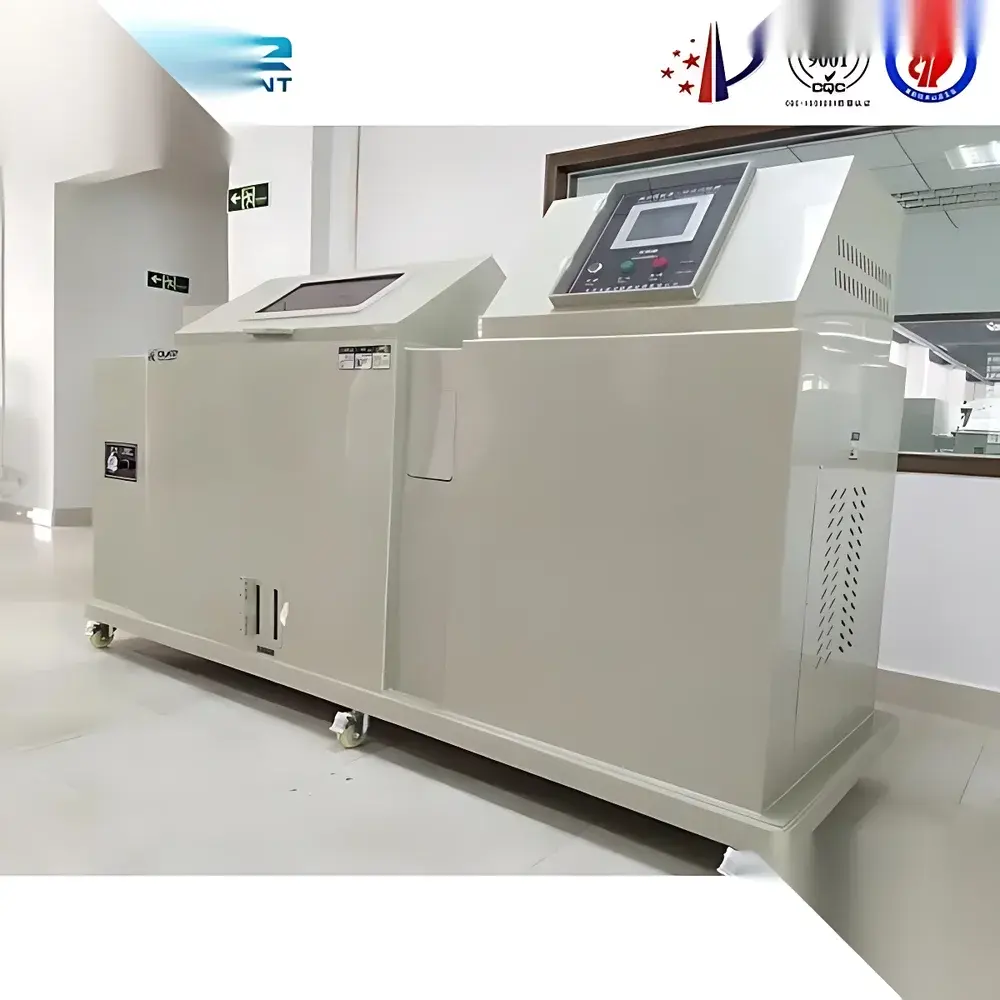
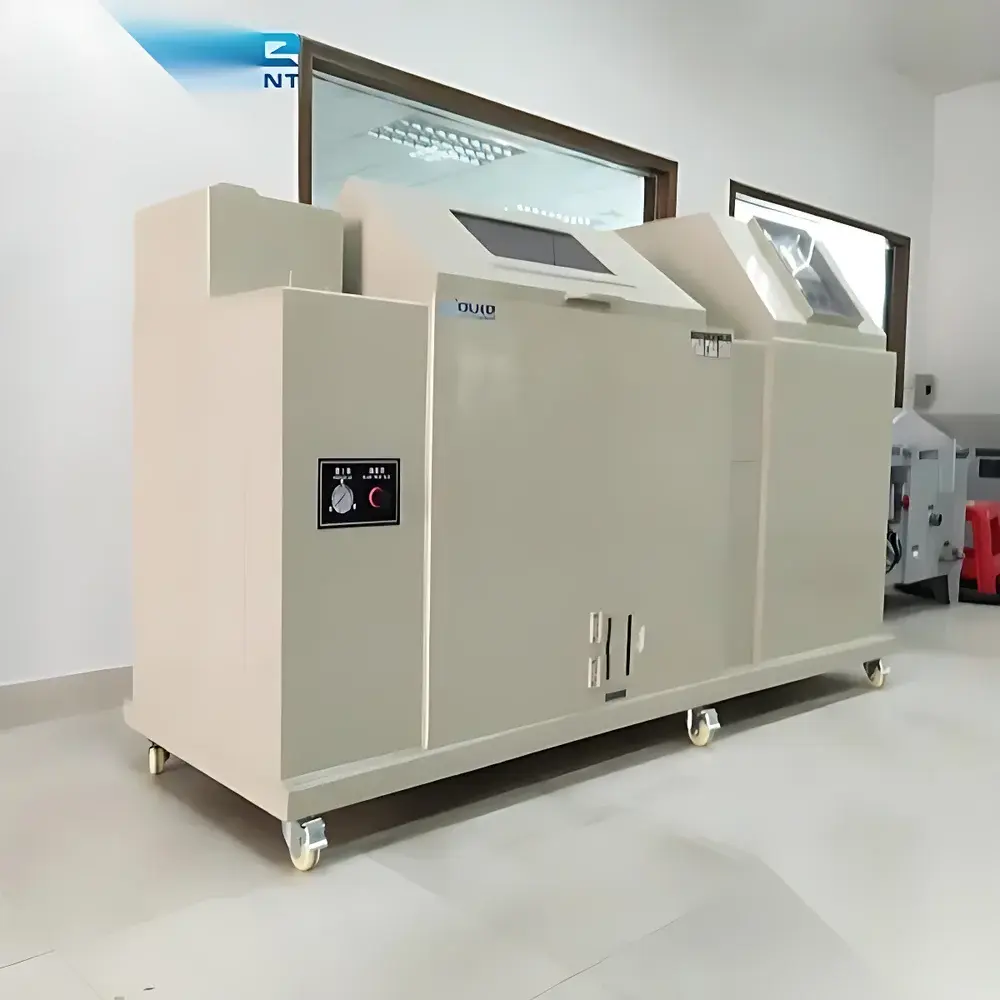
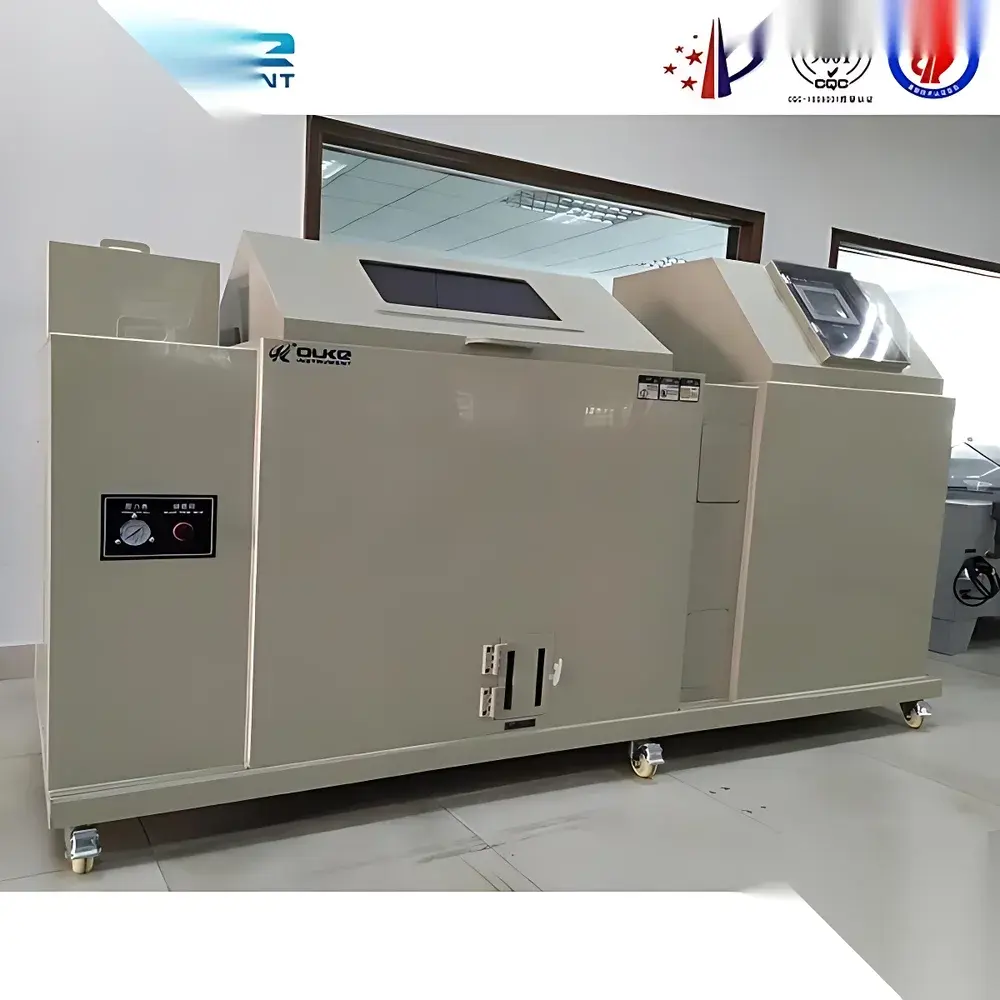
Corrosion Resistance Salt Spray Test Chamber
| Key Features | LCD digital temperature & humidity controller |
|---|---|
| Segment duration | 0–999 h 59 min |
| Loop count | 1–999 partial or 0–999 full cycles |
| Chamber material | seamless fiberglass-reinforced plastic (FRP) |
| Interior components | stainless steel, copper, or corrosion/heat-resistant materials |
| Safety protections | leakage current, short circuit, overtemperature, low-water, end-of-test, overcurrent |
| Compliance | GB/T 2423.17–2022, IEC 60068-2-11, ASTM B117, ISO 9227, DIN 50021 |
| Temperature range | +5°C to 55°C |
| Humidity range | 85–95% RH |
| Temp. uniformity | ≤ ±2°C |
| Temp. stability | ≤ ±0.5°C |
| Salt deposition rate | 1–2 mL / 80 cm²·h |
| Spray modes | continuous or cyclic |
| Timer range | 1–999 (s/min/h) |
| Power supply | AC 220V±10% / 380V±10%, 50 Hz |
| Ambient operating conditions | 5–30°C, ≤85% RH |
| Heating system | independent Ni-Cr alloy heaters |
| Spray system | tower-type atomizer with non-crystallizing nozzles |
| Salt solution pre-heating | thermally balanced with chamber air |
| Filtration | inline water filter on suction line |
| Calibration-ready | PT100 platinum resistance sensors, standard funnel & graduated cylinder for deposition measurement |
Overview
The Corrosion Resistance Salt Spray Test Chamber is an engineered environmental simulation system designed to accelerate electrochemical corrosion processes under controlled saline atmospheric conditions. Based on the fundamental principle of chloride-induced pitting and crevice corrosion, this chamber replicates aggressive coastal or industrial marine environments to evaluate the long-term anti-rust performance of metallic coatings, platings, paints, and surface treatments. It operates in strict accordance with internationally recognized accelerated corrosion testing standards—including ASTM B117 (Standard Practice for Operating Salt Spray (Fog) Apparatus), ISO 9227 (Corrosion tests in artificial atmospheres — Salt spray tests), and GB/T 2423.17–2022 (Environmental testing — Part 2: Tests — Test Ka: Salt mist)—ensuring data comparability across global R&D, quality assurance, and regulatory validation workflows. The chamber’s sealed FRP monocoque construction eliminates structural seams and potential leakage points, while its integrated thermal equilibrium system ensures precise synchronization between salt solution temperature and chamber ambient conditions—critical for reproducible deposition rates and compliant test execution.
Key Features
- High-fidelity LCD-based PID temperature and humidity controller with 50-segment programmable logic—supporting complex multi-phase test profiles (e.g., alternating salt fog, dry-off, and high-humidity recovery stages)
- Robust power interruption memory: automatically resumes interrupted tests from the exact point of failure, preserving data integrity and audit trail continuity
- Fiberglass-reinforced plastic (FRP) chamber body formed via one-piece compression molding—guaranteeing zero weld lines, zero porosity, and long-term chemical inertness against acidic NaCl aerosols
- Dual-mode operational flexibility: configurable as standalone salt spray tester or upgraded to combined humid heat + salt fog cycling mode (per ISO 9227 Annex C or ASTM G85 Annex A5)
- Tower-type spray generation system with non-crystallizing ceramic nozzles—minimizing clogging and ensuring stable, laminar fog distribution per ASTM B117 nozzle alignment requirements
- Comprehensive safety architecture: real-time monitoring of water level, heater current draw, chamber overtemperature, ground fault, and end-of-cycle status—all triggering immediate shutdown and visual/audible alerts
- Calibration-ready sensor suite: PT100 Class A platinum resistance probes for temperature, plus traceable deposition measurement tools (standard funnel + 10-mL calibrated cylinder) aligned with ISO 9227 verification protocols
Sample Compatibility & Compliance
This chamber accommodates a wide range of specimen geometries—from small fasteners and electronic connectors to large automotive subassemblies—via adjustable V-shaped stainless steel sample racks. Its uniform temperature distribution (≤ ±2°C) and tight humidity control (85–95% RH) meet the spatial homogeneity criteria specified in ASTM B117 Section 6.3 and ISO 9227 Clause 5.2. All wetted internal components—including nozzles, funnels, piping, and reservoirs—are fabricated from corrosion-resistant alloys (AISI 316 stainless steel, copper-nickel, or fluoropolymer-coated brass) to prevent cross-contamination and metal ion leaching. The system supports full compliance with GLP and GMP documentation requirements when paired with optional data loggers (IEC 60746-3 compliant), enabling 21 CFR Part 11–ready audit trails for pharmaceutical packaging or medical device coating validation.
Software & Data Management
While the base configuration features a stand-alone LED/PID controller, the chamber is fully compatible with third-party SCADA and LIMS integration via RS-485 Modbus RTU protocol. Optional Ethernet-enabled data loggers provide time-stamped, tamper-evident recording of chamber temperature, relative humidity, and cumulative spray duration—exportable in CSV or PDF formats for regulatory submission. All recorded datasets include metadata such as operator ID, test method reference (e.g., “ASTM B117-23”), and calibration certificate numbers—fulfilling traceability mandates under ISO/IEC 17025:2017 Clause 7.7 and FDA Quality System Regulation 21 CFR Part 820.72.
Applications
- Automotive OEMs validating zinc-nickel, electrophoretic primer, and chromate conversion coatings on chassis components
- Aerospace suppliers qualifying cadmium-plated fasteners and aluminum alloy anodized surfaces per MIL-STD-810H Method 509.6
- Electronics manufacturers assessing conformal coating integrity on printed circuit boards exposed to coastal environments
- Marine equipment fabricators verifying galvanic protection performance of sacrificial anodes and duplex stainless steels
- Paint & coating R&D labs benchmarking VOC-free waterborne primers against solvent-based benchmarks using quantitative rust creepage metrics (ISO 4628-3)
FAQ
What standards does this chamber comply with?
It meets the core requirements of ASTM B117, ISO 9227, GB/T 2423.17–2022, DIN 50021, and IEC 60068-2-11—with hardware-level design features (e.g., water-seal lid, calibrated deposition geometry, and thermal equilibrium) validated against each standard’s apparatus clauses.
Can it perform humidity-only or combined cyclic tests?
Yes—the controller supports standalone humid heat operation (per IEC 60068-2-78) and can be factory-configured for multi-stage cycling (e.g., 4h salt fog → 4h drying → 4h high-humidity recovery), aligning with ASTM G85 Annex A5 or ISO 14993.
Is calibration documentation included?
The unit ships with factory-assembled calibration certificates for PT100 sensors and deposition collection hardware—traceable to national metrology institutes (NIM or NIST-equivalent). On-site IQ/OQ protocols are available upon request.
What maintenance is required to sustain compliance?
Daily visual inspection of nozzles and funnels; weekly cleaning of the salt solution reservoir and inline water filter; quarterly verification of temperature uniformity and deposition rate using certified reference instruments per ISO 9227 Annex B.
Does it support remote monitoring?
When equipped with the optional Ethernet data logger module, real-time chamber status and historical logs can be accessed via secure HTTPS interface—compatible with enterprise MES and QMS platforms.



