
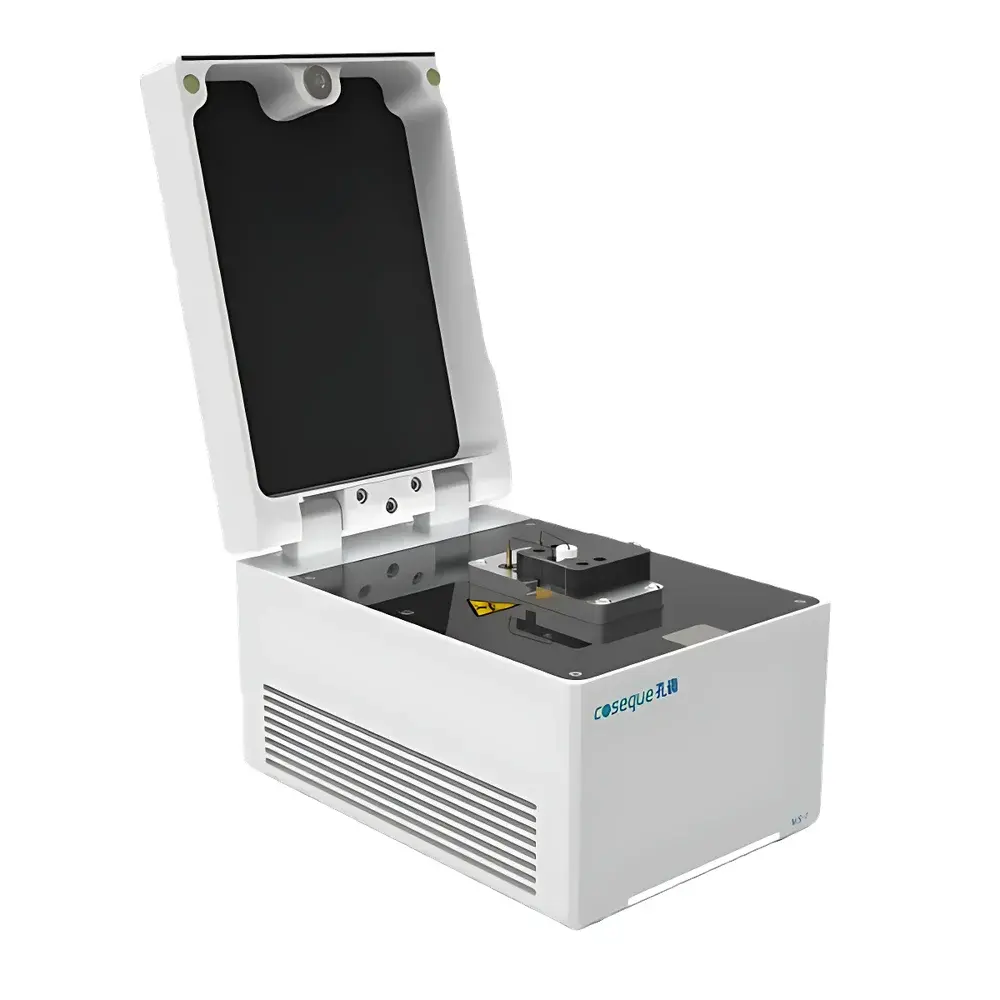
COSEQUE MS-1 Single-Channel Planar Lipid Bilayer Electrophysiology Workstation
| Brand | COSEQUE (CHENGDU) TECHNOLOGY CO., LTD. |
|---|---|
| Origin | Sichuan, China |
| Model | MS-1 |
| Dimensions | 215 × 150 × 135 mm (L×W×H, ±3 mm) |
| Current Range | ±2.5 nA |
| Bias Voltage Range | ±2500 mV |
| Sampling Rate | 1 Hz – 200 kHz (16-bit resolution) |
| Input Referred Noise | ≤0.5 pA RMS @ 10 kHz |
| Zero Offset Compensation | ±250 mV |
| Continuous Operation | ≥10 h |
| Interface | USB 2.0 |
| EMC | Integrated Faraday-cage-level shielding |
Overview
The COSEQUE MS-1 is a compact, single-channel planar lipid bilayer electrophysiology workstation engineered for high-fidelity recording of ion channel and nanopore activity under controlled membrane-mimetic conditions. Unlike traditional patch-clamp systems requiring glass micropipettes and cell-attached configurations, the MS-1 employs a solvent-free, black lipid membrane (BLM) architecture formed across a microaperture in a hydrophobic polymer partition. This planar geometry enables stable, long-duration recordings of reconstituted transmembrane proteins—including ion channels, porins, and engineered nanopores—while maintaining low electrical noise and high signal-to-noise ratio. The system operates on the principle of voltage-clamp electrophysiology: a programmable transmembrane potential drives ionic current across the bilayer, and sub-picoampere fluctuations are resolved via a low-noise headstage and high-resolution analog-to-digital conversion. Designed for both academic and industrial labs, the MS-1 supports fundamental biophysical characterization, pharmacological profiling, and biosensor development without dependency on live cells or complex microfabrication infrastructure.
Key Features
- Ultra-low input-referred noise: ≤0.5 pA RMS at 10 kHz bandwidth—optimized for resolving sub-conductance states and transient gating events.
- Integrated headstage and control electronics: No external amplifiers or separate probe assemblies required; reduces cable-induced interference and setup complexity.
- One-touch ZAP function: Programmable voltage pulse delivery for reliable, repeatable membrane rupture and pore insertion—minimizing manual intervention and experimental variability.
- Programmable voltage protocols: Supports step, ramp, and custom waveform generation with real-time parameter adjustment; configurable for voltage-dependent activation/inactivation studies.
- Embedded EMC shielding: Fully integrated electromagnetic interference (EMI) suppression architecture eliminates the need for external Faraday cages or shielded rooms—ideal for shared lab environments.
- Intelligent event monitoring: Real-time detection of membrane formation (seal resistance >1 GΩ), pore insertion, and channel blockage—with automated voltage reset and visual/audible alerts.
- Self-calibrating zero-offset compensation: Active baseline stabilization over extended recordings (>1 h continuous acquisition), reducing drift-induced artifacts.
Sample Compatibility & Compliance
The MS-1 is compatible with synthetic phospholipid bilayers (e.g., DPhPC, POPC), detergent-solubilized or purified membrane proteins (e.g., α-hemolysin, MscL, KcsA), and engineered nanopores (e.g., CsgG, ClyA). Standardized sample chambers—COChamber-1000 (1 mL volume) and COCup-1000 (disposable cup)—ensure reproducible aperture geometry and lipid film stability. All consumables are manufactured under ISO 9001-certified processes and tested for batch-to-batch consistency in capacitance, resistance, and noise floor. While not certified to FDA 21 CFR Part 11 out-of-the-box, the software architecture supports audit-trail-enabled operation (user log, timestamped parameter changes, raw data immutability) when deployed within GLP/GMP-compliant workflows. The system complies with IEC 61326-1 for electromagnetic compatibility and meets CE marking requirements for laboratory instrumentation.
Software & Data Management
The MS-1 Control Suite runs natively on Windows 7 or later and provides a modular, scriptable interface for experiment design, real-time visualization, and post-acquisition analysis. Key capabilities include: automatic seal resistance monitoring with user-defined thresholding; adaptive sampling rate switching during long-duration recordings; embedded baseline correction algorithms; and export to industry-standard formats (.abf, .dat, .txt) for downstream processing in Clampfit, Python (Neo, Elephant), or MATLAB. All user actions—including protocol loading, voltage stepping, ZAP triggering, and file saving—are logged with timestamps and operator ID. Raw data files contain embedded metadata (date, device serial number, calibration status, environmental temperature if sensor-equipped), ensuring traceability for regulatory submissions or publication-grade reporting.
Applications
- Single-channel biophysics: Quantification of conductance states, open probability, dwell time distributions, and voltage-dependent gating kinetics for wild-type and mutant ion channels.
- Membrane protein–lipid interactions: Assessment of how phospholipid headgroup charge, acyl chain saturation, or cholesterol content modulates channel stability and functional output.
- Nanopore sensing: Development of label-free, real-time biosensors for DNA translocation, small-molecule binding, or protein conformational dynamics at the single-molecule level.
- Drug mechanism screening: Evaluation of compound effects on channel inhibition, potentiation, or allosteric modulation—supporting early-stage pharmacology and target validation.
- Enzyme kinetics at interfaces: Immobilization of membrane-tethered enzymes (e.g., phospholipase A2) to monitor catalytic turnover via coupled ion flux or pH-sensitive pore conductance shifts.
FAQ
Is the MS-1 suitable for recording from native cell membranes?
No—the MS-1 is designed exclusively for planar lipid bilayer (reconstituted protein) configurations, not whole-cell or excised patch recordings.
Can the system be upgraded to multi-channel recording?
The MS-1 is a dedicated single-channel platform; multi-channel expansion requires separate hardware integration and is not supported by the current firmware or chamber design.
What calibration procedures are required before use?
The system performs automatic zero-offset compensation at startup; users must verify headstage gain using a known resistor (e.g., 1 GΩ test resistor provided) prior to each experimental session.
Does the software support third-party scripting (e.g., Python or LabVIEW)?
Yes—via documented COM interface and ASCII command protocol; full API documentation and example scripts are included in the installation package.
Are replacement chambers and lipid solutions available through COSEQUE?
Yes—COChamber-1000, COCup-1000, and certified synthetic lipid kits (DPhPC, POPC, brain polar lipid extract) are stocked and shipped globally with validated shelf life and QC certificates.




