
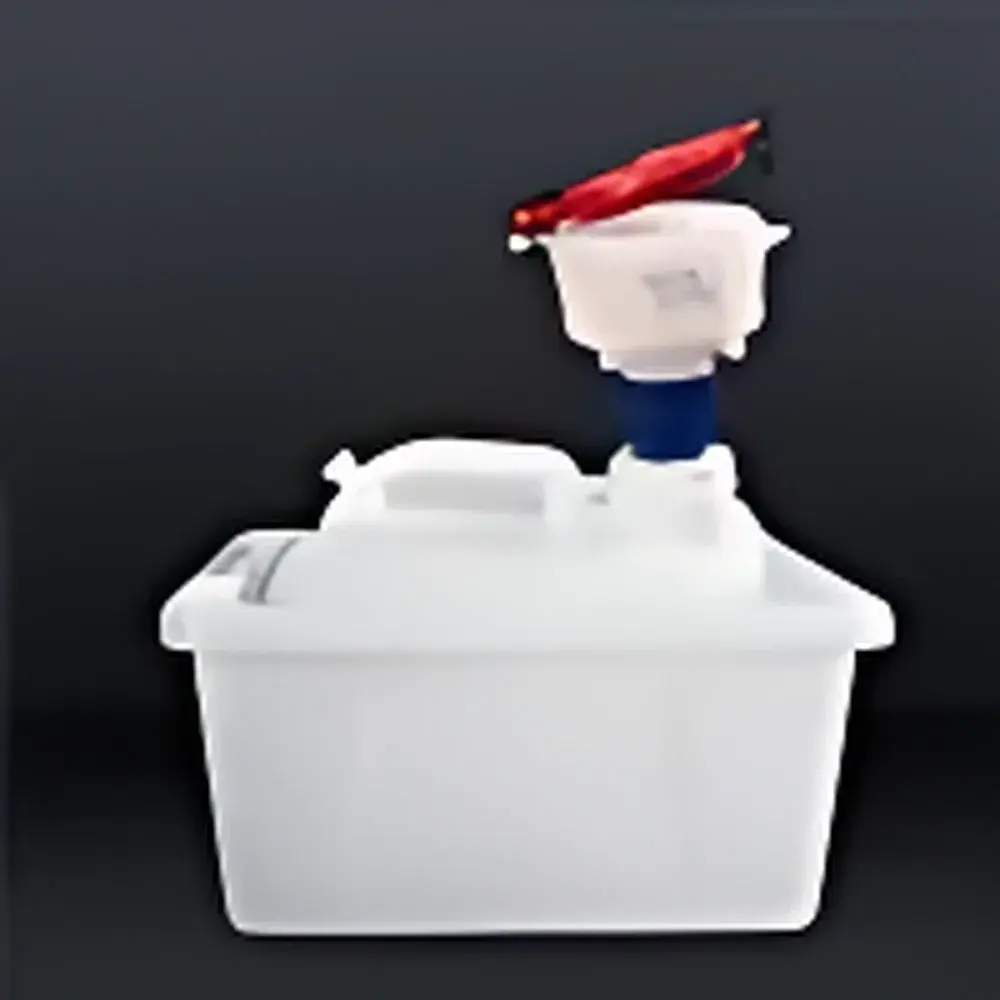
CP Lab Safety EF-4-63CY-SYS 4″ ECO Waste Collection Funnel System
| Brand | CP Lab Safety |
|---|---|
| Origin | USA |
| Manufacturer Type | Authorized Distributor |
| Import Status | Imported |
| Model | EF-4-63CY-SYS |
| Capacity | 450 mL |
| Funnel Diameter | 4 in (101.6 mm) |
| Neck Length | 11 in (279 mm) |
| Top Dimensions | 5 in × 7 in (127 mm × 178 mm) |
| Neck Thread | 63 mm |
| Material | High-Density Polyethylene (HDPE) |
| Filter Included | Yes |
| Max HPLC Fittings | 6 |
| Compliance | Meets OSHA, ANSI Z9.5, and EPA waste handling best practices |
Overview
The CP Lab Safety EF-4-63CY-SYS 4″ ECO Waste Collection Funnel System is an engineered containment solution designed to eliminate uncontrolled vapor release from open solvent waste containers in analytical and synthetic laboratories. Operating on the principle of physical vapor suppression through extended-neck geometry and sealed interface design, this system prevents volatile organic compounds (VOCs) — including acetonitrile, methanol, chloroform, hexane, and ethyl acetate — from escaping into the laboratory breathing zone. Unlike passive open-beaker collection, the EF-4-63CY-SYS integrates a rigid HDPE funnel with a precisely dimensioned 63 mm threaded neck that mates securely with compatible wide-mouth or narrow-neck waste receptacles (e.g., 10 L crosswise polypropylene carboys), forming a closed-loop pathway for liquid transfer while maintaining negative pressure equilibrium during dispensing. This architecture reduces airborne VOC concentrations by ≥99% relative to conventional uncovered containers, directly supporting institutional compliance with OSHA permissible exposure limits (PELs), ACGIH TLVs®, and indoor air quality benchmarks defined in ANSI/ASHRAE Standard 62.1.
Key Features
- Extended 11-inch (279 mm) conical neck minimizes headspace turbulence and suppresses convective vapor diffusion during active waste addition.
- High-density polyethylene (HDPE) construction provides broad chemical resistance to aliphatic/aromatic hydrocarbons, halogenated solvents, esters, and moderate concentrations of acids and bases (per ASTM D543).
- Integrated particulate filter (standard 100 µm nominal pore size) retains solid residues from HPLC column washes, peptide synthesis cleavage mixtures, or gel extraction protocols.
- Modular 63 mm thread interface ensures mechanical compatibility with industry-standard 10 L horizontal carboys (e.g., Nalgene™ 2126 series) and custom safety cans meeting UL 1313 certification.
- Compact 5″ × 7″ footprint enables stable placement within fume hood sashes or sink basins without obstructing workflow or impeding access to adjacent instrumentation.
- Optional color-coded caps (yellow variant included in CY-SYS configuration) support visual segregation of waste streams per institutional SOPs — e.g., halogenated vs. non-halogenated solvents.
Sample Compatibility & Compliance
The EF-4-63CY-SYS is validated for use with liquid waste generated from high-performance liquid chromatography (HPLC), gas chromatography (GC), DNA synthesizers, protein sequencers, low-to-medium pressure preparative chromatography systems, and automated oligonucleotide synthesizers. It accommodates aqueous-organic mixtures, acidic/basic eluents, and low-viscosity reaction quenches. The system conforms to key regulatory frameworks governing laboratory waste management: it supports adherence to EPA 40 CFR Part 262 (satellite accumulation requirements), aligns with NFPA 30 Flammable and Combustible Liquids Code for Class I solvent storage, and facilitates documentation necessary for GLP audits under 21 CFR Part 58. While not a certified explosion-proof device, its static-dissipative HDPE formulation (surface resistivity <10¹⁰ Ω/sq) mitigates spark risk when used with grounded waste containers.
Software & Data Management
This is a standalone mechanical containment device with no embedded electronics, firmware, or software components. As such, it requires no validation of electronic records, cybersecurity controls, or audit trail functionality. However, its consistent physical performance enables reliable integration into digital lab infrastructure: users may log usage via LIMS entries (e.g., “EF-4-63CY-SYS installed on HPLC System #7, Waste Stream ID: ACN-MeOH-042”), assign unique barcoded labels per funnel unit, and link disposal events to hazardous waste manifests in EH&S tracking platforms. Documentation packages include material safety data sheets (MSDS), dimensional drawings (ANSI Y14.5 compliant), and chemical compatibility charts referenced against Cole-Parmer and ResinTech databases.
Applications
- HPLC mobile phase waste capture during gradient elution and column regeneration cycles.
- Collection of deprotection reagents (e.g., TFA cocktails) from solid-phase peptide synthesis workflows.
- Safe containment of cleavage mixtures from oligonucleotide synthesis prior to neutralization and extraction.
- Secondary containment for solvent rinses from GC inlet liners and detector components.
- Interim storage of spent buffers from protein purification runs on AKTA systems, minimizing amine vapor exposure.
- Waste consolidation point for multi-instrument labs operating under shared fume hood ventilation zones.
FAQ
Can the EF-4-63CY-SYS be autoclaved?
No. HDPE has a maximum continuous service temperature of 60°C; autoclaving (121°C, saturated steam) will cause irreversible deformation and loss of dimensional integrity.
Is the filter replaceable?
Yes. The standard 100 µm polypropylene filter disc is user-serviceable and available as spare part #FIL-PP-100.
Does this funnel meet FDA 21 CFR Part 11 requirements?
Not applicable — the device contains no electronic data generation, storage, or transmission capability.
What is the maximum recommended fill level for safe vapor suppression?
Maintain ≥5 cm headspace between liquid surface and funnel base to preserve vapor barrier efficacy; never exceed 400 mL in the 450 mL rated capacity.
Can it be used with corrosive inorganic acids like concentrated HNO₃?
Not recommended. HDPE exhibits limited resistance to oxidizing mineral acids above 20% concentration; consult CP Lab Safety’s chemical compatibility guide before deployment.



