
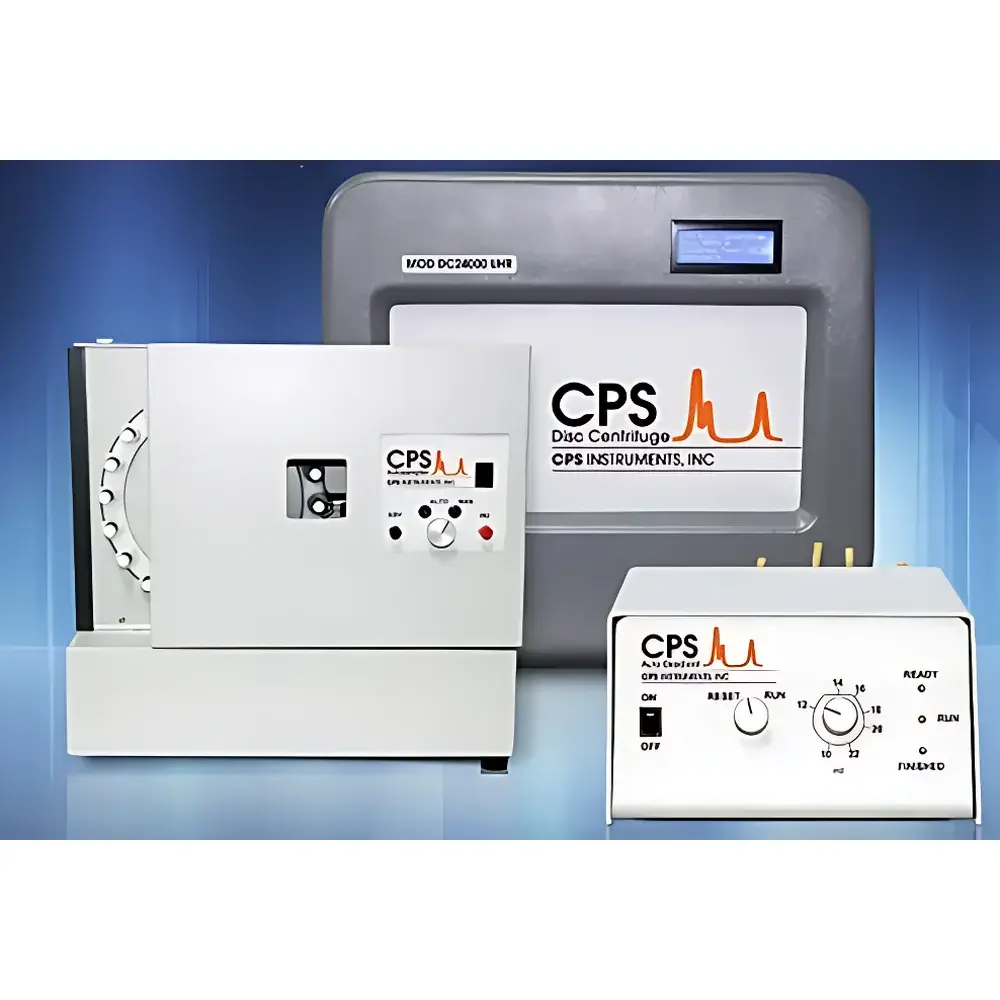
CPS DC24000 UHR High-Resolution Nanoparticle Size Analyzer
| Origin | USA |
|---|---|
| Manufacturer Type | Authorized Distributor |
| Origin Category | Imported |
| Model | DC24000 UHR |
| Price Range | USD 110,000–138,000 (FOB) |
| Particle Size Range | 5 nm – 75 µm |
| Size Measurement Repeatability | ±0.5% RSD |
| Operating Temperature | Ambient (15–30 °C) |
| Light Source Wavelength | 405 nm (violet diode laser) |
| Measurement Principle | High-Speed Centrifugal Sedimentation (HSCS) |
| Sample Mass Range | 0–10 ng |
| Sample Concentration | Matrix-independent (no dilution requirement) |
| Zeta Potential Capability | Not integrated |
| Typical Analysis Time | 1–3 minutes per run |
| Molecular Weight Determination | Not supported |
Overview
The CPS DC24000 UHR High-Resolution Nanoparticle Size Analyzer is an advanced centrifugal sedimentation instrument engineered for high-fidelity particle size distribution (PSD) analysis across colloidal and submicron regimes. Unlike optical or acoustic techniques, it operates on the physical principle of differential sedimentation velocity under precisely controlled gravitational fields—generated via ultra-high-speed rotation up to 24,000 RPM—combined with real-time optical detection at 405 nm. This enables direct, calibration-free measurement of hydrodynamic diameter based on Stokes’ law, delivering exceptional resolution (minimum peak width = 2% of peak diameter) and sensitivity down to 5 nm. Designed for laboratories requiring trace-level quantification and narrow-distribution validation—such as in nanomedicine formulation, catalyst development, and semiconductor slurry QC—the DC24000 UHR delivers reproducible data without reliance on Mie theory assumptions or refractive index inputs.
Key Features
- Ultra-high rotational capability (24,000 RPM) enabling enhanced separation force for sub-10 nm particles
- Integrated automatic density gradient generator for consistent, repeatable sedimentation medium preparation
- Robust architecture supporting unattended operation via programmable autosampler (optional)
- Density-agnostic measurement: valid for particles of any material density—including metals, oxides, polymers, and biological aggregates—without density matching constraints
- Wide dynamic range spanning five orders of magnitude (5 nm to 75 µm) in a single run
- High signal-to-noise optical detection using a stabilized 405 nm violet laser and precision photodiode array
- Measurement repeatability ≤ 0.5% RSD (based on NIST-traceable polystyrene standards, n ≥ 10)
Sample Compatibility & Compliance
The DC24000 UHR accommodates aqueous and organic dispersions, including surfactant-stabilized colloids, protein conjugates, metal nanoparticles, and abrasive slurries. Its low sample mass requirement (as little as 0.01 µg) minimizes material consumption—critical for expensive or scarce biologics and novel nanomaterials. No pre-filtration or dilution is required; concentration independence eliminates bias from aggregation artifacts induced by dilution. The system complies with ISO 13321:2020 (particle size analysis by sedimentation methods) and supports GLP/GMP-aligned workflows through audit-trail-enabled software logging. All hardware components meet CE/UL safety standards and operate within Class I cleanroom-compatible environmental specifications (IEC 60601-1).
Software & Data Management
CPS Analyze™ v5.2 software provides full instrument control, real-time data acquisition, and ISO-compliant reporting. It includes automated baseline correction, multi-peak deconvolution algorithms, and customizable report templates compliant with FDA 21 CFR Part 11 requirements—including electronic signatures, user access tiers, and immutable audit trails. Raw sedimentation profiles are stored in vendor-neutral HDF5 format, enabling third-party integration with MATLAB, Python (via h5py), or LIMS platforms. Batch processing supports method recall, statistical trend analysis, and SPC charting across multiple instruments in distributed lab networks.
Applications
- Quality control of liposomal drug carriers and mRNA nanoparticle formulations
- Characterization of catalytic nanoparticles (e.g., Pt, Pd, Ni) for surface-area correlation
- Monitoring agglomeration kinetics during storage stability studies
- Validation of milling and homogenization process endpoints in nanosuspension development
- Trace contaminant sizing in high-purity semiconductor polishing slurries
- Verification of monodispersity in quantum dot synthesis batches
FAQ
What distinguishes centrifugal sedimentation from DLS or laser diffraction?
Centrifugal sedimentation measures absolute particle size via sedimentation velocity under known g-force, independent of optical properties. DLS relies on Brownian motion assumptions and is sensitive to dust or aggregates; laser diffraction assumes spherical morphology and requires refractive index input.
Can the DC24000 UHR measure particles in viscous media?
Yes—provided the medium viscosity remains stable during analysis. Viscosity correction is applied automatically using built-in temperature-compensated calibration curves.
Is method transfer possible between DC12000, DC18000, and DC24000 UHR models?
Yes. All CPS HSCS platforms share identical software architecture, data structure, and reporting logic. Method parameters (e.g., rotor speed, ramp profile, detection threshold) scale linearly with RPM, enabling straightforward cross-platform validation.
Does the system support regulatory submissions?
Yes. Full 21 CFR Part 11 compliance is available with optional IQ/OQ documentation packages, including installation qualification protocols, operational verification reports, and instrument-specific risk assessments aligned with ICH Q5E and USP .



