
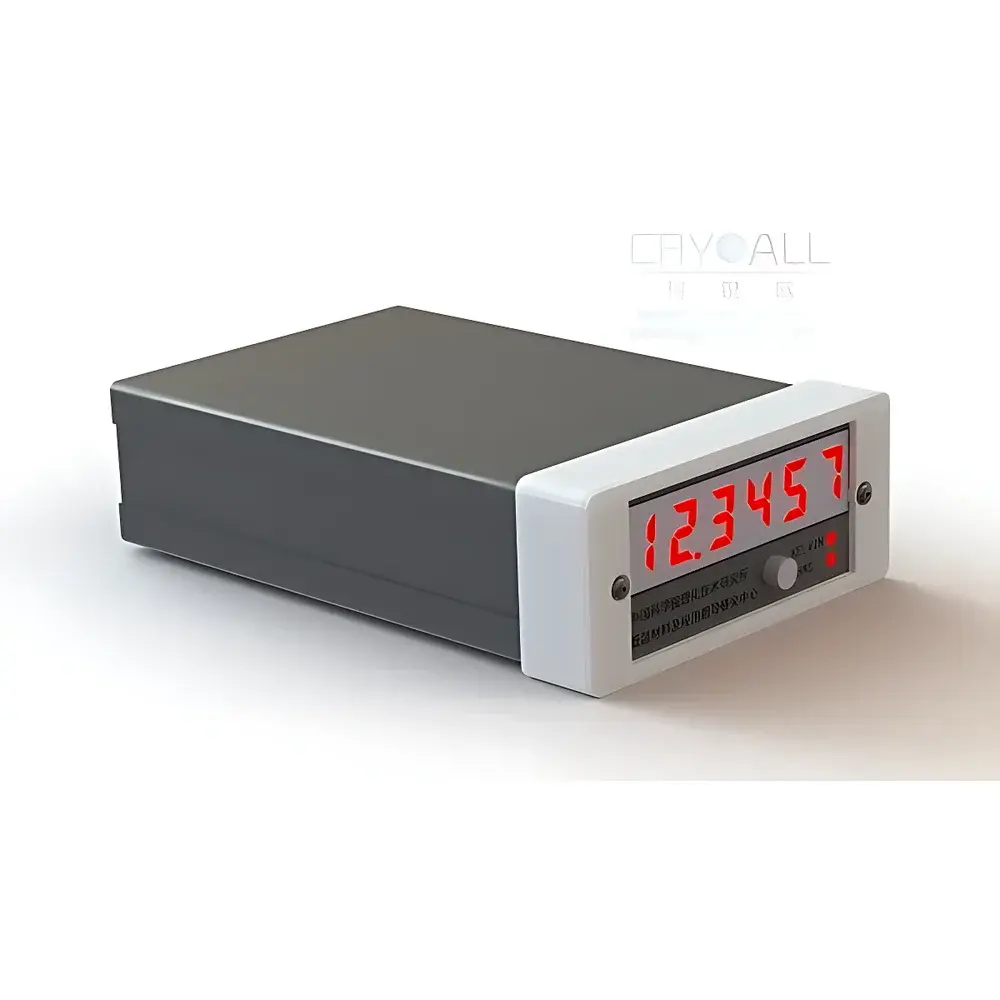
CryoAll TM-P/H Cryogenic Temperature Monitor
| Brand | CryoAll |
|---|---|
| Model | TM-P/H |
| Measurement Principle | Resistance-based cryogenic thermometry (RhFe, Diode, Pt100) |
| Temperature Range | 1.1 K to 493 K (−272.05 °C to +219.85 °C) |
| Accuracy | ±10 mK (typical, calibrated against ITS-90 traceable standards) |
| Input Channels | 1 or 6 independent sensor inputs |
| Interface Options | RS-485 (Modbus RTU), USB 2.0 (CDC/VCP), 10/100BASE-T Ethernet (TCP/IP, DHCP/Static IP), 4–20 mA analog output (isolated, loop-powered) |
| Form Factor | Benchtop (150 × 96 × 40 mm) and Handheld (85 × 50 × 20 mm, 60 g) |
| Power Supply | 5 V DC (USB) or 9–36 V DC (terminal block, reverse-polarity protected) |
| Compliance | CE, RoHS, IEC 61326-1 (EMC for laboratory environments) |
Overview
The CryoAll TM-P/H Cryogenic Temperature Monitor is a precision-engineered instrumentation platform designed for reliable, high-stability temperature measurement across extreme cryogenic to moderate high-temperature regimes—from 1.1 K up to 493 K. It operates on resistance-based thermometry principles, supporting industry-standard cryogenic sensors including rhodium-iron (RhFe) resistance thermometers, silicon diode sensors, and platinum resistance thermometers (Pt100, Pt1000). Unlike general-purpose digital thermometers, the TM-P/H incorporates low-noise analog front-end circuitry, four-wire (Kelvin) sensing capability per channel, and cold-junction-compensated analog-to-digital conversion optimized for sub-kelvin resolution. Its architecture meets the thermal stability and long-term drift requirements typical of dilution refrigerator monitoring, superconducting magnet quench detection, cryocooler feedback control, and materials science characterization setups where thermal history fidelity is critical.
Key Features
- Multi-sensor compatibility: Native support for RhFe, DT-470/DT-670 diodes, Pt100, and other IEC 60751-compliant RTDs—each with configurable excitation current and auto-ranging bridge compensation.
- High-resolution digitization: 24-bit sigma-delta ADC with programmable integration time (1–100 ms) and internal reference stability <±2 ppm/°C, enabling repeatability better than ±5 mK over 24 h at constant ambient.
- Dual form factors: Compact benchtop unit (150 × 96 × 40 mm) with screw-terminal I/O and industrial-grade enclosure; ultra-lightweight handheld variant (85 × 50 × 20 mm, 60 g) for field verification and probe calibration cross-checks.
- Industrial-grade connectivity: Simultaneous RS-485 (Modbus RTU slave), USB CDC virtual COM port, Ethernet (TCP socket & Modbus TCP), and isolated 4–20 mA analog output—enabling seamless integration into SCADA, PLC, and LabVIEW-based DAQ systems.
- Embedded firmware with local logging: Onboard non-volatile memory stores up to 1 million timestamped readings (configurable sampling interval: 0.1–10 s); data export via USB mass storage or Ethernet FTP/SFTP.
Sample Compatibility & Compliance
The TM-P/H does not interface directly with samples but serves as a certified readout system for cryogenic temperature sensors installed in vacuum chambers, cryostats, adiabatic demagnetization refrigerators (ADR), and closed-cycle coolers. Sensor lead configurations (2-, 3-, or 4-wire) are software-selectable per channel. All firmware and hardware design adhere to IEC 61326-1:2013 for electromagnetic compatibility in laboratory and light industrial settings. The device supports user-initiated calibration coefficient loading (e.g., Callendar-Van Dusen, Steinhart-Hart, or custom polynomial tables) and retains NIST-traceable calibration metadata per sensor channel. While not FDA-regulated, its audit-ready logging, timestamp integrity (RTC with ±2 ppm accuracy), and write-protected configuration memory align with GLP/GMP documentation expectations for temperature-critical process validation.
Software & Data Management
CryoAll provides a cross-platform PC application (Windows/macOS/Linux) featuring real-time multi-channel plotting, alarm threshold configuration (hysteresis-enabled), and CSV/Excel export with ISO 8601 timestamps. Firmware updates are performed via signed binary packages over USB or Ethernet, ensuring integrity verification. For automated environments, the device exposes a RESTful API over HTTP and native Modbus register mapping—supporting integration with Python (pymodbus), MATLAB Instrument Control Toolbox, or National Instruments DIAdem. All logged data includes embedded sensor ID, excitation mode, linearization method, and environmental conditions (internal board temperature, supply voltage), satisfying ISO/IEC 17025 clause 7.7 traceability requirements.
Applications
- Quantum computing infrastructure: Monitoring base temperatures of dilution refrigerators and shielding thermal fluctuations in qubit mounting stages.
- Cryogenic material testing: Tracking thermal expansion coefficients, specific heat, and phase transitions in superconductors, topological insulators, and quantum magnets.
- Calibration laboratory workflows: Serving as a transfer standard between primary fixed-point cells (e.g., TPW, INP) and secondary cryogenic probes.
- Industrial cryogenics: Closed-loop temperature regulation of helium liquefiers, LNG monitoring interfaces, and aerospace component thermal vacuum testing.
- Academic low-temperature physics: Student labs requiring rugged, portable instrumentation for liquid nitrogen/helium experiments with minimal setup overhead.
FAQ
What sensor types are supported out-of-the-box?
RhFe (1.1–300 K), silicon diodes (1.4–480 K), and Pt100/Pt1000 (10–850 K) sensors are natively supported with preloaded calibration curves compliant with ASTM E1137 and IEC 60751.
Can the TM-P/H operate inside a vacuum chamber?
No—the instrument itself must remain outside the vacuum; however, it interfaces with feedthrough-mounted sensors using shielded twisted-pair cabling rated for <10⁻⁶ mbar environments.
Is the 4–20 mA output intrinsically safe?
The output is galvanically isolated (2.5 kV RMS) and loop-powered but not certified for Class I Div 1 hazardous locations; external safety barriers are required for such deployments.
How is calibration traceability maintained?
Each unit ships with a factory calibration certificate referencing NIST-traceable standards; users may load their own accredited calibration coefficients without voiding compliance documentation.
Does the handheld version support all communication interfaces?
The handheld variant retains USB and Bluetooth LE (optional module) connectivity; RS-485 and Ethernet require the benchtop housing due to physical layer constraints.



