
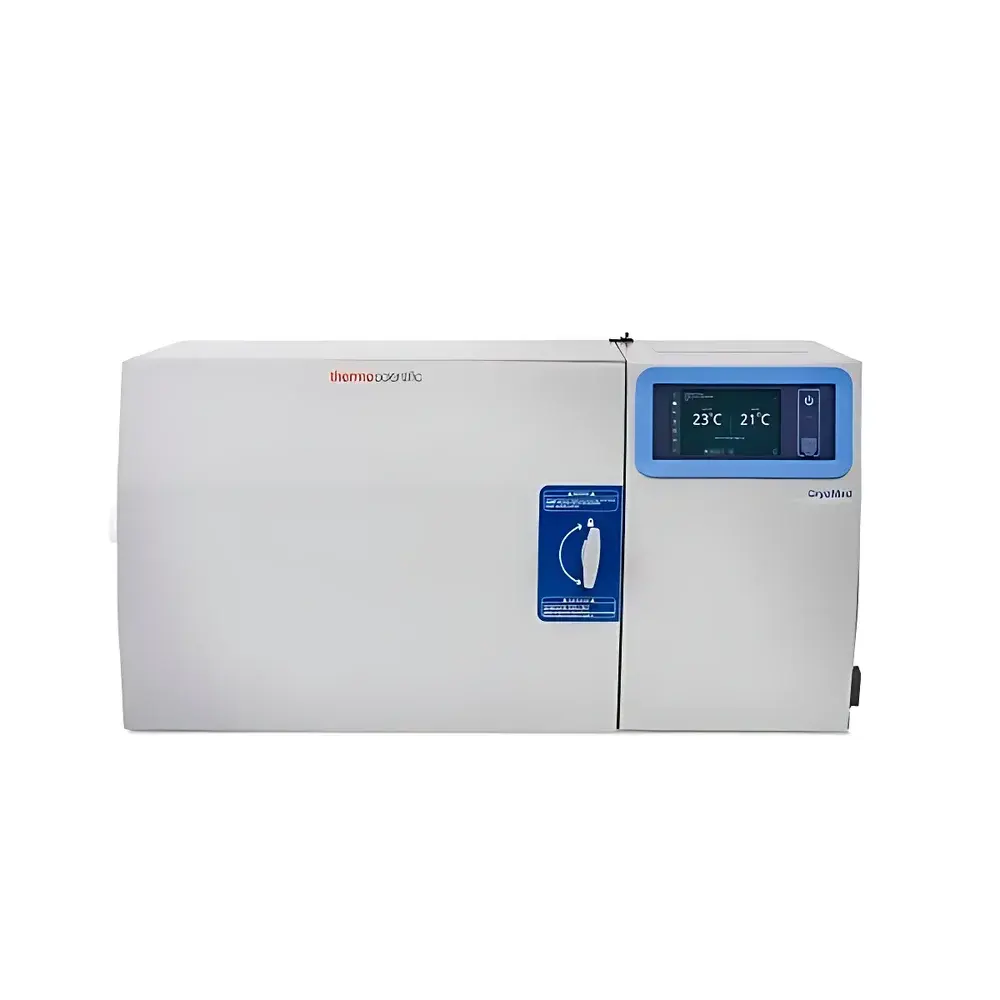
CryoMed Programmable Controlled-Rate Freezer (CRF) by Thermo Fisher Scientific
| Brand | Thermo Fisher Scientific |
|---|---|
| Origin | Shanghai, China |
| Manufacturer Type | Authorized Distributor |
| Product Origin | Domestic (China) |
| Model | CryoMed Programmable Cooling System |
| Pricing | Available Upon Request |
Overview
The CryoMed Programmable Controlled-Rate Freezer (CRF) by Thermo Fisher Scientific is an engineered solution for precise, reproducible cryopreservation of biologics across research, cell and gene therapy development, vaccine manufacturing, and biobanking applications. Operating on the principle of controlled-rate freezing—where sample temperature is dynamically regulated via liquid nitrogen (LN2) injection and gas-phase heat exchange—the system minimizes intracellular ice formation and thermal shock, thereby preserving cellular viability, membrane integrity, and functional biomolecular structure. Unlike passive freezing methods, the CryoMed CRF delivers programmable cooling profiles with real-time thermal feedback, ensuring compliance with critical cryobiological standards including ISO 20387:2018 (biobanking), ASTM F1986 (cryopreservation of hematopoietic progenitor cells), and USP <1043> (cryopreservation of viable cells). Its architecture integrates hardware-level redundancy, audit-ready data logging, and GxP-aligned operational safeguards to support GLP, GMP, and FDA-regulated workflows.
Key Features
- Intuitive 7-inch capacitive touchscreen interface with multilingual support and role-based access control (Level 1–3 user permissions)
- Six factory-preset freezing protocols plus up to 14 customizable user-defined programs, each supporting multi-segment ramp/hold profiles with independent rate, target temperature, and dwell time parameters
- Real-time dual-point thermal monitoring using calibrated T-type thermocouples—one positioned in the chamber air stream and one directly in contact with sample carriers—to eliminate thermal lag and enable closed-loop temperature correction
- Dual-solenoid LN2 injection system with dynamic duty-cycle modulation, ensuring stable cooling rates from –1°C/min to –40°C/min with ±0.5°C accuracy across the operating range (–80°C to +20°C ambient)
- Preventive maintenance indicator for LN2 solenoid valves, triggered by cumulative actuation cycles to minimize unplanned downtime
- Integrated event logging with timestamped records of all user actions, system alarms, thermal deviations, and power interruptions; exportable as PDF or CSV via USB port
- 21 CFR Part 11-compliant data management: electronic signatures, audit trails, and immutable record retention with user authentication and session timeout enforcement
- Remote operation capability via optional PC-based software, enabling protocol upload/download, live temperature visualization, run validation checks, and automated report generation
Sample Compatibility & Compliance
The CryoMed CRF accommodates standard cryovial formats (1.8–5.0 mL), cryobags (up to 250 mL), and custom sample carriers compatible with ISO 15189-accredited biorepositories. Chamber design supports uniform temperature distribution (±1.2°C spatial variance at –80°C) through optimized LN2 dispersion rings and laminar airflow management. All firmware and software components undergo periodic verification per IEC 62304 (medical device software lifecycle) and are validated for use in environments requiring adherence to EU Annex 11, MHRA GCP, and WHO TRS No. 961 Annex 5. The stainless-steel 304 interior with powder-coated exterior meets ISO 14644-1 Class 7 cleanroom compatibility requirements when installed in controlled environments.
Software & Data Management
Data integrity is maintained through a secure, embedded Linux-based operating system with encrypted local storage and tamper-evident log files. Each freezing cycle generates a digitally signed PDF certificate containing operator ID, start/end timestamps, thermal profile trace, alarm history, and deviation annotations. The system supports integration with LIMS via HL7 or CSV batch import/export. Audit trail functionality captures all configuration changes, user logins, and protocol modifications with full attribution and temporal context—meeting ALCOA+ principles (Attributable, Legible, Contemporaneous, Original, Accurate, Complete, Consistent, Enduring, Available). Optional thermal printer module provides hard-copy documentation for immediate QA review.
Applications
- Cryopreservation of primary human cells (e.g., PBMCs, MSCs, T-cells) for clinical-grade manufacturing under ATMP regulations
- Stabilization of viral vectors (AAV, lentivirus) and mRNA-LNP formulations during process development and release testing
- Long-term archiving of stem cell lines and genetically engineered models in accredited biobanks
- Process validation and comparability studies for frozen drug product intermediates in Phase II–III clinical trials
- Standardized freezing of reference standards used in potency assays and stability-indicating methods
FAQ
Does the CryoMed CRF support IQ/OQ/PQ documentation packages?
Yes—Thermo Fisher provides vendor-qualified installation qualification (IQ), operational qualification (OQ), and performance qualification (PQ) templates aligned with ASTM E2500 and ISPE Baseline Guide Volume 5.
Can the system be integrated into a centralized facility monitoring system (FMS)?
The unit offers Modbus TCP and optional OPC UA connectivity for real-time telemetry and alarm forwarding to enterprise SCADA or FMS platforms.
Is remote firmware update capability available?
Firmware updates must be performed locally via authenticated USB drive following a documented change control procedure; no over-the-air (OTA) updates are permitted for regulatory compliance reasons.
What is the recommended preventive maintenance schedule?
Biannual calibration verification of thermocouples and solenoid valve function testing is advised; the built-in maintenance counter triggers alerts at 10,000 actuation cycles per valve.
How is data integrity ensured during power loss?
Non-volatile memory retains all active logs and running protocol states; upon recovery, the system resumes operation with automatic checkpoint restoration and timestamp continuity.





