
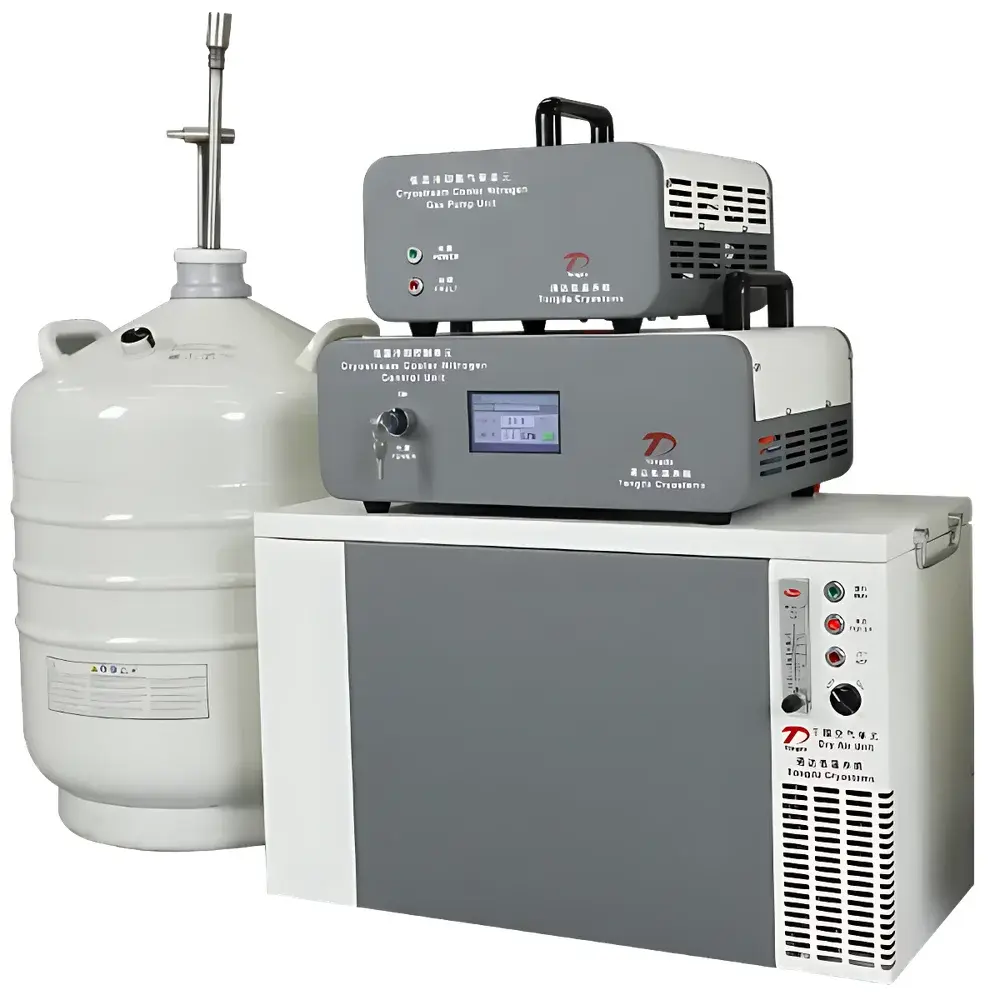
Cryostream TD-100 Low-Temperature Liquid Nitrogen Cooling System
| Brand | Tongda |
|---|---|
| Origin | Liaoning, China |
| Manufacturer Type | Authorized Distributor |
| Country of Origin | China |
| Model | TD-100 |
| Price Range | USD 14,000 – 70,000 |
| Main Power Supply | 220–240 VAC, 50/60 Hz |
| Power Consumption | 1.0 kW |
| Liquid Nitrogen Consumption | 0.6 L/h |
| Gas Flow Rate | 5 L/min |
| Temperature Stability | ±0.3 K |
| Cooling Time to 100 K | 35 min |
| Cold Head Temperature Range | 100–300 K |
| Standard Flexible Transfer Line Length | 3000 mm |
| Dewar Capacity | 35 L |
| Dewar Neck Flange Diameter | 50 mm |
| Standard Transfer Line Length | 1.5 m (optional: 4 m) |
| Distance from Gas Supply Module to Dewar (standard / max) | 6 m / 9 m |
Overview
The Cryostream TD-100 Low-Temperature Liquid Nitrogen Cooling System is an open-flow cryogenic gas cooling instrument engineered for precision temperature control in X-ray diffraction (XRD), single-crystal diffractometry, spectroscopy, and low-temperature materials characterization. It operates on the principle of controlled vaporization and laminar flow of liquid nitrogen (LN2)—converted into a dry, regulated cold gas stream—delivered via a flexible transfer line to a cryostat cold head mounted directly on the sample stage. Unlike closed-cycle refrigerators, the TD-100 eliminates mechanical vibration and magnetic interference, making it ideal for high-resolution structural analysis where thermal and mechanical stability are critical. The system integrates a compact gas supply module housing the LN2 pump, pressure regulator, flow controller, and desiccant-based air drying unit—reducing footprint, minimizing interconnect complexity, and enabling rapid deployment in constrained laboratory environments.
Key Features
- Integrated gas supply module consolidating LN2 pumping, pressure regulation, mass flow control, and compressed dry air generation—eliminating external compressors and separate dryer units.
- High-stability temperature control with ±0.3 K stability across the full operating range (100–300 K), achieved via closed-loop PID feedback using calibrated platinum resistance thermometers (PRTs) at the cold head.
- Optimized thermal design enabling cooling from ambient to 100 K in ≤35 minutes, supporting efficient throughput in time-sensitive crystallographic experiments.
- Modular transfer line architecture: standard 1.5 m length (extendable to 4 m); total flexible line length up to 3000 mm; compatible with standard 50 mm O.D. dewar neck flanges.
- Dewar compatibility with 35 L capacity and integrated level monitoring interface—enabling unattended operation over extended shifts when paired with optional auto-refill kits.
- Compliance-ready firmware architecture supporting audit trail logging, user access levels, and configurable alarm thresholds—aligned with GLP and ISO/IEC 17025 documentation requirements.
Sample Compatibility & Compliance
The TD-100 is designed for universal integration with commercial and custom cryostats, goniometers, and sample stages used in synchrotron beamlines, academic crystallography labs, and industrial R&D facilities. Its non-magnetic, vibration-free cold gas delivery ensures compatibility with sensitive detectors—including CCD, CMOS, and hybrid photon-counting (HPC) X-ray sensors. The system meets IEC 61000-6-3 (EMC emission standards) and conforms to CE marking requirements for laboratory equipment. While not FDA-cleared (as it is non-invasive and non-diagnostic), its operational logs, parameter traceability, and user authentication support compliance with 21 CFR Part 11 when deployed in regulated pharmaceutical or biotech analytical workflows requiring electronic record integrity.
Software & Data Management
The TD-100 is operated via an embedded touchscreen controller with real-time display of LN2 level, cold head temperature, gas flow rate, and system status. Optional Ethernet or RS-232 connectivity enables remote monitoring and command execution through ASCII-based SCPI protocol. Data export (CSV format) includes timestamped temperature, flow, and alarm events—suitable for inclusion in LIMS or ELN platforms. Firmware supports configuration locking, event-driven logging, and password-protected parameter modification—facilitating adherence to SOP-controlled environments and internal QA/QC protocols.
Applications
- Single-crystal X-ray diffraction at cryogenic temperatures to reduce atomic displacement parameters (ADPs) and improve structural model accuracy.
- In situ low-temperature Raman and FTIR spectroscopy for probing phonon modes, phase transitions, and lattice dynamics.
- Magnetic susceptibility measurements under controlled thermal conditions using SQUID or VSM systems.
- Low-temperature electrical transport studies on superconductors, topological insulators, and 2D materials.
- Time-resolved crystallography experiments requiring rapid, repeatable thermal cycling between 100 K and 300 K.
FAQ
What is the minimum achievable base temperature with the TD-100?
The system achieves stable operation down to 100 K under standard atmospheric pressure and nominal flow conditions. Sub-100 K operation is not supported without supplemental vacuum jacketing or modified gas composition.
Can the TD-100 be used with helium or argon instead of nitrogen?
No—the system is specifically engineered for liquid nitrogen vaporization and flow control. Helium or argon require different thermal conductivity, latent heat, and pressure regulation profiles incompatible with the TD-100’s pump and valve architecture.
Is the 35 L dewar included with the base system?
Yes—the 35 L stainless steel dewar with 50 mm neck flange and level sensor interface is supplied as standard equipment.
Does the TD-100 support automated refilling from bulk LN2 tanks?
Automated refill capability is available via optional accessory kit (part no. TD-AF-01), which interfaces with standard bulk tank level transmitters and solenoid fill valves.
How often does the desiccant in the air drying unit require replacement?
Under continuous operation at 25 °C ambient and 60% RH, the integrated desiccant cartridge maintains dew point < −40 °C for approximately 6 months—replacement interval is logged automatically in the controller’s maintenance calendar.
Related Products



