
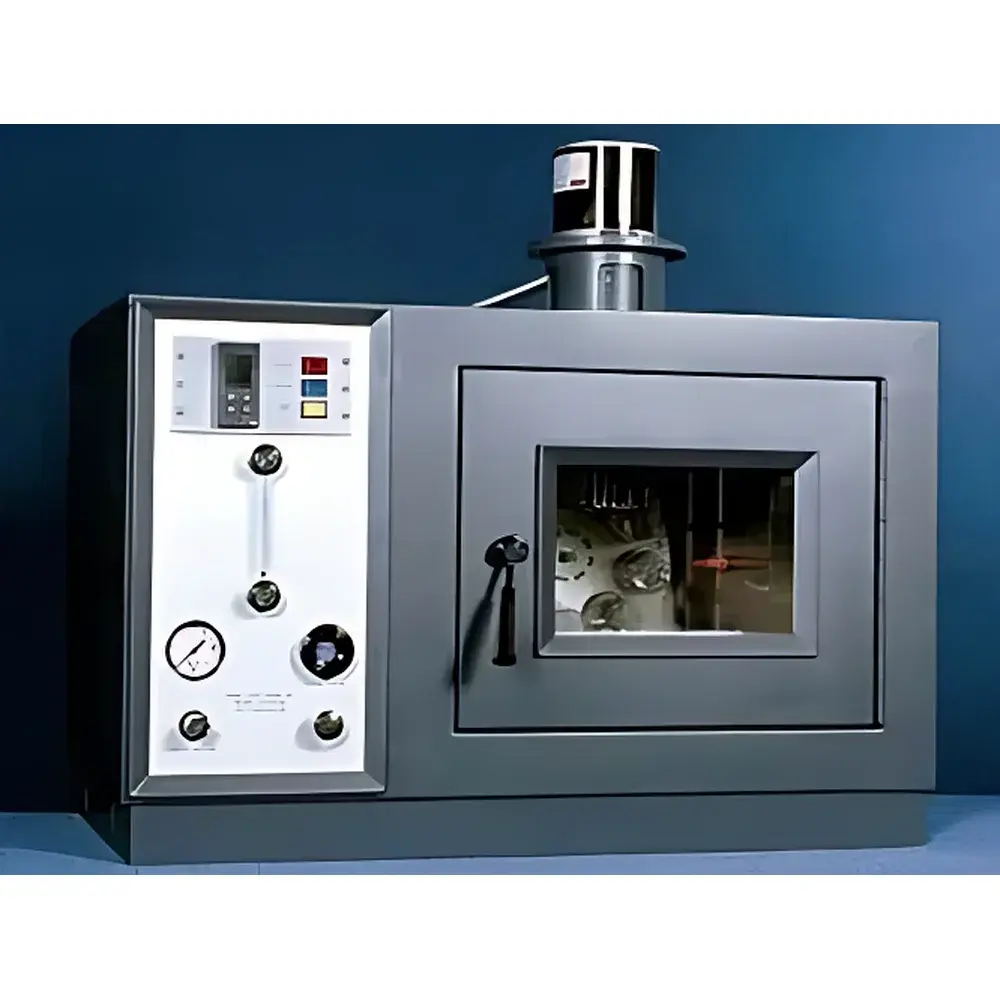
CS325 Asphalt Rotating Film Oven (RFO)
| Origin | USA |
|---|---|
| Manufacturer Type | Authorized Distributor |
| Origin Category | Imported |
| Model | CS325 |
| Pricing | Available Upon Request |
Overview
The CS325 Asphalt Rotating Film Oven (RFO) is a precision-engineered thermal aging apparatus designed specifically for simulating short-term oxidative aging of asphalt binders under controlled laboratory conditions. It operates in strict accordance with the procedural and performance requirements of ASTM D2872 (“Standard Test Method for Effect of Heat and Air on a Moving Film of Asphaltic Material (Rolling Thin-Film Oven Test)”), AASHTO T 240 (“Standard Method of Test for Effect of Heat and Air on a Moving Film of Asphaltic Material (Rolling Thin-Film Oven Test)”), and California Test Method 346. The device subjects a thin, rotating film of asphalt binder to elevated temperature (163 °C ± 0.5 °C) and forced air circulation for a defined duration (typically 85 minutes), thereby replicating the thermal and oxidative stresses experienced during hot-mix asphalt production and placement. Accurate thermal control—particularly stability, uniformity, and ramp fidelity—is fundamental to test reproducibility; the CS325 achieves this through a closed-loop PID temperature regulation system coupled with high-fidelity sensing architecture.
Key Features
- High-accuracy temperature control system calibrated to maintain 163 °C ± 0.5 °C throughout the entire test chamber volume, meeting or exceeding ASTM D2872 and AASHTO T 240 thermal uniformity specifications.
- Integrated platinum resistance temperature detector (RTD) sensor with minimal thermal mass and sub-second thermal/electrical time constant, enabling real-time, low-lag temperature sampling directly within the test environment.
- Microprocessor-based PID controller with auto-tuning capability; users may manually adjust proportional, integral, and derivative constants while access to tuning parameters is protected by operator-level password authentication.
- Dual 4-digit LED displays showing both actual chamber temperature and user-defined setpoint simultaneously, facilitating immediate verification of thermal compliance during operation.
- Patented anti-overshoot control algorithm that enhances dynamic response without compromising stability—critical during temperature ramp-up and steady-state maintenance phases.
- Robust stainless-steel construction with insulated double-wall chamber and calibrated airflow manifold, ensuring consistent air velocity and laminar flow across all sample positions.
Sample Compatibility & Compliance
The CS325 accommodates standard 34-mm-diameter, 135-mm-long glass sample bottles (ASTM D2872-compliant), mounted on a rotating spindle at 15 rpm. Up to eight bottles can be processed per cycle. All internal surfaces contacting air or samples are inert and non-reactive, eliminating catalytic interference with oxidation chemistry. The instrument is supplied with full traceable calibration documentation and conforms to ISO/IEC 17025-relevant metrological practices for testing equipment. It supports GLP-compliant workflows through configurable audit trails (when integrated with optional data logging software) and satisfies prerequisite instrumentation criteria for laboratories accredited to ASTM, AASHTO, and state DOT quality assurance programs.
Software & Data Management
While the CS325 operates as a standalone benchtop unit, it features an RS-232 serial interface for integration with external PC-based data acquisition systems. Optional companion software enables time-stamped temperature logging, automated report generation (PDF/CSV), and deviation alerting—fully compliant with FDA 21 CFR Part 11 requirements when deployed with electronic signature and audit trail modules. All temperature records are timestamped and stored with metadata including operator ID, test ID, ambient conditions, and calibration status—supporting full traceability for QA/QC audits and regulatory submissions.
Applications
- Assessment of short-term aging behavior of asphalt binders prior to mixing with aggregates (e.g., PG grading evaluation per AASHTO M 320).
- Quality control of polymer-modified binders (PMBs) and crumb rubber modified (CRM) asphalt formulations.
- Comparative evaluation of antioxidant efficacy in asphalt additives.
- Preparation of aged binder specimens for subsequent rheological testing (e.g., DSR per ASTM D7175) or chemical analysis (e.g., FTIR per ASTM D7553).
- Supporting pavement performance prediction models requiring input from controlled oxidative aging protocols.
FAQ
What standards does the CS325 RFO comply with?
It meets all thermal and mechanical requirements specified in ASTM D2872, AASHTO T 240, and California Test Method 346.
Is temperature uniformity verified across the chamber?
Yes—uniformity is validated per ASTM D2872 Annex A1 using nine-point mapping; typical deviation is ≤ ±0.4 °C at 163 °C.
Can the CS325 be used for RTFOT testing on emulsified or cutback asphalts?
No—this instrument is intended exclusively for paving-grade asphalt cements and oxidized binders per the referenced standards.
Does the unit include calibration certificates?
Each CS325 ships with NIST-traceable factory calibration documentation and a certificate of conformance.
Is remote monitoring supported?
Via optional RS-232-to-Ethernet gateway and compatible SCADA or LIMS platforms, subject to site-specific IT security policies.





