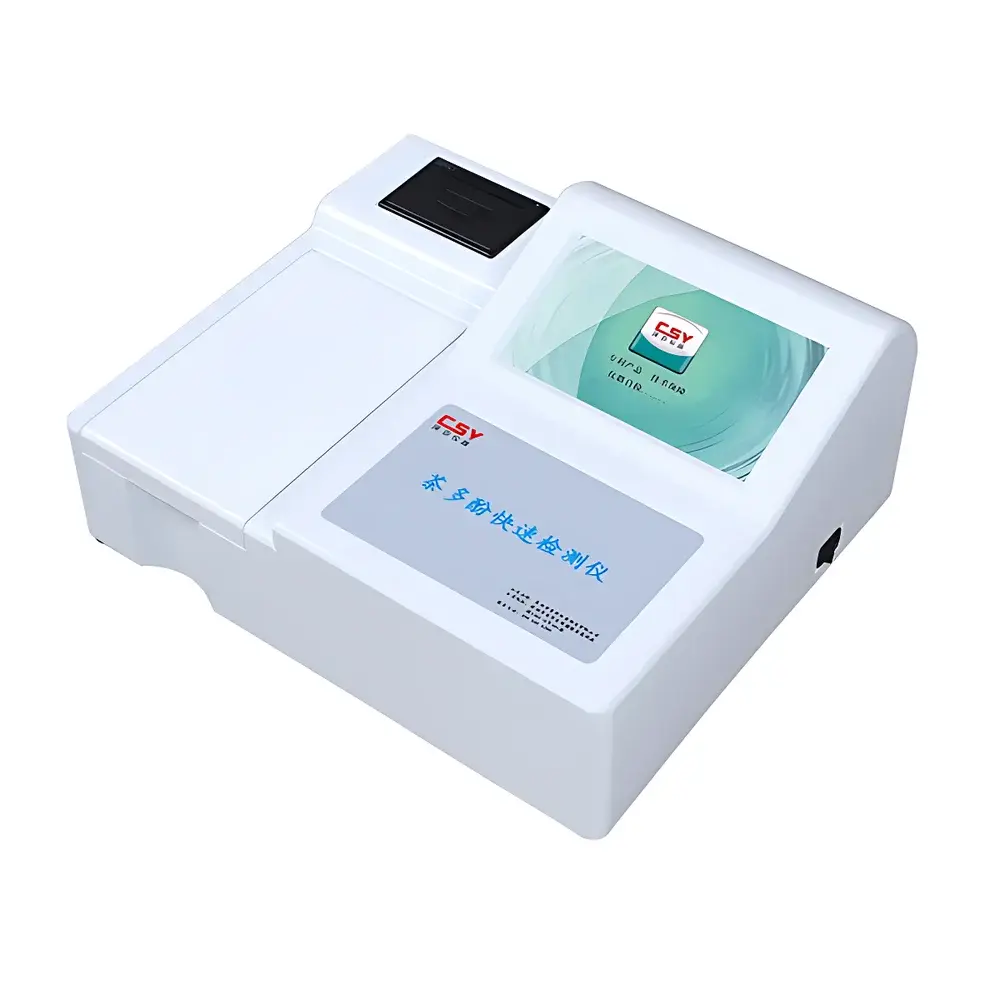
CSY-10CDF Tea Polyphenol Analyzer by CSY Instruments
| Brand | CSY Instruments |
|---|---|
| Origin | Guangdong, China |
| Manufacturer Type | Authorized Distributor |
| Country of Origin | China |
| Model | CSY-10CDF |
| Function Type | Multi-analyte (10-channel) Spectrophotometric Analyzer |
| Sample Compatibility | Liquid extracts from tea leaves, tea beverages, instant tea powders, and herbal infusions |
| Wavelength | 410 nm ± 2 nm |
| Measurement Time per Sample | ≤ 3 min |
| Photometric Repeatability | ±1% (Transmittance) |
| Optical Path | 10 mm cuvette |
| Absorbance Range | 0.000–4.000 ABS |
| Wavelength Accuracy | < ±2.0 nm |
| Baseline Stability | ±0.001 A/hr |
| Data Storage Capacity | ≥ 8,000 records |
| Display | 7-inch color TFT LCD touchscreen |
| Connectivity | RS-232, USB, Wi-Fi, Ethernet |
| Power Supply | AC 100–240 V, 50/60 Hz or optional DC 12 V battery operation |
| Dimensions | 350 × 290 × 130 mm |
| Weight | 3.8 kg |
Overview
The CSY-10CDF Tea Polyphenol Analyzer is a dedicated benchtop spectrophotometric instrument engineered for rapid, quantitative determination of total tea polyphenols (TTP) in aqueous extracts derived from Camellia sinensis leaves, ready-to-drink tea beverages, powdered tea formulations, and related botanical infusions. It operates on the principle of visible-light absorbance spectroscopy, leveraging the well-established Folin–Ciocalteu reaction—where polyphenolic compounds reduce phosphomolybdic–phosphotungstic acid complexes under alkaline conditions to yield a stable blue chromophore with maximal absorption near 410 nm. This method conforms to standardized protocols referenced in ISO 14502-1:2005 (Determination of substances with antioxidant properties — Part 1: Determination of total polyphenol content using the Folin–Ciocalteu method) and aligns with AOAC Official Method 2004.01 for total phenolics in plant materials. The analyzer integrates a high-stability, narrow-bandwidth LED light source centered at 410 nm ± 2 nm, eliminating thermal drift and mechanical wavelength adjustment mechanisms. Its solid-state optical architecture ensures long-term photometric fidelity without recalibration, supporting field-deployable use in mobile labs, regulatory inspection vehicles, and production-line quality control stations.
Key Features
- 10 independent optical detection channels enabling parallel analysis of up to 10 samples per run—reducing batch testing time while minimizing inter-channel variability through synchronized LED excitation and dual-point baseline correction.
- Integrated 7-inch capacitive touchscreen interface with full Chinese/English bilingual firmware, supporting direct input of sample IDs, operator codes, and batch metadata without external peripherals.
- Onboard microthermal printer with permanent printhead design—generates audit-ready reports including sample name, measured absorbance, calculated TTP concentration (mg/g or mg/mL), pass/fail status against configurable regulatory thresholds (e.g., GB 2763–2021 limits), date/time stamp, and instrument serial number.
- Auto-diagnostic self-check at power-on: verifies LED intensity stability, dark-current offset, cuvette alignment tolerance, and memory integrity—logging fault codes compliant with GLP documentation requirements.
- Zero-maintenance optical path: no moving gratings, no lamp replacement cycles; LED lifetime exceeds 50,000 hours under intermittent duty cycling, supporting >10 years of routine operation per IEC 62471 photobiological safety classification.
- Multi-interface data export: native support for RS-232 serial, USB mass storage, IEEE 802.11n Wi-Fi, and 10/100 Mbps Ethernet—enabling seamless integration into centralized food safety information systems (FSIS) via HL7 or CSV-based ingestion pipelines.
Sample Compatibility & Compliance
The CSY-10CDF accepts standard 10 × 10 mm quartz or optical-grade plastic cuvettes. It is validated for use with clarified tea extracts prepared according to ISO 14502-1 extraction procedures (e.g., 70% aqueous acetone, 60 °C water bath, centrifugation at 4,000 × g). Matrix interference from caffeine, amino acids, and simple sugars is mitigated through optimized reagent stoichiometry and dual-wavelength background subtraction (reference channel at 700 nm). Instrument performance meets ISO/IEC 17025:2017 clause 5.9 (method validation) for precision (RSD ≤ 1.0% within-run, ≤ 2.5% between-day), linearity (r² ≥ 0.999 over 0–500 mg/L gallic acid equivalents), and limit of quantitation (LOQ = 2.5 mg/L). All firmware and calibration routines are traceable to NIST SRM 1643e (certified conductivity standard) and internal reference filters calibrated per JIS Z 8722:2012.
Software & Data Management
Embedded firmware supports user-defined calibration curves (up to 5 stored profiles), configurable pass/fail criteria per analyte, and role-based access control (operator, supervisor, administrator). Data files are stored in encrypted SQLite format with SHA-256 hash integrity verification. Optional CSY-FSIS Cloud Gateway software enables automatic synchronization with regional food safety surveillance platforms—supporting FDA 21 CFR Part 11-compliant electronic signatures, audit trails (including operator ID, timestamp, parameter changes, and result modifications), and automated report generation in PDF/A-1b format. Local data retention complies with GDPR Article 32 and China’s GB/T 35273–2020 personal information protection standards.
Applications
- Routine QC screening of raw tea lots prior to processing—verifying compliance with national standards (e.g., GB/T 8313–2018 for total polyphenols in tea).
- Verification of label claims for functional tea beverages marketed with antioxidant content declarations.
- Regulatory field inspections by municipal market supervision bureaus and customs laboratories under China’s Food Safety Law (Article 112).
- Process optimization in tea extract manufacturing—monitoring polyphenol yield across enzymatic hydrolysis, solvent extraction, and spray-drying steps.
- Educational use in food science curricula for teaching spectrophotometric assay development and validation principles.
FAQ
What extraction protocol is recommended for tea leaf samples?
Standardized hot-water extraction (100 °C, 15 min, 1:20 w/v ratio) followed by centrifugation (4,000 × g, 10 min) and filtration (0.45 µm PVDF membrane) is validated per ISO 14502-1.
Can the instrument quantify individual catechins (e.g., EGCG)?
No—the CSY-10CDF measures total polyphenol content via the Folin–Ciocalteu assay and does not resolve individual phenolic compounds; HPLC or UPLC-MS/MS is required for speciation.
Is third-party calibration certification available?
Yes—CSY Instruments provides optional NIST-traceable calibration verification reports issued by CNAS-accredited laboratories (certificate ID format: CNAS-CL01-2018-XXXXX).
How is photometric accuracy maintained during extended field use?
The LED source undergoes real-time thermal compensation via integrated PT1000 sensors, and optical path integrity is verified daily using built-in neutral density reference filters (OD 1.0 and OD 2.0).
Does the system support LIMS integration?
Yes—via HL7 v2.5.1 message mapping or RESTful API endpoints (JSON payload) for bidirectional data exchange with laboratory information management systems compliant with ASTM E1578-18.