
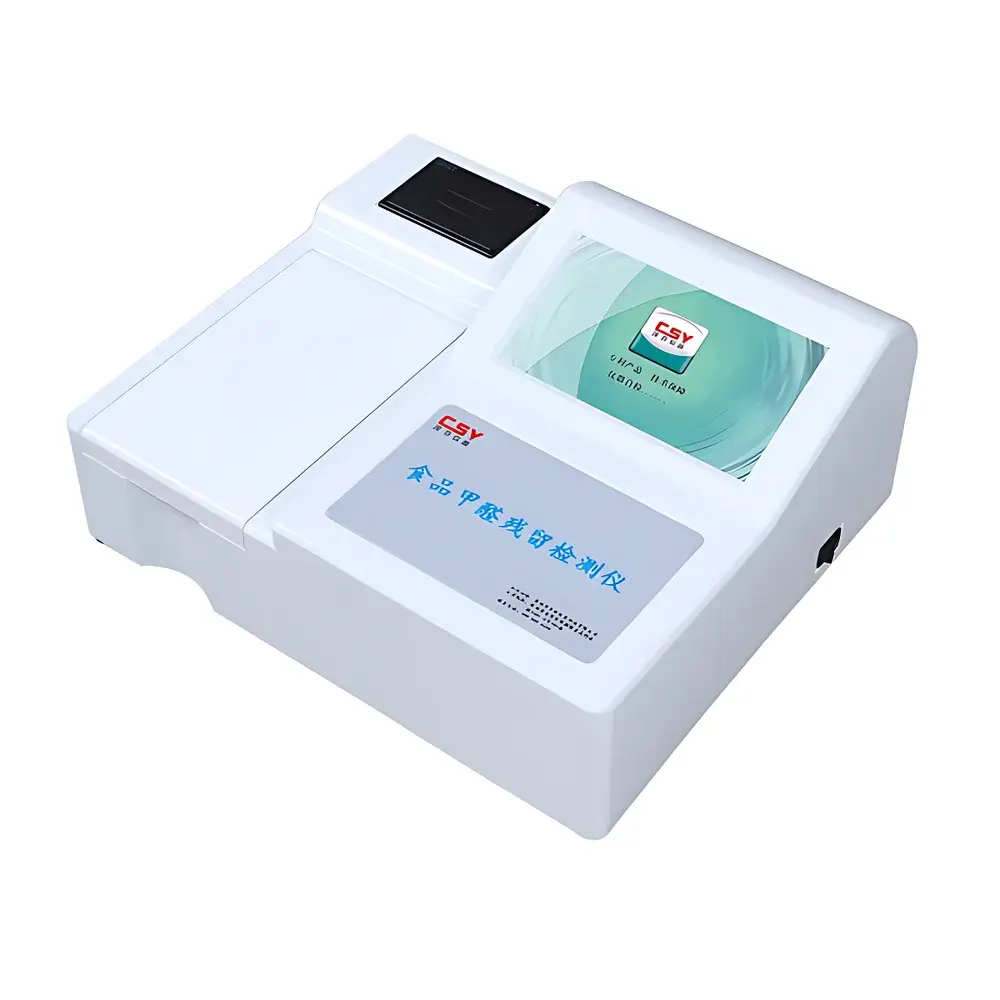
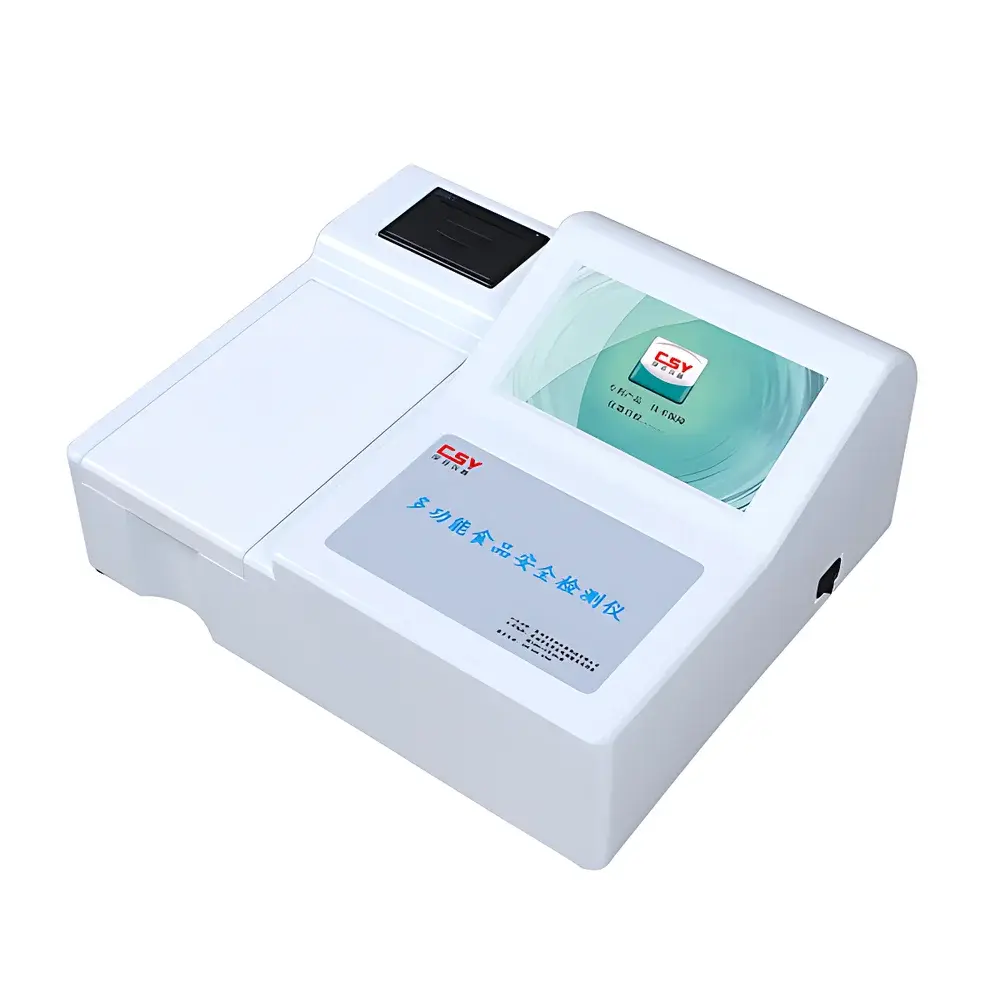
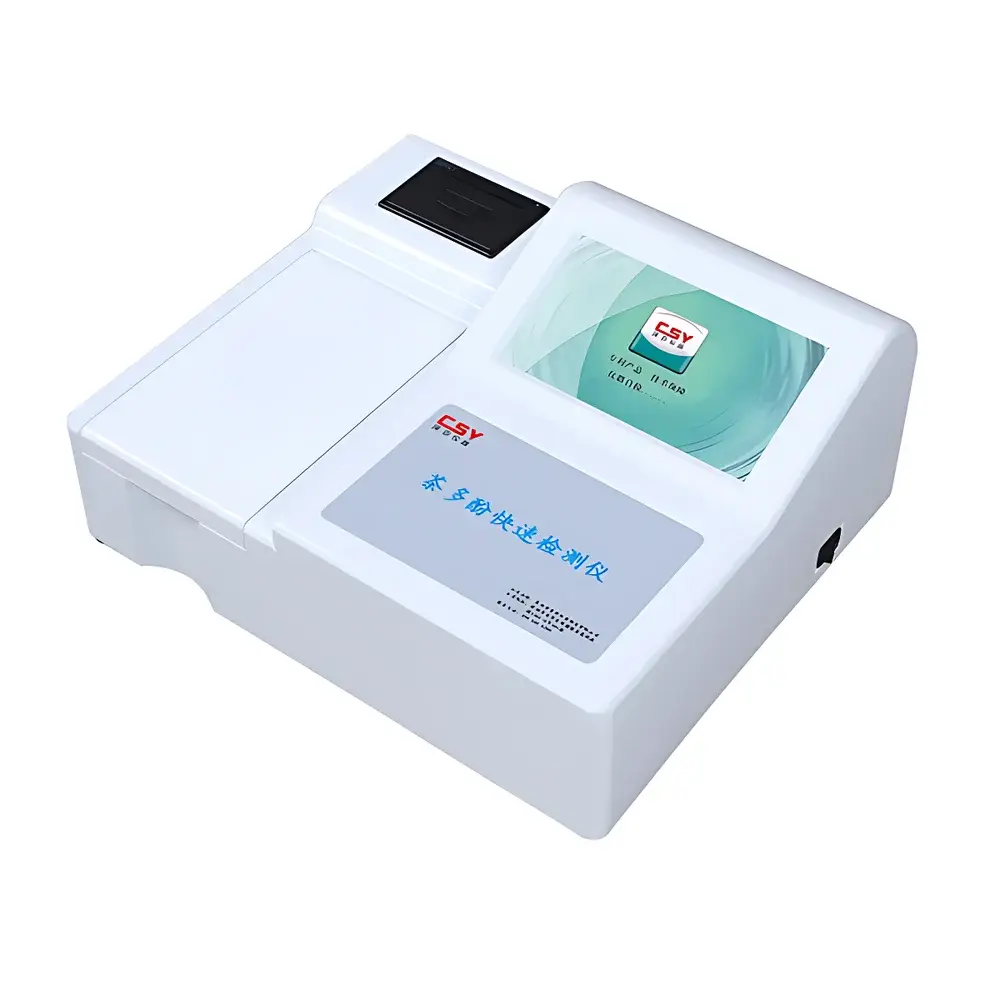
CSY-10JQ Food Formaldehyde Content Analyzer
| Brand | CSY |
|---|---|
| Model | CSY-10JQ |
| Origin | Guangdong, China |
| Detection Principle | Visible Spectrophotometry (410 nm ± 2 nm) |
| Optical Path | 10 × 10 mm Cuvette |
| Absorbance Range | 0.000–4.000 ABS |
| Wavelength Accuracy | < 2.0 nm |
| Absorbance Stability | ±0.001 A/hr |
| Linearity Error | ±5 ‰ |
| Measurement Accuracy | ±3% |
| Transmittance Repeatability | ±1% |
| Sample Test Time | ≤ 3 min |
| Data Storage Capacity | ≥ 8,000 records |
| Display | 7-inch Color TFT LCD Touchscreen |
| Connectivity | RS-232, USB, Wi-Fi, Ethernet |
| Printer | Embedded Thermal Printer (ribbon-free, lifetime operation) |
| Channel Configurations | 5–30 customizable photometric channels |
| Power Supply | AC 220 V / DC 12 V portable option |
| Dimensions | 350 × 290 × 130 mm |
| Weight | ~3.2 kg |
Overview
The CSY-10JQ Food Formaldehyde Content Analyzer is a benchtop-to-field portable spectrophotometric instrument engineered for quantitative determination of formaldehyde in food and consumer goods matrices. It operates on the principle of visible-light absorbance spectroscopy at a fixed wavelength of 410 nm ± 2 nm, where formaldehyde—after derivatization with a proprietary chromogenic reagent—forms a stable colored complex. The intensity of the resulting color, measured as absorbance (0.000–4.000 ABS), correlates linearly with formaldehyde concentration within the validated dynamic range, adhering to the Lambert–Beer law. Designed for regulatory compliance and routine quality control, the analyzer delivers field-deployable performance without sacrificing laboratory-grade reproducibility. Its solid-state LED optical architecture eliminates mechanical moving parts, ensuring robustness against vibration and environmental fluctuations common in mobile inspection scenarios—including roadside enforcement, cold-chain audits, and production-line QC stations.
Key Features
- High-precision optical system: Imported narrow-band LED light source with wavelength accuracy < 2.0 nm and repeatability < ±1% transmittance, minimizing inter-channel variability across multi-sample analysis.
- Modular channel configuration: Supports 5–30 independent photometric channels; users select channel count based on throughput requirements—ideal for batch screening of aquatic products, tofu, dried fruits, or textile auxiliaries.
- Integrated thermal printing & real-time reporting: Built-in ribbon-free thermal printer generates auditable reports containing sample ID, formaldehyde concentration (mg/kg), pass/fail status per national limit thresholds (e.g., GB 2760–2024), test date, operator ID, and instrument serial number.
- Field-ready hardware design: Compact footprint (350 × 290 × 130 mm), lightweight chassis (~3.2 kg), dual power mode (AC mains or optional DC 12 V battery pack), and shock-resistant housing enable seamless deployment in vehicles, markets, or processing facilities.
- Self-diagnostic firmware: Automatic wavelength calibration, baseline drift compensation, and system health monitoring ensure consistent metrological integrity over extended operational life (>10 years under typical usage).
- Regulatory data traceability: All measurements are timestamped, user-authenticated, and stored locally with immutable audit trails—supporting GLP-aligned documentation practices and facilitating FDA 21 CFR Part 11–compliant data export when integrated with certified LIMS platforms.
Sample Compatibility & Compliance
The CSY-10JQ is validated for formaldehyde quantification in diverse matrices subject to Chinese national food safety standards (GB 5009.49–2023 for formaldehyde in foods; GB/T 2912.1–2009 for textiles). Tested applications include aqueous extracts from soaked seafood (e.g., squid, jellyfish), rice wine and fruit wines, poultry skin, soy-based curds, preserved nuts, and formaldehyde-treated fabric swatches. Sample preparation follows standardized acid hydrolysis and chromotropic acid–based derivatization protocols. Instrument performance meets ISO/IEC 17025 technical requirements for measurement uncertainty estimation and is routinely verified using NIST-traceable formaldehyde reference standards (CRM 8422). The device supports method validation per AOAC Official Method 2017.01 for rapid formaldehyde screening in high-moisture foods.
Software & Data Management
Embedded firmware provides intuitive touchscreen navigation in English and Simplified Chinese, with configurable language switching. Measurement data—including raw absorbance values, calculated concentrations, calibration curve parameters, and QC flagging—is stored internally with time/date stamps and operator login credentials. Export options include CSV via USB flash drive, direct RS-232 transmission to legacy lab PCs, or encrypted Wi-Fi/Ethernet upload to centralized databases such as the China National Food Safety Information System (NFIS). Optional CSY-FoodSafe Network Software enables hierarchical deployment: county-level inspectors upload results to municipal dashboards, which aggregate into provincial trend analytics engines—supporting early-warning surveillance for regional contamination events. All digital logs maintain full ALCOA+ attributes (Attributable, Legible, Contemporaneous, Original, Accurate, Complete, Consistent, Enduring, Available) for regulatory inspections.
Applications
- Routine screening of formaldehyde adulteration in wet-market aquatic products and tofu during wholesale distribution.
- Verification of formaldehyde residuals in post-harvest treatment of dried fruits and nuts per GB 2760–2024 maximum residue limits.
- On-site assessment of formaldehyde migration from decorative laminates or textile finishing agents into food-contact environments.
- Contract laboratory support for third-party certification (e.g., HACCP, ISO 22000 audits) requiring documented formaldehyde testing at point-of-manufacture.
- Epidemiological investigations linking elevated formaldehyde levels in street-vended beverages to acute gastrointestinal toxicity cases.
FAQ
What formaldehyde detection method does the CSY-10JQ employ?
It uses chromotropic acid–based colorimetric derivatization followed by fixed-wavelength (410 nm) absorbance measurement—fully compliant with GB 5009.49–2023 Annex A.
Can the instrument be calibrated with external standards?
Yes. Users may load custom calibration curves via USB or perform two-point verification using certified formaldehyde standard solutions (0.5–20 mg/kg range).
Is remote software update supported?
Firmware updates are delivered via encrypted USB media or authenticated HTTPS download through the CSY Support Portal—no internet-dependent OTA functionality is implemented for security-critical environments.
How is data integrity ensured during wireless transmission?
All Wi-Fi/Ethernet transfers utilize TLS 1.2 encryption and require pre-configured network authentication keys; no unencrypted HTTP or FTP protocols are enabled by default.
Does the analyzer meet international export requirements for CE or RoHS?
The CSY-10JQ complies with IEC 61010-1:2010 for electrical safety and EN 61326-1:2013 for EMC. CE marking is available upon request for EU-market configurations with modified power supply and documentation packages.




