
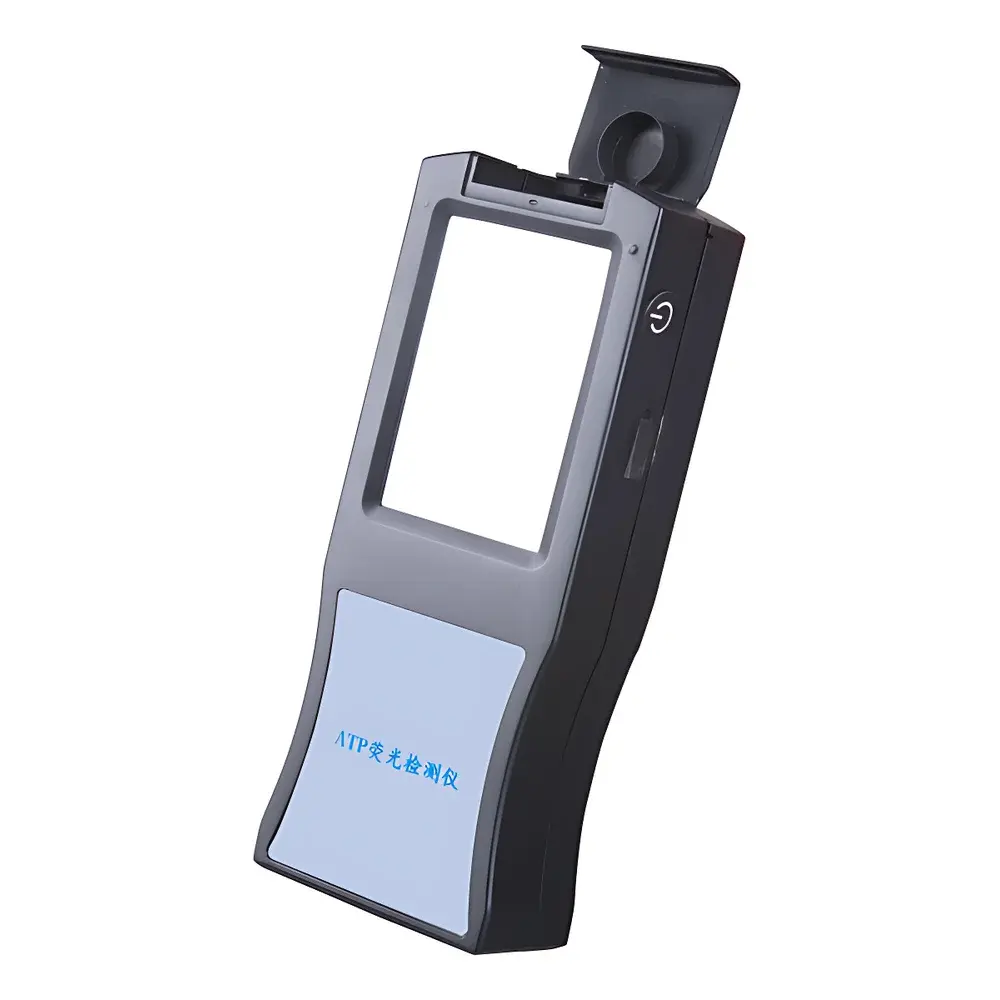
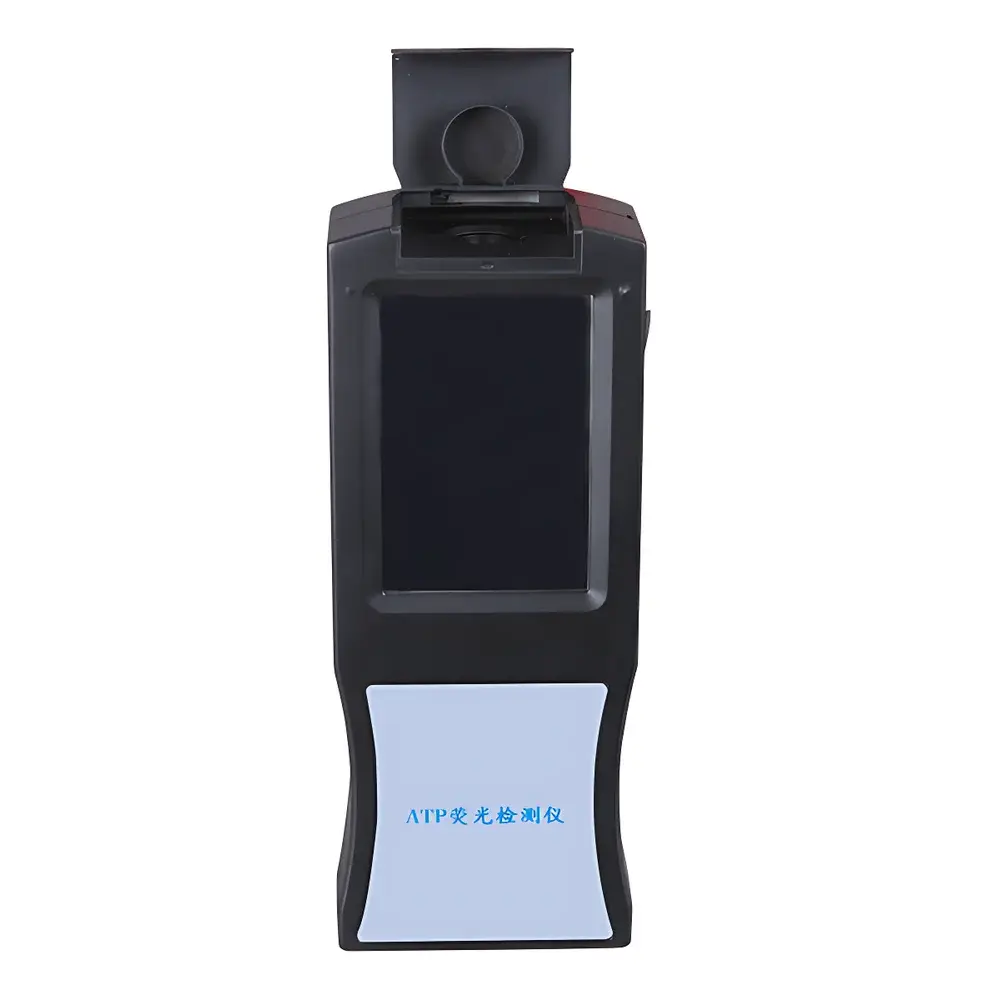
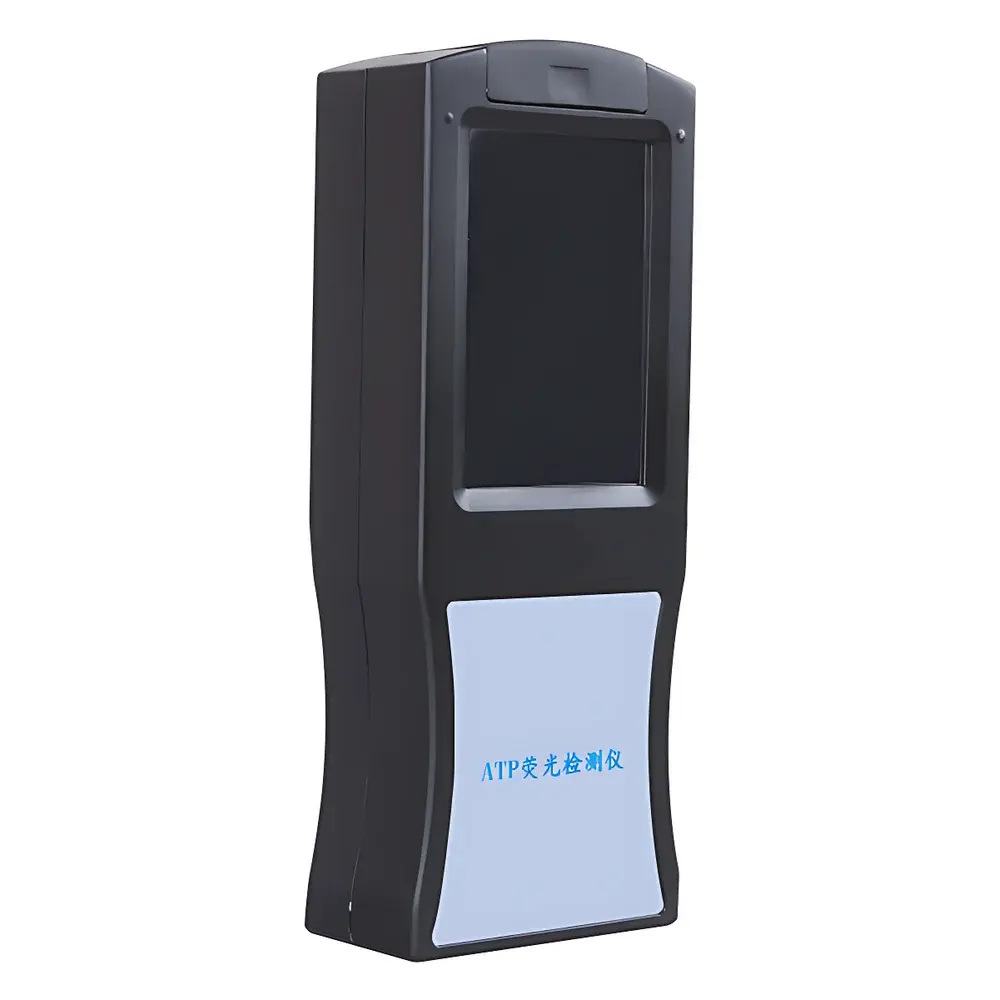
CSY ATP Bioluminescence Detector
| Brand | CSY |
|---|---|
| Origin | Guangdong, China |
| Manufacturer Type | Authorized Distributor |
| Country of Manufacture | China |
| Model | CSY-ATP |
| Price Range | USD 1–999 (FOB) |
| Detection Principle | Luciferin–Luciferase Bioluminescent Reaction |
| Detection Unit | RLU (Relative Light Unit) |
| Sensitivity | 1 × 10⁻¹⁶ mol ATP |
| Dynamic Range | 1–9999 RLU (customizable up to 999999) |
| Measurement Time | ≤10 s per sample |
| Repeatability | ≤±5% CV |
| Sample Point Capacity | ≥2000 unique locations |
| Data Storage | ≥20,000 test records |
| Connectivity | USB 2.0, Bluetooth 4.2, Wi-Fi 802.11 b/g/n |
| Result Interpretation | Pre-programmed RLU-to-Cleanliness-Level mapping (e.g., Pass/Alert/Fail) with configurable thresholds |
Overview
The CSY ATP Bioluminescence Detector is a portable, field-deployable instrument engineered for rapid assessment of surface hygiene in food processing, healthcare, pharmaceutical manufacturing, and institutional cleaning environments. It quantifies total adenosine triphosphate (ATP) via the firefly luciferin–luciferase enzymatic reaction: ATP + luciferin + O₂ → oxyluciferin + AMP + PPi + CO₂ + light (λ ≈ 560 nm). The emitted photons are captured by a high-gain photomultiplier tube (PMT) or silicon photodiode sensor and converted into Relative Light Units (RLU), a dimensionless metric proportional to ATP concentration. Unlike microbial culture-based methods (e.g., ISO 4833-1, FDA BAM Chapter 3), this assay detects biologically active ATP from viable microorganisms (bacteria, yeasts, molds) *and* organic residues (e.g., carbohydrates, proteins, lipids) left on surfaces post-cleaning. Therefore, RLU values reflect overall biological contamination load—not colony-forming units (CFU)—and serve as a validated proxy for cleaning efficacy under hygiene monitoring programs aligned with HACCP, ISO 22000, and BRCGS Food Safety Issue 9.
Key Features
- Sub-femtomole sensitivity: Detects as low as 1 × 10⁻¹⁶ mol ATP—enabling verification of near-sterile conditions on stainless steel, plastic, or conveyor belts.
- 10-second measurement cycle: Includes integrated luminometer stabilization, auto-zeroing, and real-time RLU calculation—optimized for high-throughput facility audits.
- Robust repeatability: ≤±5% coefficient of variation across repeated measurements on identical swab extracts, ensuring data consistency across shifts and operators.
- Configurable cleanliness grading: On-device algorithm converts raw RLU into user-defined pass/fail/alert categories based on site-specific validation studies (e.g., <100 RLU = acceptable for ready-to-eat zones per USDA FSIS guidelines).
- Dual-mode data handling: Local storage of ≥20,000 timestamped results with GPS-tagged location metadata (when enabled via Bluetooth-connected smartphone); exportable via USB or encrypted Wi-Fi to LIMS or cloud-based hygiene dashboards.
- Regulatory-ready audit trail: Firmware supports GLP-compliant operation with operator ID logging, calibration history tracking, and tamper-proof result timestamps—facilitating 21 CFR Part 11 alignment when paired with validated software platforms.
Sample Compatibility & Compliance
The detector is validated for use with standardized ATP swabs containing lyophilized luciferase/luciferin reagents (e.g., CSY-SWAB series, ISO 22000 Annex A.7 compatible). Swabs are designed for consistent elution efficiency across porous (concrete, wood) and non-porous (stainless steel, glass) surfaces. Instrument performance meets ISO 21528-2:2017 requirements for rapid hygiene verification systems. While not a direct replacement for microbiological enumeration per ISO 6887-1, it satisfies preventive control validation criteria under FDA Food Safety Modernization Act (FSMA) §117.135 and EU Regulation (EC) No 852/2004 Annex II Section II. All firmware and calibration protocols undergo annual third-party verification per ILAC-G8:2021.
Software & Data Management
CSY Connect Desktop Suite (v3.2+) provides secure data aggregation, statistical process control (SPC) charting, and trend analysis across multiple instruments. Raw RLU files (.csv/.xlsx) retain full metrological traceability—including swab lot number, operator ID, environmental temperature/humidity logs, and instrument serial number. Optional API integration enables automated report generation for internal quality review boards or external auditors (e.g., SQF Edition 9, FSSC 22000 v5.1). Audit logs comply with ALCOA+ principles (Attributable, Legible, Contemporaneous, Original, Accurate, Complete, Consistent, Enduring, Available).
Applications
- Pre-operational sanitation verification in meat/poultry processing lines prior to startup (USDA FSIS Directive 7120.1).
- Environmental monitoring of cleanroom surfaces in pharmaceutical aseptic filling suites (ISO 14644-1 Class 5–8).
- Validation of CIP/SIP cycles in dairy and beverage production tanks.
- Routine hygiene scoring in hospital operating theaters and endoscopy reprocessing areas (CDC Guideline for Disinfection and Sterilization).
- Training feedback tool for sanitation staff—real-time RLU visualization reinforces proper swabbing technique and dwell time adherence.
FAQ
What does an RLU value represent, and how is it different from CFU?
RLU quantifies total photon flux generated by ATP-driven bioluminescence—not viable cell count. CFU requires 24–72 h of incubation and selective media; RLU delivers actionable hygiene insight within seconds but cannot distinguish microbial ATP from residual organic matter.
Can this instrument detect viruses or spores?
No. Viruses lack metabolic ATP; bacterial spores contain minimal ATP until germination. The assay targets metabolically active cells and fresh organic debris—making it ideal for verifying removal of vegetative pathogens (e.g., Listeria monocytogenes, E. coli) and food soils.
Is calibration required before each use?
Factory calibration is stable for 12 months under normal operating conditions (15–30°C, <80% RH). Daily system checks using CSY-certified ATP standard swabs (100 RLU ±10%) are recommended per ISO/IEC 17025:2017 Clause 7.7.
How are detection limits validated for specific food matrices?
Users must perform matrix-specific recovery studies per AOAC Official Method 2012.02: swabbing efficiency, extraction yield, and background interference must be characterized for each surface type and residue category (e.g., cheese whey vs. baked flour dust).
Does Bluetooth/Wi-Fi transmission affect measurement accuracy?
No. Wireless modules operate independently of the optical detection circuitry. Data transmission occurs only after RLU integration is complete and digitally locked—ensuring metrological integrity is preserved during connectivity events.





