
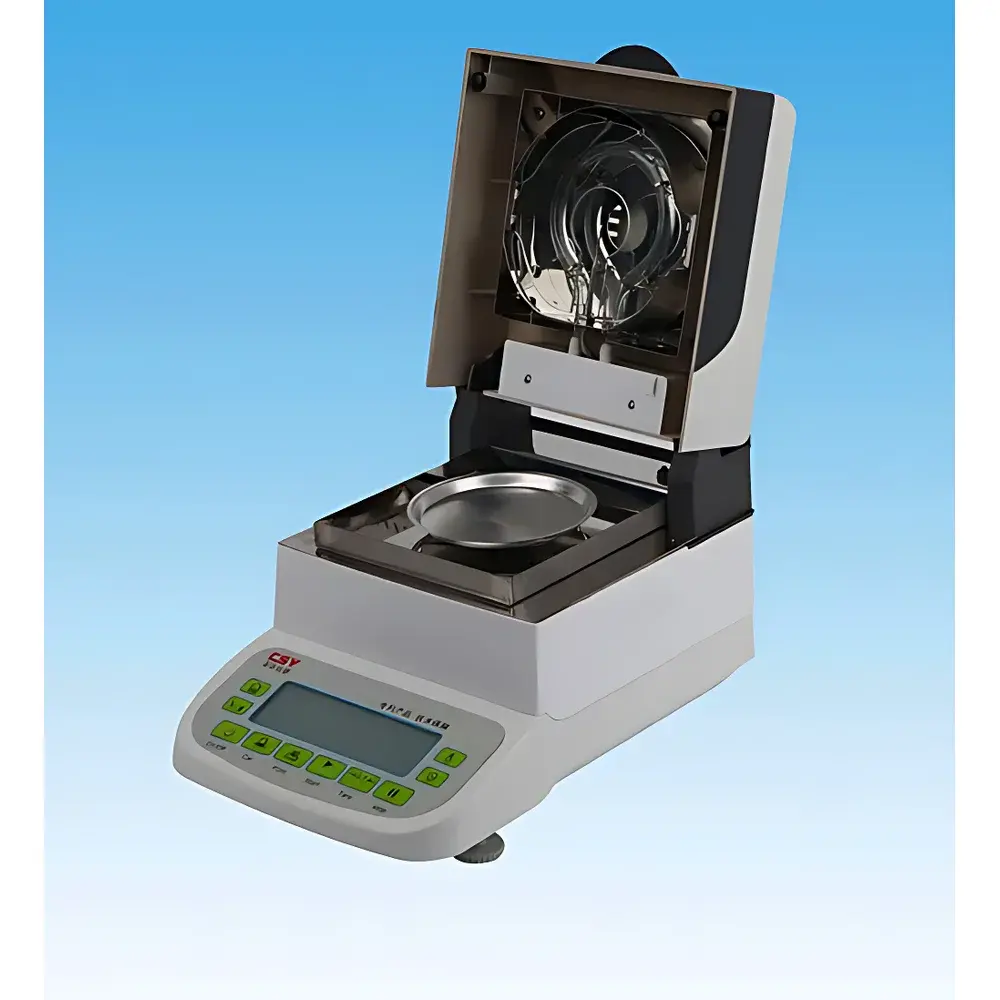
CSY-L5A ABS Engineering Plastic Moisture Analyzer
| Brand | CSY |
|---|---|
| Origin | Guangdong, China |
| Manufacturer Type | Authorized Distributor |
| Origin Category | Domestic (China) |
| Model | CSY-L5A |
| Price Range | USD 1–1,400 (FOB) |
| Moisture Range | 0.01–100% |
| Readability | 0.01% |
| Weighing Capacity | 0–100 g |
| Sensor Resolution | 0.001 g |
| Weighing Technology | Electromagnetic Force Compensation Sensor |
| Heating Source | Halogen Tungsten-Quartz Annular Lamp |
| Temperature Range | Ambient to 205 °C |
| Display Parameters | % Moisture, Time (s), Temperature (°C), Weight (g) |
| Interface | RS232 (FDA/HACCP-compliant data export) |
| Power Supply | 220 V ±10% / 110 V ±10%, 50/60 Hz ±1 Hz |
| Pan Diameter | 110 mm |
Overview
The CSY-L5A ABS Engineering Plastic Moisture Analyzer is a precision halogen moisture analyzer engineered for rapid, gravimetric determination of moisture content in thermoplastic polymer granules and pellets—including ABS, PP, PE, PVC, PS, PA, PC, PET, PPS, and related additives and raw materials. It operates on the principle of loss-on-drying (LOD), utilizing controlled infrared heating via a halogen tungsten-quartz annular lamp to drive off volatile components, while an electromagnetic force compensation sensor continuously monitors mass loss in real time. The instrument calculates moisture percentage by comparing initial and final dry mass, delivering results traceable to ASTM D6980, ISO 15512, and GB/T 29246—ensuring metrological equivalence with conventional convection oven methods (e.g., ASTM D6980 Method A), but with cycle times reduced from hours to under 10 minutes. Its compact benchtop architecture integrates thermal uniformity, sensor stability, and regulatory-ready data handling—making it suitable for QC laboratories operating under GLP, GMP, or ISO/IEC 17025 frameworks.
Key Features
- Electromagnetic force compensation weighing system with 0.001 g resolution and <0.01% repeatability—certified per OIML R76 and compatible with ISO 9001 calibration protocols.
- Annular halogen tungsten-quartz lamp providing uniform, directional IR radiation; enables volumetric heating with minimal surface degradation and no hot-spot formation.
- Programmable temperature control (ambient to 205 °C) with real-time thermal feedback; supports method development for heat-sensitive polymers.
- Intuitive LCD interface displaying % moisture, elapsed time, sample temperature, and current weight—simultaneously and in real time.
- Multiple operation modes: fully automatic termination (based on drift threshold), timed drying (1–9999 s), and manual hold—enabling method flexibility across material classes.
- RS232 serial interface compliant with FDA 21 CFR Part 11 Annex 11 requirements for audit-trail-capable data export to LIMS, printers, or PCs.
- No external ventilation, desiccant, or ambient humidity control required—validated for stable performance at 30–80% RH and 15–30 °C ambient.
Sample Compatibility & Compliance
The CSY-L5A is validated for heterogeneous solid particulates with particle sizes ranging from 0.5 mm to 5 mm—covering standard plastic pellets, regrind, masterbatches, and hygroscopic additives (e.g., flame retardants, plasticizers). It complies with moisture testing requirements outlined in UL 746C (polymer electrical safety), ISO 11357-2 (DSC moisture correlation), and ASTM D6980 Annex A1 for polymeric resins. Each unit ships with factory calibration certificates traceable to NIM (National Institute of Metrology, China) and includes user-accessible verification weights (10 g and 50 g) for daily performance checks. The halogen heating profile has been verified against reference oven methods per ISO 5725-2 for intermediate precision (RSD < 1.2% across n=6 replicates on ABS granules at 0.25% nominal moisture).
Software & Data Management
While the CSY-L5A operates autonomously via embedded firmware, its RS232 port enables bidirectional communication with third-party laboratory software using ASCII-based command protocols (e.g., “READ”, “PRINT”, “CAL”). Raw data output includes timestamp, operator ID (user-defined), method ID, initial/final mass, moisture %, drying curve points (mass vs. time), and thermal profile metadata. Exported files conform to FDA/HACCP-compliant CSV structure—supporting integration into electronic lab notebooks (ELN), SAP QM modules, or custom QA dashboards. Audit trails are retained locally for ≥1,000 test records with tamper-resistant timestamps; data integrity is preserved during power interruption via non-volatile memory backup.
Applications
This analyzer serves as a primary moisture screening tool in incoming raw material inspection, production line release testing, and R&D formulation validation. Typical use cases include: monitoring ABS pellet moisture pre-drying to prevent hydrolytic degradation during extrusion; verifying PE/PP resin compliance before injection molding (target ≤0.02% for optical-grade parts); quantifying moisture uptake in PA6/PA66 after ambient exposure per ISO 62; validating desiccant dryer efficiency in hopper-fed systems; and supporting DOE studies on drying time–temperature–moisture relationships. It is routinely deployed in Tier-1 automotive plastics suppliers, medical device compounders, and contract manufacturers adhering to IATF 16949 and ISO 13485 quality systems.
FAQ
Is the CSY-L5A compliant with FDA 21 CFR Part 11 for electronic records?
Yes—the RS232 data export protocol supports unique user login, electronic signatures (via external authentication), and immutable audit trails meeting Part 11 Subpart B requirements.
Can it measure moisture in conductive or carbon-filled polymers?
Yes—halogen IR heating is unaffected by electrical conductivity; however, dark or highly absorptive samples may require lower temperature setpoints to avoid localized charring.
What calibration standards are recommended for routine verification?
Use certified anhydrous sodium tartrate (15.66% H₂O) or polyethylene glycol 2000 (trace moisture reference) per ASTM E1868; verify sensor linearity with Class M1 stainless steel weights.
Does the instrument support GLP-compliant reporting?
Yes—test reports include instrument ID, calibration due date, environmental conditions (recorded manually), operator signature field, and full drying curve metadata.
How often should the halogen lamp be replaced?
Rated lifetime is ≥5,000 hours; replacement is indicated when drying time increases >15% or temperature uniformity deviates >±3 °C across pan radius.
Related Products





