
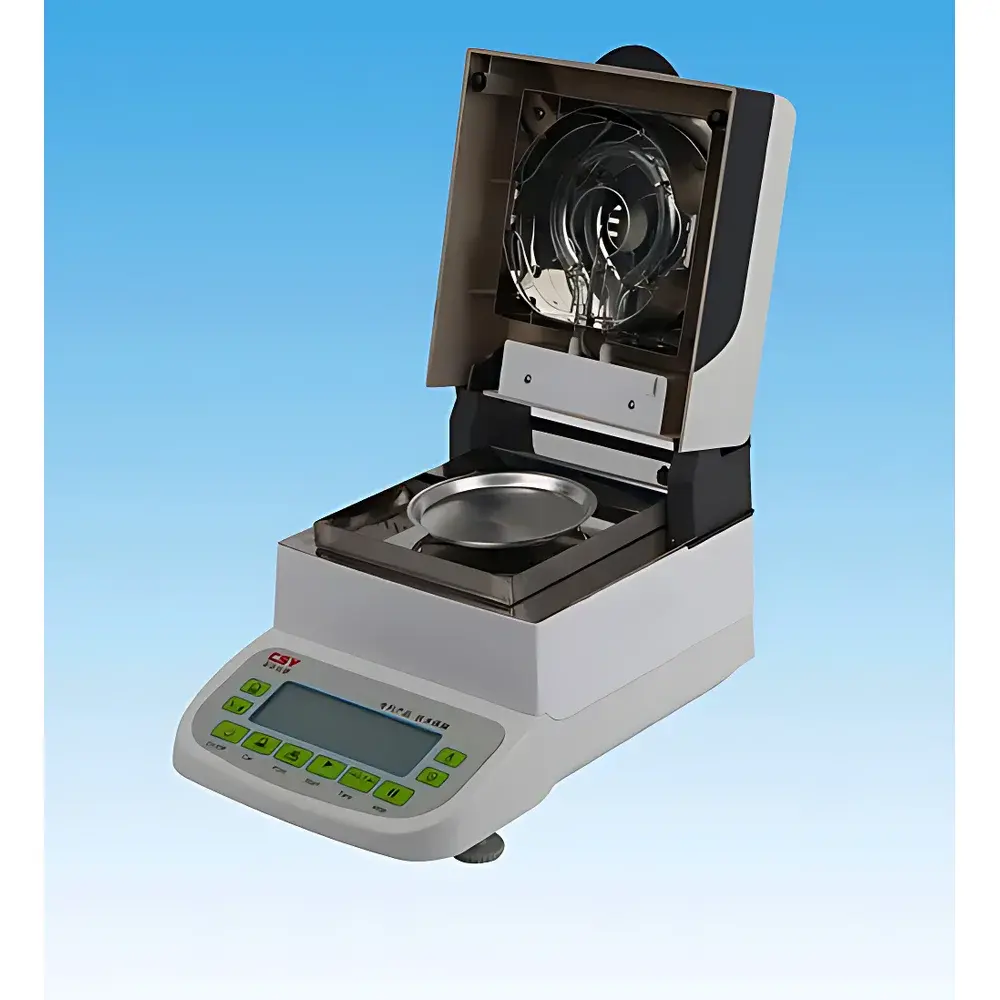
CSY-L5A Plastic Masterbatch Moisture Analyzer
| Brand | CSY |
|---|---|
| Origin | Guangdong, China |
| Manufacturer Type | Authorized Distributor |
| Country of Origin | China |
| Model | CSY-L5A |
| Moisture Range | 0.01–100% |
| Readability | 0.01% |
| Weighing Capacity | 0–100 g |
| Sensor Accuracy | 0.001 g |
| Weighing Technology | Electromagnetic Force Compensation Sensor |
| Heating Source | Halogen Tungsten Ring Lamp |
| Heating Temperature Range | Ambient to 205 °C |
| Display Parameters | % Moisture, Time, Temperature, Weight |
| Pan Diameter | 110 mm |
| Interface | RS232 (FDA/HACCP-compliant data export) |
| Power Supply | 220 V ±10% / 110 V ±10%, 50/60 Hz |
Overview
The CSY-L5A Plastic Masterbatch Moisture Analyzer is a dedicated halogen moisture analyzer engineered for rapid, gravimetric determination of moisture content in thermoplastic polymers, masterbatches, and pelletized resin feedstocks. It operates on the principle of loss-on-drying (LOD), utilizing precise electromagnetic force compensation weighing combined with controlled halogen tungsten infrared heating to drive off volatiles under reproducible thermal conditions. Unlike conventional convection ovens, the CSY-L5A applies uniform radiant heat across the entire sample surface via its annular halogen lamp—minimizing thermal gradients, preventing localized degradation of heat-sensitive polymer matrices (e.g., PA6, PC, or flame-retardant formulations), and ensuring representative mass loss measurement. The instrument complies with ASTM D6980–22 (“Standard Test Method for Determination of Moisture Content in Plastics by Loss in Weight”), ISO 15512:2019 (“Plastics — Determination of water content”), and aligns with the procedural rigor expected in ISO/IEC 17025-accredited QC laboratories.
Key Features
- Electromagnetic force compensation weighing system with 0.001 g resolution and <0.01% repeatability—meeting international Class I analytical balance performance criteria per OIML R76.
- Annular halogen tungsten lamp providing rapid, uniform heating up to 205 °C; optimized thermal profile minimizes charring or oxidation of polyolefins (PP, PE), engineering resins (PBT, PPS), and hygroscopic nylons (PA6, PA66).
- Real-time dynamic display of moisture loss (%), elapsed time, sample temperature, and current mass—enabling immediate process validation and deviation detection.
- Three operational modes: fully automatic (predefined endpoint), timed drying (user-specified duration), and semi-automatic (manual termination)—supporting method development per material-specific drying kinetics.
- Compact benchtop footprint (W × D × H ≈ 220 × 320 × 180 mm) with 110 mm diameter stainless-steel weighing pan—designed for integration into high-throughput polymer compounding lines and incoming raw material inspection stations.
- RS232 serial interface compliant with FDA 21 CFR Part 11 requirements for electronic records and signatures when paired with validated data acquisition software; supports direct printing to thermal label printers or CSV export to LIMS.
Sample Compatibility & Compliance
The CSY-L5A accommodates heterogeneous granular samples including color masterbatches, filler-loaded compounds (CaCO₃, talc, glass fiber), flame-retardant concentrates, and virgin polymer pellets (PET, PC, ABS, PS, PP). Its LOD methodology is validated for materials with initial moisture levels between 0.01% and 10% w/w—a critical range for extrusion-grade resins where >0.02% residual moisture can induce hydrolytic chain scission during melt processing. Instrument operation adheres to GLP documentation standards: each test generates a timestamped report containing operator ID, sample ID, method name, start/end time, final moisture value, and calibration verification status. Traceable calibration using certified NIST-traceable reference standards (e.g., sodium tartrate dihydrate) ensures metrological continuity across shifts and facilities.
Software & Data Management
While the CSY-L5A operates as a standalone unit with embedded firmware, its RS232 port enables bidirectional communication with external PCs running compliant laboratory data management systems. Raw output includes ASCII-formatted strings containing moisture %, weight loss curve timestamps, and thermal ramp logs—structured to map directly into SQL-based QC databases or statistical process control (SPC) platforms such as Minitab or InfinityQS. Audit trail functionality—when enabled via host software—records all parameter modifications, user logins, and result exports in immutable chronological order, satisfying FDA 21 CFR Part 11 Annex 11 and EU GMP Annex 11 requirements for regulated environments.
Applications
- Pre-extrusion quality gate: Verifying moisture compliance of hygroscopic engineering plastics (e.g., PA, PET, PC) prior to twin-screw processing.
- Masterbatch release testing: Quantifying moisture ingress in pigment- or additive-concentrated carriers after storage or transport.
- Supplier qualification: Benchmarking moisture stability of resin lots against contractual specifications (e.g., ≤0.03% for PET bottle-grade).
- R&D formulation screening: Assessing drying efficacy of desiccant dryers or hopper dryers under varying temperature/dwell time conditions.
- Root cause analysis: Correlating elevated moisture readings with downstream defects such as splay, voids, or reduced tensile strength in injection-molded parts.
FAQ
How does the CSY-L5A compare to traditional oven-drying methods per ASTM D6980?
It delivers equivalent accuracy (±0.02% vs. reference oven method) with 90% reduction in cycle time—typically 3–7 minutes versus 2–4 hours—while eliminating operator-dependent endpoint judgment errors.
Can the instrument be calibrated and verified in-house?
Yes. Internal calibration uses built-in weight standards; external verification employs NIST-traceable reference materials (e.g., 15.66% sodium tartrate dihydrate) with documented uncertainty budgets.
Is the halogen heating source suitable for flame-retardant or UV-stabilized masterbatches?
Yes—the controlled radiant energy profile avoids convective turbulence and hot-spot formation, preserving additive integrity better than forced-air ovens.
What maintenance is required for long-term accuracy?
Annual sensor linearity verification and lamp intensity profiling are recommended; no consumables beyond standard cleaning of the pan and chamber reflector surface.
Does the CSY-L5A support multi-language UI or custom reporting templates?
Firmware supports English and simplified Chinese UI; report formatting is configurable via host-side software using standardized field mapping protocols.






