
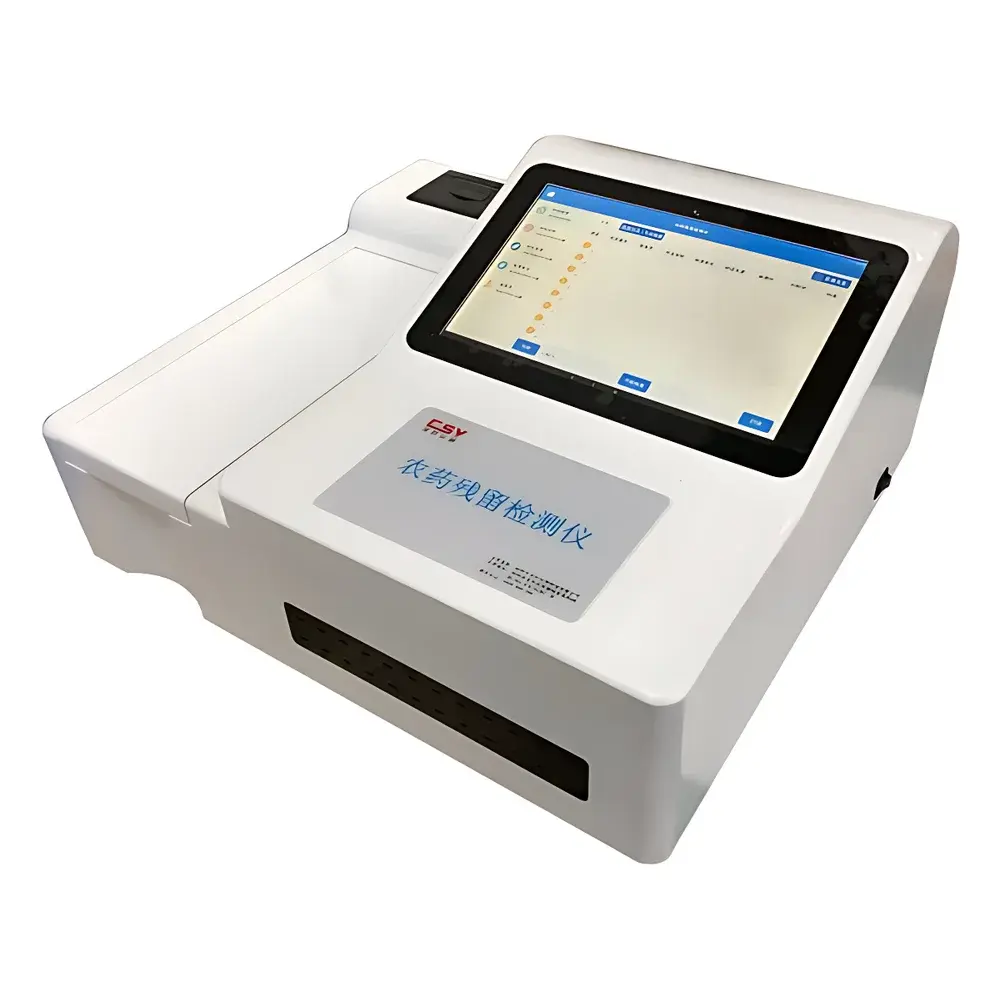
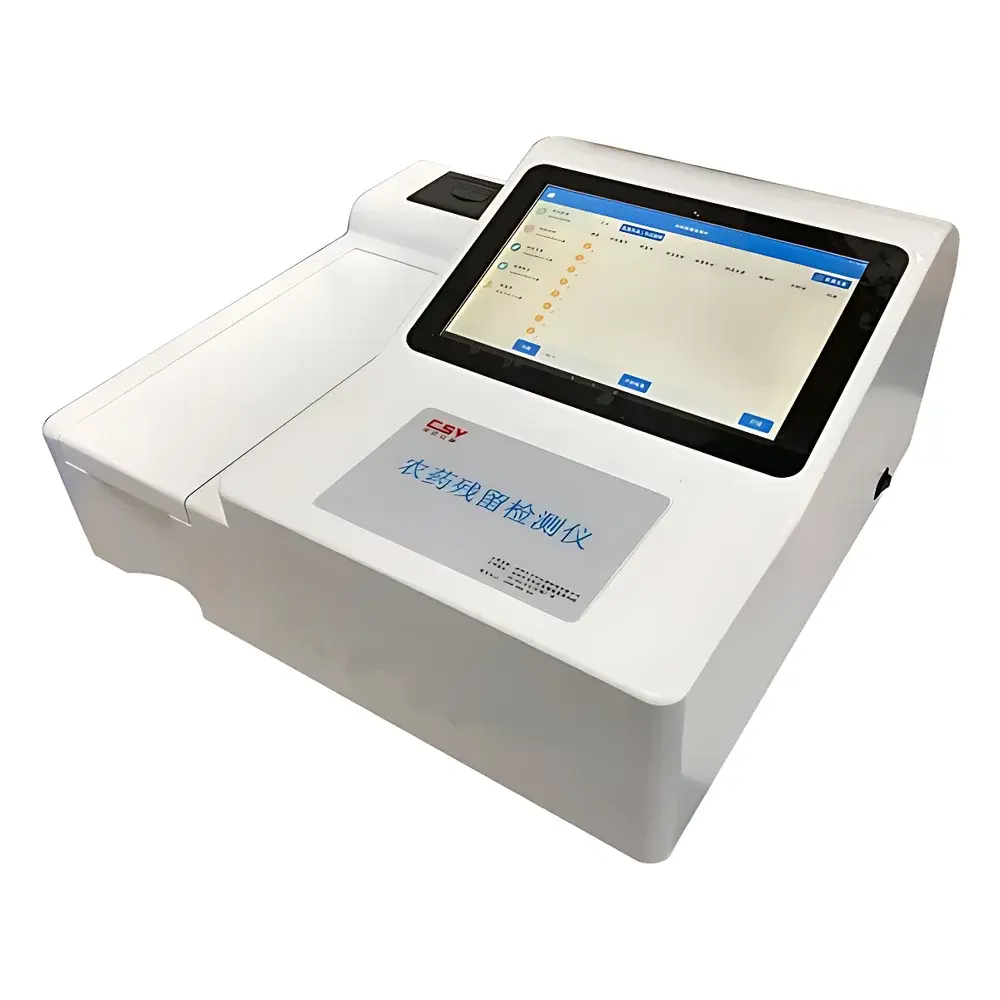
CSY-N24A Smart Edible Agricultural Product Compliance Certificate & Pesticide Residue Detector
| Brand | CSY (Shenzhen Finysis Instrument Manufacturing Co., Ltd.) |
|---|---|
| Origin | Guangdong, China |
| Manufacturer Type | Authorized Distributor |
| Domestic Production | Yes |
| Model | CSY-N24A |
| Function Type | Multi-analyte Rapid Detection System |
| Sample Compatibility | Broad-spectrum for fruits, vegetables, herbs, and fresh produce |
| Wavelength | 412 nm ± 2 nm |
| Optical Path | 10 mm standard cuvette |
| Absorbance Range | 0.000–4.000 ABS |
| Photometric Repeatability | ≤0.1% |
| Photometric Accuracy | ±1% transmittance |
| Inter-channel Variation | ≤0.2% |
| Stability | ±0.001 A/hr |
| Measurement Time per Sample | ≤3 minutes |
| Data Storage Capacity | >800,000 records |
| Display | 10.1″ capacitive touchscreen (1920×1200), Android OS |
| Connectivity | USB, RS-232, Wi-Fi, Bluetooth, MicroSD slot |
| Integrated Thermal Printer | Compliance certificate + QR/barcode hybrid printing |
| Cloud Integration | Compatible with national agricultural traceability platforms (e.g., China National Traceability Platform) |
| Regulatory Alignment | Designed to support GB/T 22292–2017 (Pesticide Residue Testing in Vegetables and Fruits), NY/T 448–2021 (Rapid Detection of Organophosphorus and Carbamate Pesticides), and GLP-aligned data audit trails |
Overview
The CSY-N24A Smart Edible Agricultural Product Compliance Certificate & Pesticide Residue Detector is a CE-compliant, field-deployable rapid screening system engineered for integrated quality assurance in fresh produce supply chains. It combines dual-function capability—quantitative spectrophotometric detection of organophosphorus and carbamate pesticide residues via acetylcholinesterase inhibition assay—with real-time generation of traceable compliance documentation. The instrument operates on the principle of enzymatic colorimetric reaction kinetics: sample extracts inhibit acetylcholinesterase activity, resulting in proportional changes in yellow chromophore (5,5′-dithiobis-(2-nitrobenzoic acid), DTNB) absorbance at 412 nm. This photometric measurement is calibrated against reference standards traceable to NIM (National Institute of Metrology, China) and validated per ISO/IEC 17025 requirements for routine testing laboratories. Designed for use at farm gates, wholesale markets, regulatory checkpoints, and food processing facilities, the CSY-N24A supports decentralized, high-throughput verification aligned with China’s “One Network, One Code” national traceability mandate.
Key Features
- 24 independent optical detection channels with inter-channel deviation ≤0.2%, enabling parallel analysis without cross-contamination or signal crosstalk.
- High-stability LED light source (412 nm ±2 nm) with photometric repeatability ≤0.1% and long-term drift <±0.001 A/hr—critical for multi-shift operational consistency.
- Integrated thermal printer compliant with GB/T 29313–2012 for simultaneous generation of edible agricultural product compliance certificates, GS1-compatible barcodes, and scannable QR codes containing batch ID, sampling time, operator ID, and test result metadata.
- 10.1-inch industrial-grade capacitive touchscreen running Android OS with secure firmware partitioning; supports over-the-air (OTA) updates, role-based user access control, and encrypted local data storage (>800,000 records).
- Dual operation modes: synchronized multi-channel start for throughput optimization, or sequential single-channel activation to isolate and recalibrate individual wells—minimizing systematic error in heterogeneous sample matrices.
- Full I/O flexibility: RS-232 for legacy lab equipment integration, USB host/device for peripheral expansion, Wi-Fi/Bluetooth for wireless telemetry, and MicroSD slot for offline data backup and method transfer.
Sample Compatibility & Compliance
The CSY-N24A accommodates homogenized aqueous extracts from leafy greens, root vegetables, fruits, edible fungi, and herbal materials—validated per NY/T 448–2021 extraction protocols. No organic solvent handling is required; all reagents are pre-packaged, lyophilized enzyme-substrate kits with 18-month shelf life at 4–25°C. Instrument output complies with China’s Ministry of Agriculture and Rural Affairs (MARA) Notice No. 269 (2020) on electronic合格证 (Compliance Certificates), and raw absorbance data meets audit requirements for GLP environments—including timestamped operator logins, immutable result logs, and full revision history of calibration curves. Data export formats include CSV, PDF (certificate), and XML for direct ingestion into provincial-level traceability platforms and the national unified system (agri-trace.gov.cn).
Software & Data Management
Embedded software implements FDA 21 CFR Part 11–aligned electronic record controls: digital signatures, automatic audit trails (user actions, calibration events, result modifications), and session timeouts. Cloud synchronization uses TLS 1.2 encryption to transmit anonymized metadata (not raw spectra) to centralized dashboards. Local database supports SQL queries for trend analysis (e.g., residue incidence by region/crop/season). Third-party API endpoints enable integration with ERP systems (e.g., SAP S/4HANA Food & Beverage modules) and LIMS platforms via RESTful webhooks. Firmware updates undergo cryptographic signature verification prior to installation.
Applications
- Pre-harvest field screening by cooperative extension agents to guide harvest timing and post-harvest treatment decisions.
- Wholesale market entry verification—mandatory scanning of QR-coded certificates before stall allocation.
- Regulatory spot checks during inter-provincial transport inspections under MARA’s “Green Channel” enforcement framework.
- Internal QA/QC in HACCP-certified packing houses, where certificate issuance triggers automated lot release workflows.
- Training and capacity building in rural technical service centers, leveraging the intuitive UI and multilingual prompt system (English/Chinese/Spanish optional).
FAQ
Does the CSY-N24A comply with international pesticide MRL standards such as Codex Alimentarius?
It provides semi-quantitative screening relative to Chinese MRLs (GB 2763–2021); confirmatory quantification requires LC-MS/MS per ISO 14501.
Can the instrument be calibrated using third-party reference standards?
Yes—NIST-traceable absorbance filters and enzyme activity standards are supported via custom calibration mode.
Is remote diagnostic support available outside mainland China?
Firmware-level diagnostics and screen-sharing troubleshooting are accessible globally via secure VNC tunnel with end-to-end encryption.
What data security certifications does the embedded OS hold?
Android OS image is hardened per Common Criteria EAL2+ for embedded devices; all data-at-rest is AES-256 encrypted.
How frequently must the optical system be recalibrated?
Factory calibration remains valid for 12 months under normal use; field verification with blank/reference cuvettes is recommended before each daily shift.




