
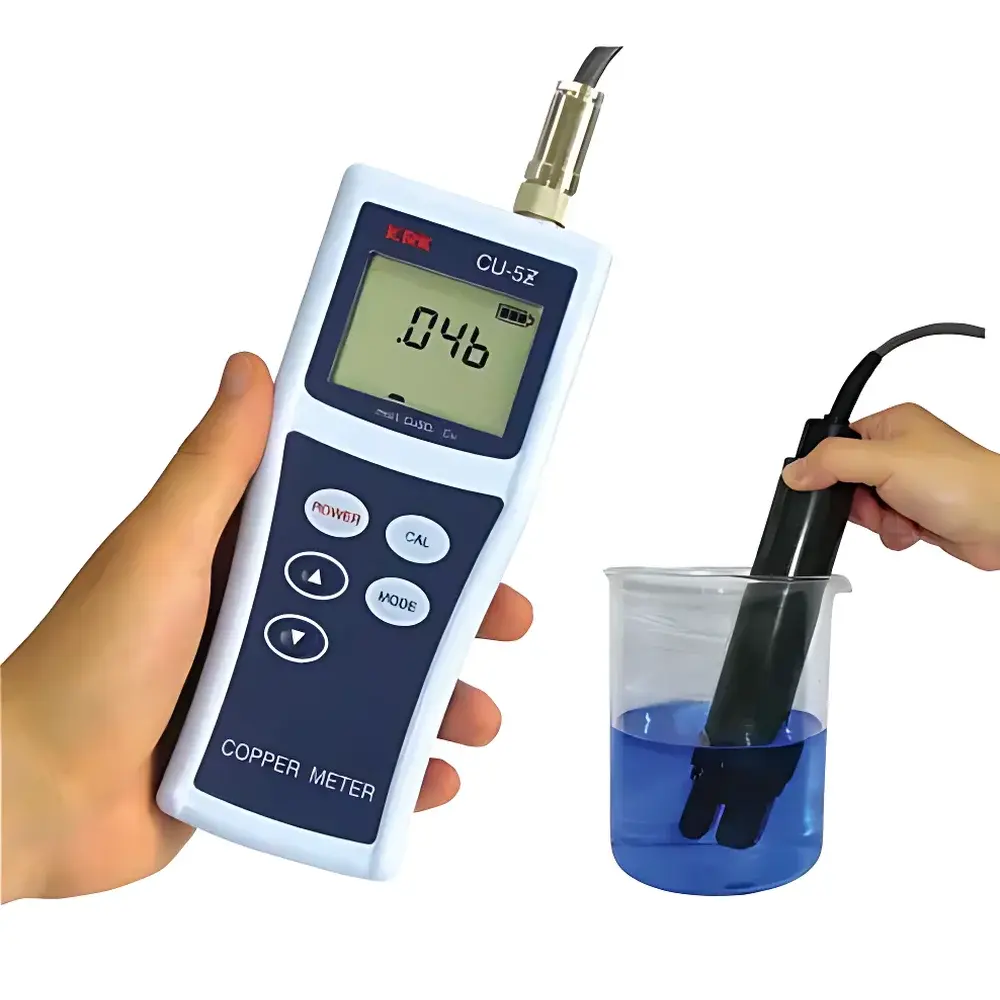
CU-5Z Portable Copper Ion Concentration Meter for Electroplating Industry
| Brand | — |
|---|---|
| Origin | Beijing, China |
| Manufacturer Type | Authorized Distributor |
| Country of Origin | China |
| Model | CU-5Z |
| Price | Upon Request |
| Measurement Principle | Absorption Photometry |
| Measurement Ranges | 0.000–1.200 mol/L (Cu²⁺ molar concentration) |
| Accuracy | ±2% FS (under specified calibration and environmental conditions) |
| Resolution | 0.001 mol/L |
| Calibration | Two-point calibration using certified Cu²⁺ standard solutions |
| Temperature Compensation | Automatic (NTC sensor integrated in CUD-61 electrode) |
| Display | 3½-digit LCD |
| Operating Environment | −5°C to +45°C, ≤85% RH (non-condensing) |
| Power Supply | DC 4.5 V (3 × AA alkaline batteries), auto-power-off after 30 min idle |
| Dimensions (main unit) | 75(W) × 180(D) × 38(H) mm |
| Weight | ~300 g (main unit), ~550 g (CUD-61 electrode with 2 m cable) |
| Standard Configuration | Main unit, CUD-61 copper-selective electrode (2 m coaxial cable), instruction manual, certificate of conformity |
Overview
The CU-5Z Portable Copper Ion Concentration Meter is a field-deployable photometric analyzer engineered for rapid, on-site quantification of dissolved Cu²⁺ ions in electroplating bath solutions, rinse waters, and effluent streams. Unlike ion-selective electrode (ISE) or anodic stripping voltammetry systems, the CU-5Z employs absorption photometry—specifically, colorimetric detection based on the formation of a stable, Cu²⁺-dithizone complex in acidic medium. This method delivers high selectivity against common interferents such as Ni²⁺, Fe²⁺/Fe³⁺, and Zn²⁺ when operated within manufacturer-specified pH and masking agent protocols. Designed for routine QC/QA in PCB fabrication, decorative plating, and functional coating lines, the instrument operates without reagent cartridges or fluidic pumps; instead, it relies on user-introduced, pre-formulated colorimetric reagent kits (e.g., Hach Method 8506 or equivalent ASTM D1688-compliant protocols). Its compact form factor and battery-powered architecture enable direct immersion measurements at tank-side or benchtop locations where fixed analyzers are impractical.
Key Features
- Triple-range photometric quantification: simultaneous display of Cu²⁺ in mol/L, elemental Cu (g/L), and CuSO₄ (g/L)—enabling direct correlation with bath formulation recipes.
- Integrated NTC temperature sensor within the CUD-61 electrode assembly ensures real-time compensation across −5°C to +45°C, critical for maintaining stoichiometric consistency in color development kinetics.
- 3½-digit LCD with backlight-independent contrast optimization for legibility under factory lighting or shaded outdoor conditions.
- Auto-power-off circuitry (30-minute idle timeout) preserves battery life without compromising measurement continuity during multi-sample workflows.
- Ruggedized housing rated IP54 for resistance to splashes and particulate ingress during wet-process environments.
- No internal memory or data logging—designed explicitly for immediate operator decision-making rather than regulatory archival (compliant with ISO/IEC 17025 Clause 7.7 for equipment used in non-accredited testing).
Sample Compatibility & Compliance
The CU-5Z is validated for use with aqueous matrices containing up to 200 g/L total dissolved solids (TDS), including sulfate-, chloride-, and cyanide-based electroplating electrolytes. It requires sample pH adjustment to 3.0–4.5 prior to reagent addition, per ASTM D1688-22 Section 7.2. Interference mitigation is achieved via controlled addition of ammonium citrate and sodium diethyldithiocarbamate (DDTC) as specified in the included protocol sheet. While not certified to EPA Method 200.7 or ISO 8288, its photometric methodology aligns with the performance criteria outlined in ISO 7027-1:2016 for turbidity-corrected absorbance measurement. The device meets CE marking requirements for electromagnetic compatibility (2014/30/EU) and low-voltage safety (2014/35/EU); full compliance documentation is provided upon request for GLP audit preparation.
Software & Data Management
The CU-5Z operates as a standalone hardware system with no embedded firmware updates, cloud connectivity, or PC interface. All calibration, range selection, and unit conversion are performed manually via front-panel push buttons. Calibration verification is traceable to NIST-traceable Cu²⁺ standard solutions (e.g., AccuStandard CUS-100 series), and each unit ships with a Certificate of Conformance listing serial-number-matched verification data at three points (0.1, 1.0, and 5.0 g/L Cu). For laboratories operating under FDA 21 CFR Part 11 or EU Annex 11, the instrument is classified as “non-configurable equipment” — meaning its output is considered raw observational data requiring manual transcription into LIMS or ELN systems, with operator signature and timestamp applied post-measurement per SOP-ANL-023.
Applications
- Real-time monitoring of copper sulfate concentration in acid copper plating baths to maintain optimal current efficiency and deposit uniformity.
- Verification of drag-out recovery system performance by measuring residual Cu²⁺ in counter-current rinse stages.
- Pre-discharge screening of treated wastewater against local discharge limits (e.g., US EPA Effluent Guidelines 40 CFR Part 413, EU IED BREFs).
- Troubleshooting organic additive depletion via correlation between Cu²⁺ drift and polarization resistance shifts measured concurrently with cyclic voltammetric stripping (CVS).
- Field validation of online analyzers during commissioning or periodic verification per ISO/IEC 17025 Clause 6.4.10.
FAQ
Is the CUD-61 electrode compatible with other photometers or ISE meters?
No—the CUD-61 is mechanically and electrically optimized exclusively for the CU-5Z’s optical path geometry and signal conditioning circuitry.
Can the CU-5Z measure copper in cyanide-containing alkaline baths?
Not directly; free cyanide must first be destroyed via nitric acid digestion and pH neutralization prior to analysis, per ASTM D1688 Section 9.3.
What is the shelf life of the included reagent kit?
Unopened dithizone reagent vials retain stability for 24 months when stored at 2–8°C in darkness; opened vials must be used within 30 days.
Does the instrument require annual recalibration by an accredited lab?
Per ISO/IEC 17025, calibration interval is determined by usage frequency and risk assessment; most electroplating facilities perform daily verification with mid-range standards and full two-point calibration weekly.
Is there a version with Bluetooth or USB output for data export?
No—this model intentionally omits digital interfaces to minimize failure modes in corrosive, high-humidity production environments.
Related Products







