
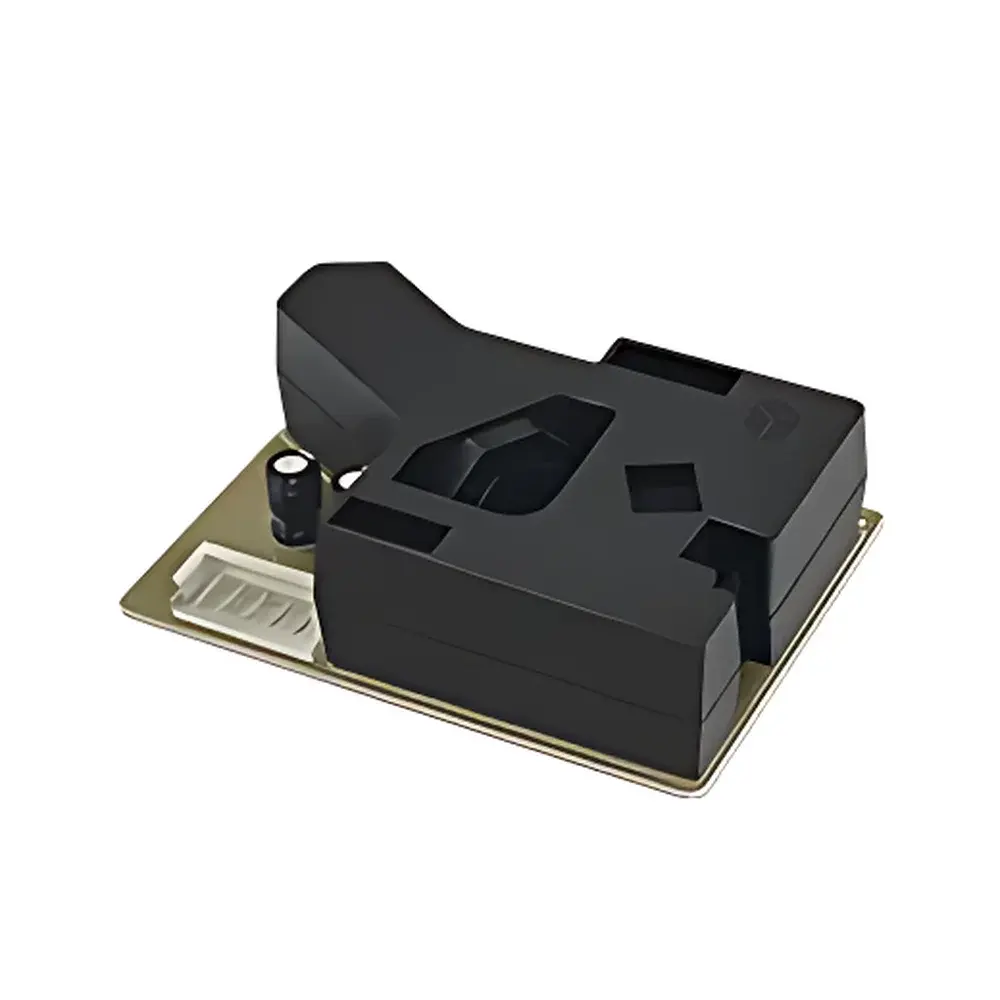
Cubic PM1003 Infrared Dust Sensor
| Brand | Cubic |
|---|---|
| Origin | Hubei, China |
| Manufacturer Type | Authorized Distributor |
| Origin Category | Domestic (China) |
| Model | PM1003 |
| Pricing | Available Upon Request |
| Detection Principle | Optical Scattering (Infrared LED Source) |
| Measurement Range | 0–500 µg/m³ (PM2.5/PM10 mass concentration) |
| Warm-up Time | <40 s |
| Accuracy | ±25 µg/m³ or ±25% of reading (at 25°C ±2°C, 50% RH ±10%, calibrated against NIST-traceable reference instrument) |
| Operating Temperature | −10°C to +50°C |
| Operating Humidity | 0–95% RH (non-condensing) |
| Storage Conditions | −30°C to +60°C, 0–95% RH (non-condensing) |
| Supply Voltage | DC 5 V ±0.5 V (ripple <50 mV) |
| Operating Current | ≤90 mA |
| Output Interfaces | UART TTL (logic level 4.5 V), PWM (4.5 V logic) |
| Dimensions | 59 × 45 × 20 mm (W × H × D) |
| Lens Access | Front-window design with cleanable optical surface |
| Internal Compensation | Real-time temperature compensation algorithm |
| Shielding | Integrated electromagnetic interference (EMI) shielding |
| Calibration | Factory-calibrated using gravimetric reference standards per ISO 12103-1 A2 test dust and EPA PM2.5/PM10 reference protocols |
Overview
The Cubic PM1003 Infrared Dust Sensor is an OEM-grade particulate matter (PM) detection module engineered for reliable, continuous monitoring of airborne particulate mass concentrations in indoor air quality (IAQ), HVAC control, smart home appliances, and portable environmental monitors. It employs a fixed-wavelength infrared light-emitting diode (IR-LED) coupled with a high-sensitivity photodiode to detect forward-scattered light from suspended particles ≥1 µm in aerodynamic diameter. Unlike beta attenuation or tapered element oscillating microbalance (TEOM) methods, the PM1003 utilizes Mie scattering theory under controlled optical geometry to infer mass concentration—primarily targeting PM2.5 and PM10 fractions—by correlating scattered intensity with particle number and size distribution assumptions validated against traceable reference aerosols. Its compact form factor, low power envelope, and dual digital output interfaces make it suitable for integration into resource-constrained embedded systems requiring real-time, low-latency PM feedback without external signal conditioning.
Key Features
- Optical architecture optimized for stability: IR-LED source with narrow spectral bandwidth (850 nm) minimizes humidity-induced signal drift and eliminates UV degradation concerns common in blue-light scatter sensors.
- Integrated temperature compensation algorithm continuously adjusts baseline and sensitivity across −10°C to +50°C, ensuring consistent response in uncontrolled thermal environments such as wall-mounted thermostats or duct-mounted air handlers.
- Electromagnetic shielding compliant with IEC 61000-4-3 (radiated immunity) and IEC 61000-4-6 (conducted immunity) ensures robust operation in electrically noisy settings—including near variable-frequency drives, switching power supplies, or Wi-Fi modules.
- Front-access optical window enables routine lens cleaning without disassembly, preserving long-term optical throughput and minimizing calibration drift associated with dust accumulation on sensing surfaces.
- Onboard MCU performs real-time signal processing, including dark-current subtraction, pulse-height discrimination, and linearization against factory gravimetric calibration curves derived from ISO 12103-1 A2 Arizona Road Dust and ammonium sulfate aerosol challenges.
- Dual-output flexibility: UART TTL interface provides full-resolution PM concentration data at configurable baud rates (default 9600 bps), while PWM output delivers duty-cycle-modulated analog-equivalent signals compatible with microcontroller timer capture peripherals.
Sample Compatibility & Compliance
The PM1003 is validated for use with ambient indoor air containing typical urban/residential aerosols—including combustion-derived soot, pollen fragments, textile fibers, and mineral dusts—with minimal bias for hygroscopic growth effects due to its IR-based detection wavelength. It does not require sample heating or drying, making it unsuitable for high-humidity outdoor applications without enclosure-level humidity management. The sensor complies with RoHS Directive 2011/65/EU and REACH Regulation (EC) No. 1907/2006. While not certified to EN 15251 or ISO 16814 for building IAQ verification, its performance aligns with technical requirements outlined in Annex B of ISO 16000-27 for indicative PM monitoring devices. Calibration traceability follows internal procedures aligned with ISO/IEC 17025 principles for measurement uncertainty estimation (<15% k=2 expanded uncertainty at 100 µg/m³).
Software & Data Management
Cubic provides a comprehensive UART communication protocol specification (v2.1), including frame structure, checksum validation, and command-response sequences for firmware version query, self-test initiation, and reset control. Raw data output includes PM1.0, PM2.5, and PM10 mass concentrations (µg/m³) updated every second. The embedded firmware supports configurable reporting intervals (1–60 s) and optional moving-average filtering (3-/7-/15-point). For regulatory or audit purposes, timestamped binary logs can be captured via host-side serial logging tools; however, the device itself does not implement FDA 21 CFR Part 11-compliant audit trails, electronic signatures, or data encryption. Integration with cloud platforms (e.g., AWS IoT Core, Azure IoT Hub) is achieved through edge gateway abstraction layers that handle protocol translation and TLS-secured transmission.
Applications
- Residential and commercial HVAC demand-controlled ventilation (DCV) systems requiring real-time PM input for fan speed modulation and filter life estimation.
- OEM integration into air purifiers, robotic vacuum cleaners, and smart thermostats where space, power, and cost constraints preclude use of reference-grade beta-attenuation monitors.
- Indoor air quality dashboards deployed in schools, offices, and healthcare waiting areas—used alongside CO₂, VOC, and relative humidity sensors for holistic IAQ scoring.
- Low-cost environmental monitoring networks supporting municipal air quality awareness programs, provided site-specific co-location correction with FRM/FEM reference instruments is applied during post-processing.
- Research-grade prototyping platforms for aerosol exposure studies, where repeatable relative trends—not absolute metrological accuracy—are the primary analytical requirement.
FAQ
Does the PM1003 require periodic recalibration in the field?
No. The sensor is factory-calibrated against gravimetric reference standards and designed for stable operation over its rated lifetime (typically >5 years under normal indoor conditions). However, users should verify performance annually using a portable reference monitor if deployed in mission-critical applications.
Can the PM1003 distinguish between PM2.5 and PM10 fractions?
Yes. It outputs separate PM2.5 and PM10 mass concentration values derived from multi-angle scattering analysis and proprietary size-bin mapping algorithms trained on polydisperse aerosol datasets.
Is the UART interface 3.3V-tolerant?
No. The UART logic level is fixed at 4.5 V. Direct connection to 3.3 V microcontrollers requires level-shifting circuitry or open-drain buffer configuration.
What is the recommended airflow rate across the sensing chamber?
A minimum volumetric flow of 0.1 L/min is advised to ensure representative sampling; passive diffusion is sufficient for static indoor monitoring, but forced convection improves response time and reduces boundary-layer artifacts.
Does the sensor support I²C or SPI communication?
No. Only UART TTL and PWM interfaces are implemented. I²C/SPI functionality is not available in the PM1003 hardware revision.







