
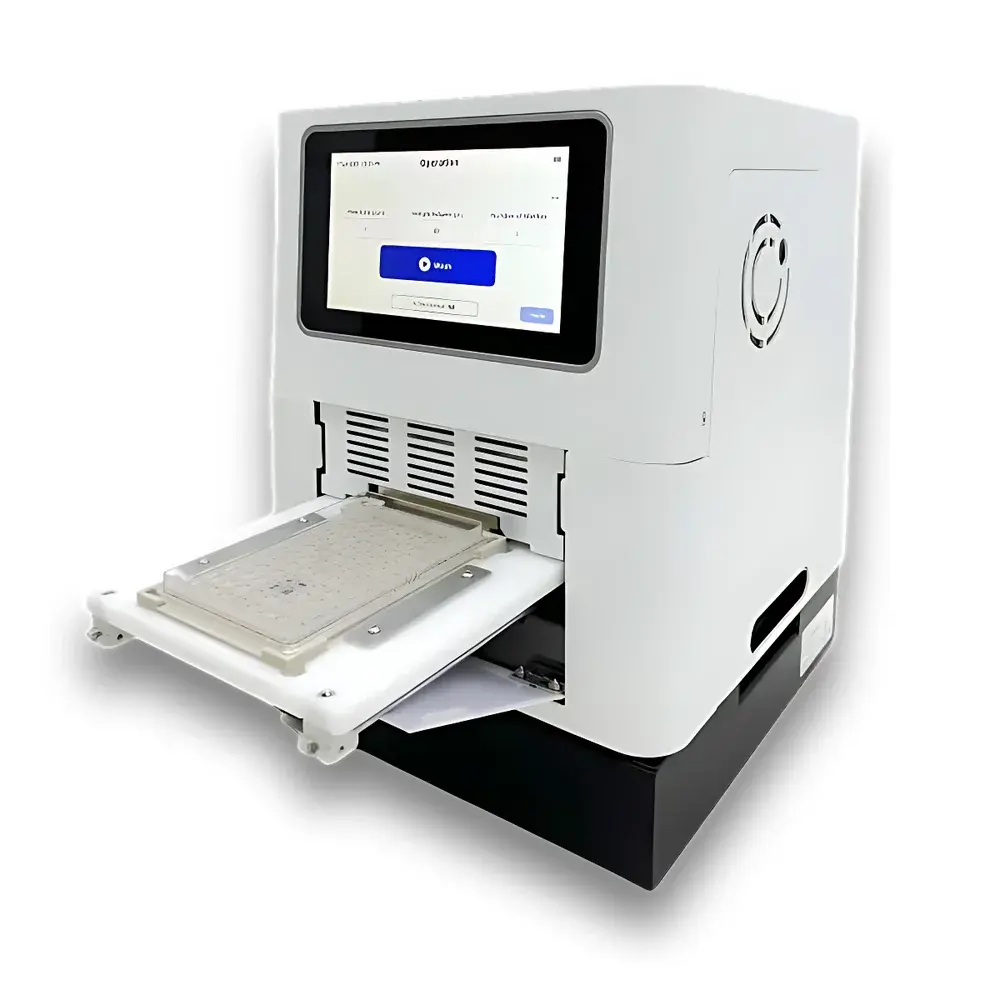
Curiox HT2100 Laminar Wash™ Flow Cytometry Sample Preparation System
| Brand | Curiox |
|---|---|
| Origin | South Korea |
| Model | HT2100 |
| Nozzle Flow Rate | 5–20 µL/s |
| Maximum Droplet Volume | 80 µL |
| Microplate Format | 96-well Laminar Wash Plate |
| Total Infusion Flow Rate | 300 mL/min |
| Dilution Factor per Wash Cycle | 3.5× |
Overview
The Curiox HT2100 Laminar Wash™ System is an engineered solution for high-fidelity, non-centrifugal sample preparation in flow cytometry and single-cell multi-omics workflows. Unlike conventional centrifugation-based washing—where shear stress, pellet resuspension variability, and cell loss compromise data integrity—the HT2100 leverages laminar fluid dynamics to achieve gentle, continuous, and volumetrically controlled exchange of buffer and reagents over adherent or suspended cells. This principle relies on precisely regulated hydrodynamic displacement within microstructured 96-well plates, where low-Reynolds-number flow ensures predictable, diffusion-dominated mass transfer without turbulence or mechanical perturbation. The system is purpose-built for applications demanding high cell viability, minimal phenotypic alteration, and quantitative reproducibility—particularly in rare-cell isolation, immunophenotyping, mass cytometry (CyTOF), CITE-seq, and spectral flow cytometry.
Key Features
- Gentle, centrifuge-free washing: Eliminates g-force-induced membrane damage, apoptosis activation, and surface marker internalization commonly observed after centrifugation.
- High cell retention efficiency: Achieves >95% recovery across diverse primary cell types—including PBMCs, tumor-infiltrating lymphocytes (TILs), stem cells, and fragile circulating tumor cells (CTCs)—even at initial counts below 10⁴ per well.
- Consistent volumetric dilution control: Each wash cycle delivers a fixed 3.5× dilution factor with <±2% coefficient of variation (CV) across all 96 wells, enabling robust normalization for downstream quantification.
- Integrated laminar flow architecture: Dual independent fluid paths support simultaneous aspiration and dispense with real-time pressure monitoring; nozzle flow rate is digitally tunable between 5–20 µL/s to accommodate viscous media or low-volume assays.
- Biosafety-compliant footprint: Compact dimensions (W × D × H: 34 × 42 × 30 cm) allow full operation inside Class II biological safety cabinets without airflow disruption or spatial compromise.
- Modular automation interface: Equipped with standard RS-232 and Ethernet ports, supporting bidirectional communication with third-party liquid handlers (e.g., Hamilton STAR, Tecan Fluent) and LIMS integration via ASCII command protocol.
Sample Compatibility & Compliance
The HT2100 is validated for use with human, murine, and non-human primate primary cells, as well as immortalized lines (e.g., Jurkat, THP-1, K562). It accommodates whole blood, bone marrow aspirates, dissociated solid tissues, and cryopreserved samples thawed under GMP-compliant protocols. All wetted components are manufactured from USP Class VI-certified polymers and undergo rigorous endotoxin testing (<0.03 EU/mL). The system supports ALARA (As Low As Reasonably Achievable) handling principles for biospecimens and aligns with ISO 20387:2018 requirements for biobanking quality management. While not FDA-cleared as an IVD device, its operational parameters comply with CLIA and CAP pre-analytical standards for flow cytometry sample preparation.
Software & Data Management
The HT2100 operates via Curiox’s proprietary LaminarControl™ v3.2 software, which provides audit-trail-enabled method storage, user-level access controls (admin/operator/guest), and timestamped event logging compliant with 21 CFR Part 11 Annex 11 requirements. All run logs—including flow rate profiles, cycle count, plate barcode scan history, and error flags—are exportable in CSV/JSON format. Software updates are delivered through secure HTTPS channels with SHA-256 signature verification. Optional integration with LabVantage or Thermo Fisher SampleManager enables automatic sample ID propagation and QC flagging based on predefined retention thresholds.
Applications
- Flow and mass cytometry sample prep: Enables consistent antibody staining, intracellular cytokine fixation/permeabilization, and viability dye removal without aggregation artifacts.
- Single-cell multi-omics: Preserves transcriptomic and proteomic integrity prior to 10x Genomics Chromium or BD Rhapsody library construction.
- Tumor microenvironment profiling: Maintains stromal-immune cell interactions during washing—critical for spatial context preservation in downstream imaging mass cytometry.
- HLA crossmatching and transplant immunology: Reduces false-positive T-cell activation signals caused by centrifugation-induced CD69 upregulation.
- Cell therapy manufacturing: Supports release testing workflows under cGMP conditions for CAR-T and NK cell products, including residual reagent clearance validation.
- Vaccine immunogenicity studies: Facilitates high-throughput analysis of antigen-specific T/B cell responses from limited clinical trial blood draws.
FAQ
Does the HT2100 require specialized consumables?
Yes—the system exclusively uses Curiox-certified 96-well Laminar Wash Plates (Cat. No. LW-96-01), which feature micro-engineered channel geometry optimized for Reynolds numbers <50 and uniform wall shear stress distribution.
Can it process 384-well formats?
No—HT2100 is designed specifically for 96-well laminar flow plates. A separate platform (HT384) is under development and scheduled for Q4 2025 release.
Is calibration traceable to NIST standards?
Volumetric performance is verified using gravimetric methods traceable to NIST SRM 3150a (certified water density standard); calibration certificates are issued annually upon service contract renewal.
What maintenance is required?
Daily: Wipe-down of dispensing manifold and waste tray; weekly: replacement of fluidic filters (included in annual service kit); biannual: pressure sensor recalibration by certified field engineer.
How does it handle viscous buffers such as BSA- or FBS-containing media?
The dual-pump architecture includes programmable ramp-up profiles and real-time backpressure compensation, enabling stable delivery of media up to 15 cP viscosity without flow deviation or air entrapment.




