
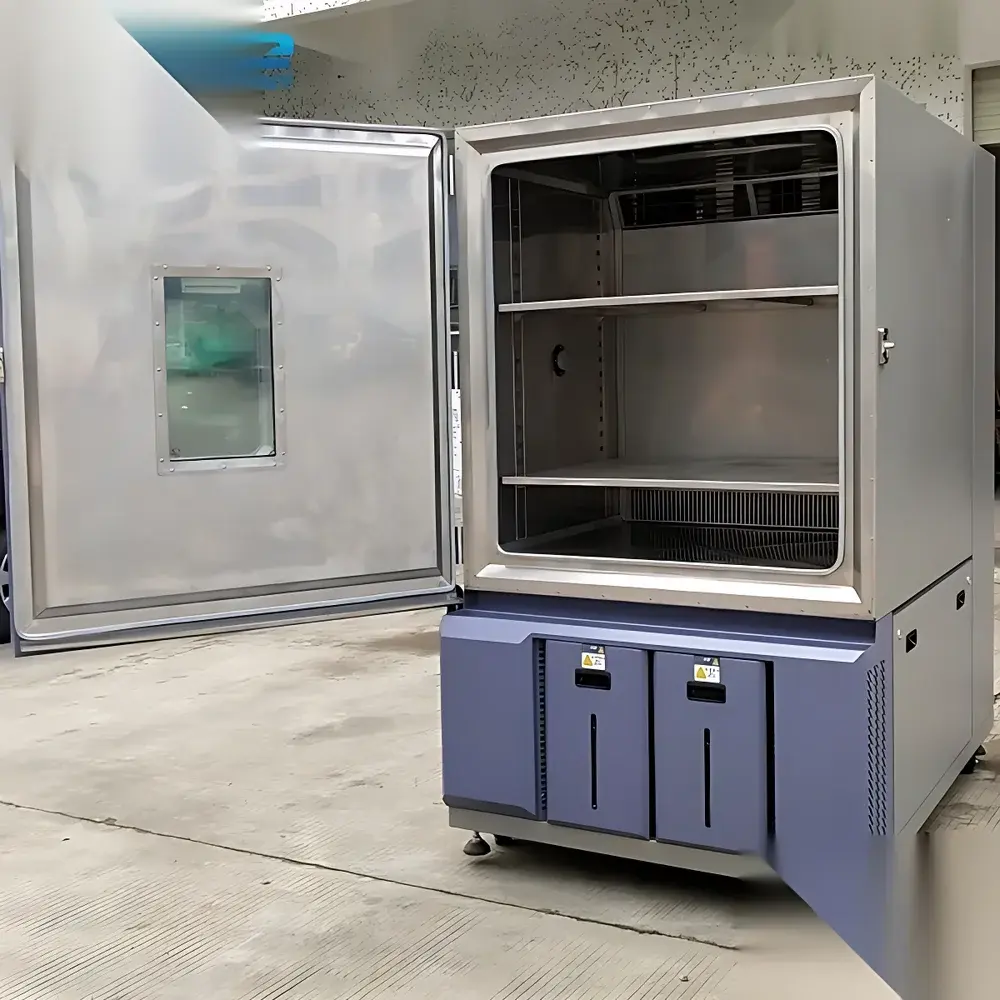
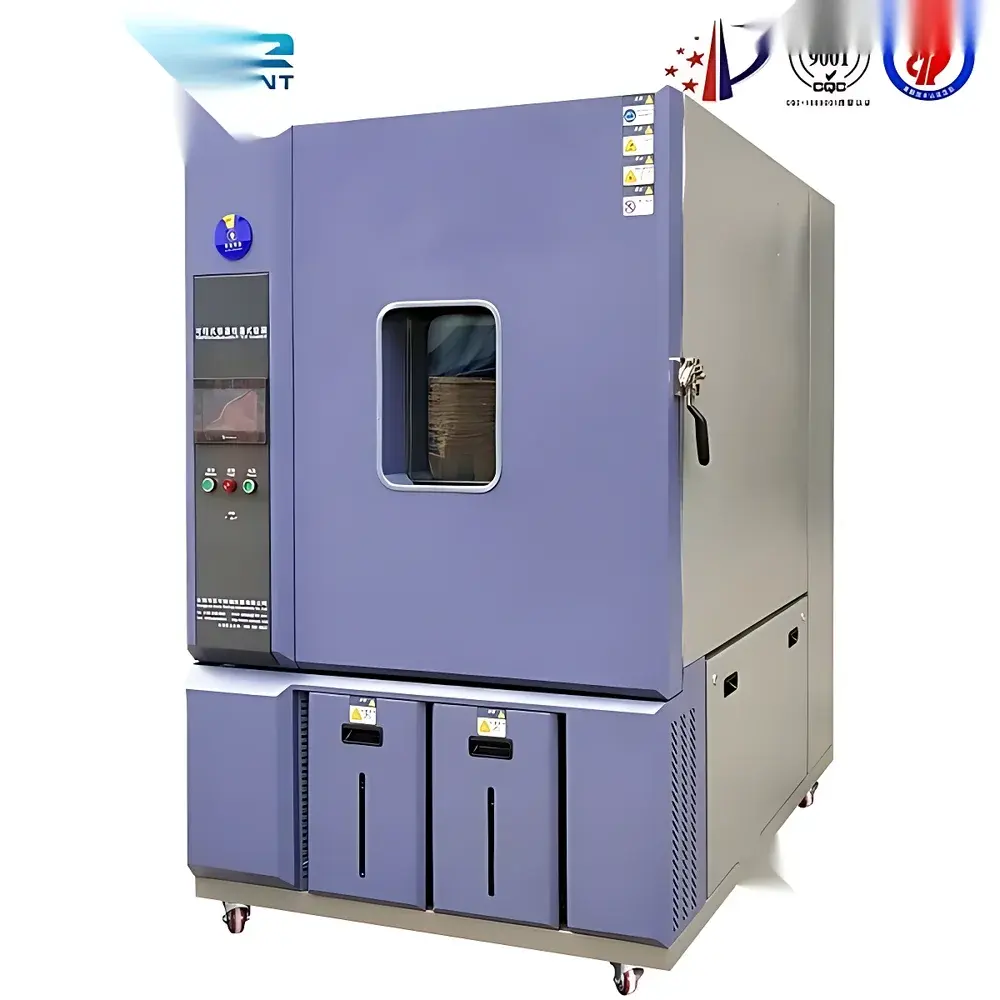
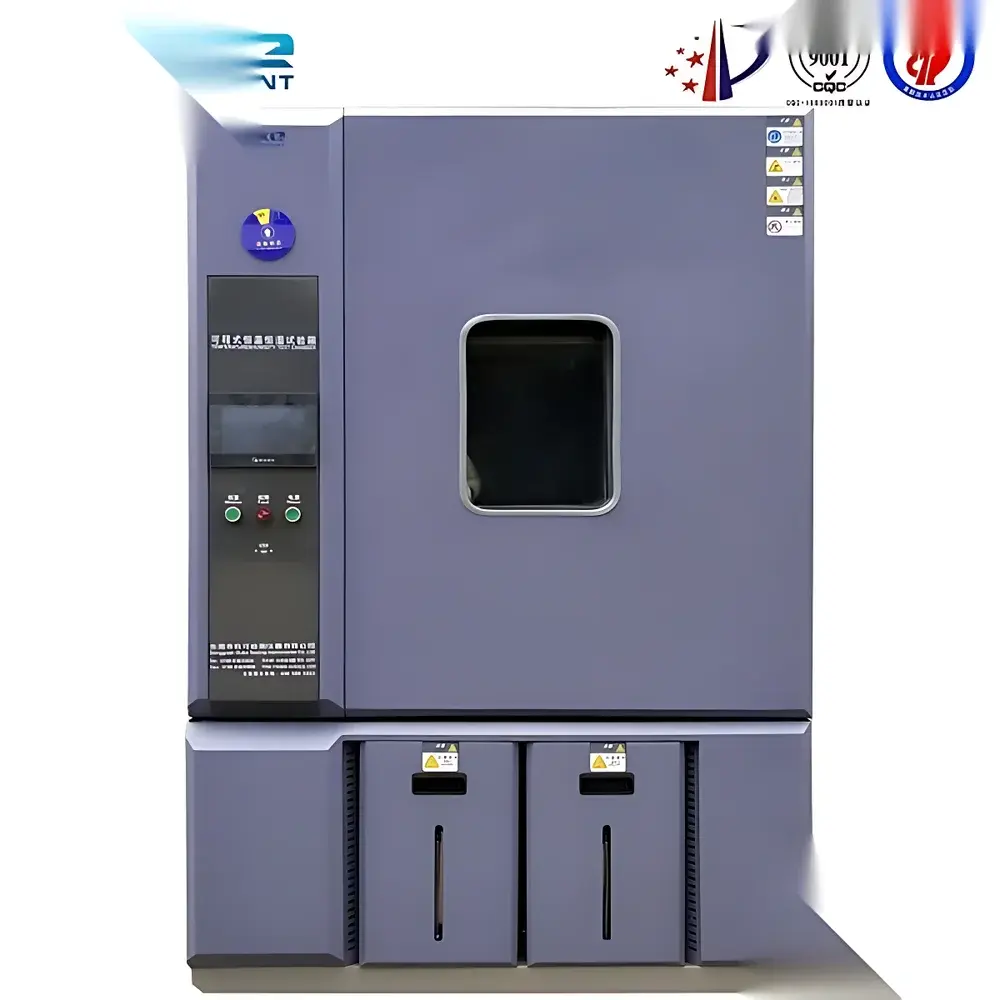
Custom-Built Compact Vertical Temperature & Humidity Controlled Chamber
| Brand | OEM / Custom Manufacturer |
|---|---|
| Origin | Imported |
| Manufacturer Type | Authorized Distributor |
| Model | Custom-Engineered (OK-TH Series) |
| Price | USD 2,650 (FOB) |
| Internal Dimensions (W×H×D) | 40×50×40 cm to 100×100×100 cm |
| Temperature Range | –70 °C to +150 °C (selectable sub-ranges A–D) |
| Humidity Range | 5–98 %RH (standard 20–98 %RH |
| Temp. Uniformity | ±0.5 °C |
| RH Uniformity | ±2.5 %RH |
| Temp. Stability | ±2 °C |
| RH Stability | +2 to +3 %RH |
| Resolution | 0.1 °C / 0.1 %RH |
| Ramp Rate | Heating ~4.0 °C/min |
| Refrigeration | Hermetic dual-stage compressor system with eco-friendly R404A/R23 refrigerant blend |
| Control System | Full-color LCD touchscreen controller with bilingual (English/Chinese) interface |
| Construction | Interior and exterior chambers fabricated from SUS#304 stainless steel |
| Viewing Window | Multi-layer laminated tempered glass with integrated conductive ITO film for anti-fogging and real-time observation |
| Port | One 50 mm diameter test port on left side (sealable, cable-ready) |
| Safety | Comprehensive fault detection — over-temperature, over-humidity, compressor overload, sensor failure — with automatic power cutoff and on-screen alarm logging |
| Compliance | Meets IEC 60068-2-1 (Cold), IEC 60068-2-2 (Dry Heat), IEC 60068-2-78 (Steady-State Damp Heat), IEC 60068-2-30 (Cyclic Damp Heat), GB/T 2423.1–2001, GB/T 2423.2–2001, GB/T 2423.4–1993, MIL-STD-810G Method 502.5 & 507.5, GJB 150.3–1986 & GJB 150.4–1986 |
Overview
The Custom-Built Compact Vertical Temperature & Humidity Controlled Chamber is an engineered environmental simulation platform designed for precise, repeatable exposure testing of electronic components, aerospace materials, automotive ECUs, polymer specimens, pharmaceutical packaging, and optoelectronic devices under tightly regulated thermal and hygrothermal conditions. Based on the principle of forced-air convection combined with dual-stage refrigeration and PID-controlled steam humidification, this chamber delivers high-fidelity replication of real-world climatic stress profiles—including steady-state and cyclic temperature/humidity regimes—within a space-optimized vertical footprint. Its modular architecture supports full customization of internal volume (from 80 L to 1000 L), temperature extremes (down to –70 °C), and humidity resolution (as low as 5 %RH), making it suitable for both R&D validation and compliance-driven qualification per international environmental test standards.
Key Features
- Full-color 7-inch capacitive touchscreen controller with intuitive navigation, real-time trend graphs, and seamless English/Chinese language switching—designed for multi-user lab environments with audit-ready operation logs.
- Dual-stage hermetic refrigeration system utilizing R404A/R23 blended refrigerant, compliant with current EU F-Gas Regulation (EU No 517/2014) and EPA SNAP requirements, ensuring low global warming potential (GWP) and long-term serviceability.
- SUS#304 stainless steel construction throughout interior and exterior chambers—resistant to corrosion, non-outgassing, and compatible with cleanroom-grade maintenance protocols.
- Multi-layer laminated observation window with embedded indium tin oxide (ITO) conductive film, enabling continuous visual monitoring without condensation or optical distortion—even during rapid humidity transitions.
- Single 50 mm diameter access port located on the left side, fitted with silicone gasket and stainless-steel flange—facilitating external signal routing, power feedthrough, or sensor integration while maintaining chamber integrity.
- Integrated safety architecture including independent high-limit temperature sensors, humidity sensor redundancy, compressor discharge pressure monitoring, and automatic mains disconnection upon fault detection—fully traceable via event timestamping in controller memory.
Sample Compatibility & Compliance
This chamber accommodates a broad spectrum of test specimens—from PCB assemblies and lithium-ion battery cells to coated metal substrates and sterile medical device packaging—without compromising environmental fidelity. Its uniformity performance (±0.5 °C / ±2.5 %RH) and stability metrics meet the stringent spatial and temporal tolerances required by MIL-STD-810G, IEC 60068-2 series, and GB/T 2423 national standards. The system supports GLP-compliant operation through configurable data retention policies, user-level access control (admin/operator/guest), and optional 21 CFR Part 11–compliant electronic signature modules for regulated industries. All firmware and calibration records are stored internally with SHA-256 hash verification to ensure data integrity across audit cycles.
Software & Data Management
Standard controller firmware includes USB export of test logs (CSV format), real-time RS485/Modbus RTU communication for SCADA integration, and programmable step-and-soak profiles with up to 99 segments per cycle. Optional PC-based software (Windows/Linux/macOS) enables remote supervision, multi-chamber synchronization, statistical process control (SPC) charting, and automated report generation compliant with ISO/IEC 17025 documentation requirements. All recorded parameters—including chamber setpoints, actual values, alarm history, and compressor runtime—are time-stamped with millisecond precision and retained for ≥12 months onboard.
Applications
- Qualification testing of automotive infotainment systems per ISO 16750-4 (Environmental Conditions and Testing for Electrical and Electronic Equipment).
- Accelerated aging studies of conformal coatings and encapsulants used in avionics hardware.
- Stability assessment of active pharmaceutical ingredients (APIs) and blister-packaged formulations under ICH Q1A(R2) recommended storage conditions.
- Validation of moisture barrier performance in flexible OLED display encapsulation layers.
- Thermal shock pre-conditioning prior to HALT/HASS screening of high-reliability microelectromechanical systems (MEMS).
- Material compatibility testing of adhesives, sealants, and elastomers exposed to tropical or arctic climatic profiles.
FAQ
Can the chamber be configured for ultra-low humidity (≤10 %RH)?
Yes—low-humidity variants utilize optional desiccant-assisted drying modules and enhanced chamber purge logic to achieve and maintain 5–10 %RH with ±1.5 %RH stability.
Is third-party calibration certification included?
Factory calibration is performed using NIST-traceable reference instruments; ISO/IEC 17025-accredited calibration certificates are available as a value-added service.
What electrical infrastructure is required for the –70 °C configuration?
The –70 °C model requires dedicated 3-phase 380 VAC ±5 %, 50 Hz ±0.5 Hz supply with minimum 32 A circuit protection and proper grounding per IEC 61000-6-2 EMC immunity requirements.
How is temperature/humidity uniformity validated?
Uniformity mapping is conducted per IEC 60068-3-5 using nine calibrated PT100 sensors placed at standardized locations (center + six face centers + two corners); results are documented in the Factory Acceptance Test (FAT) report.
Can the controller support custom alarm escalation (e.g., email/SMS alerts)?
Yes—the optional Ethernet module enables SMTP-based notification triggers, SNMP trap forwarding, and integration with enterprise IT alerting platforms via RESTful API endpoints.
Related Products



