
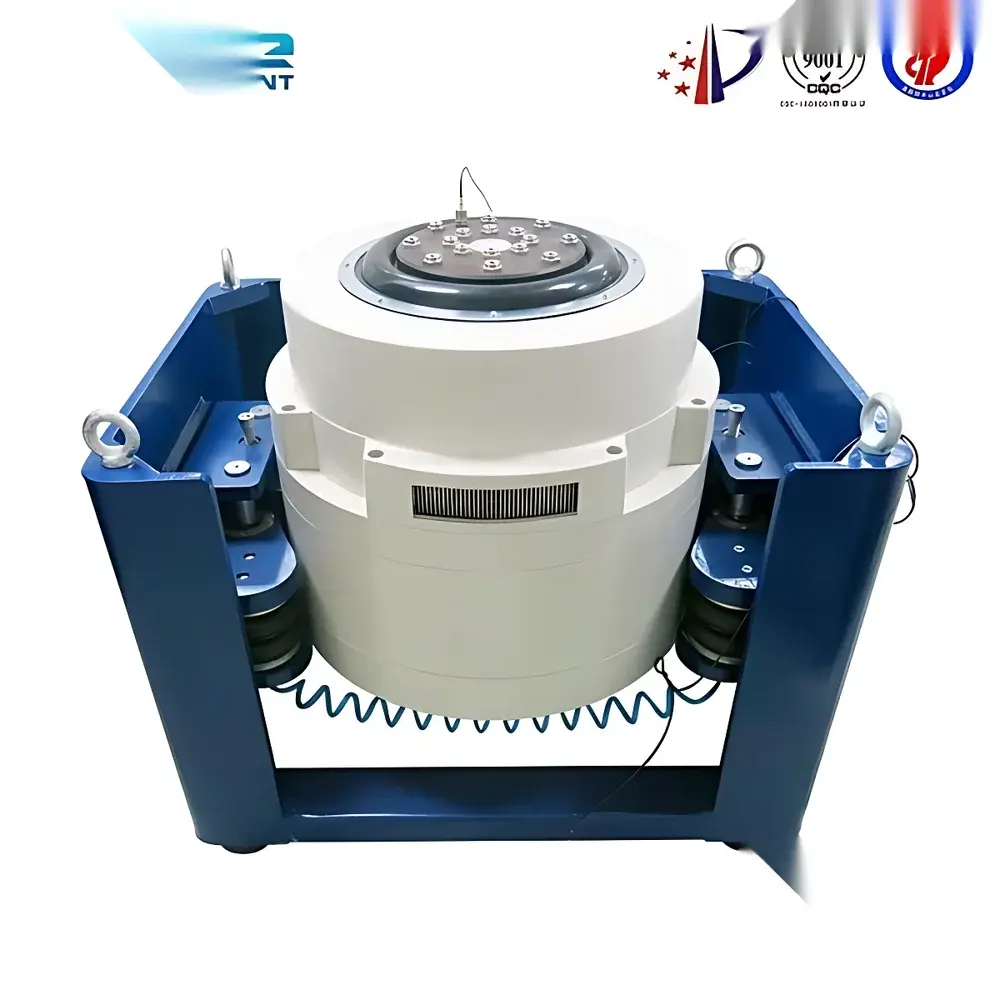
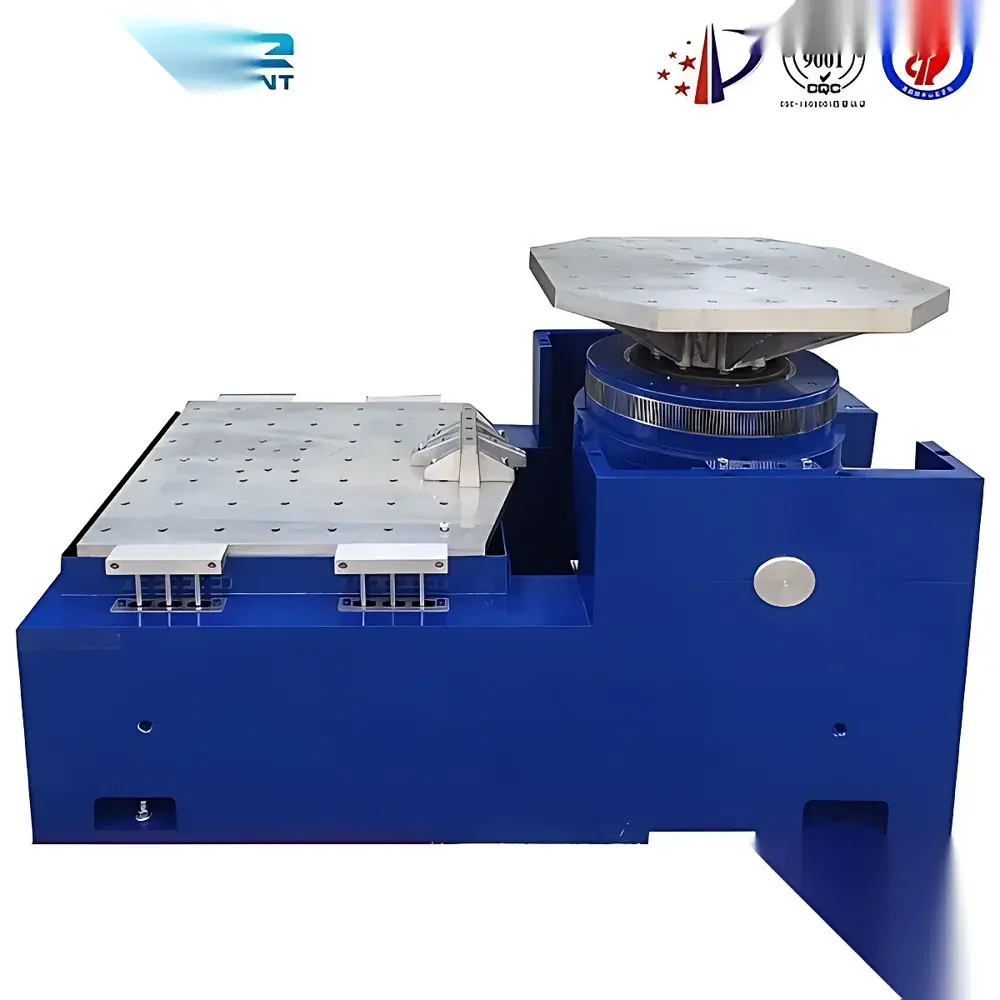
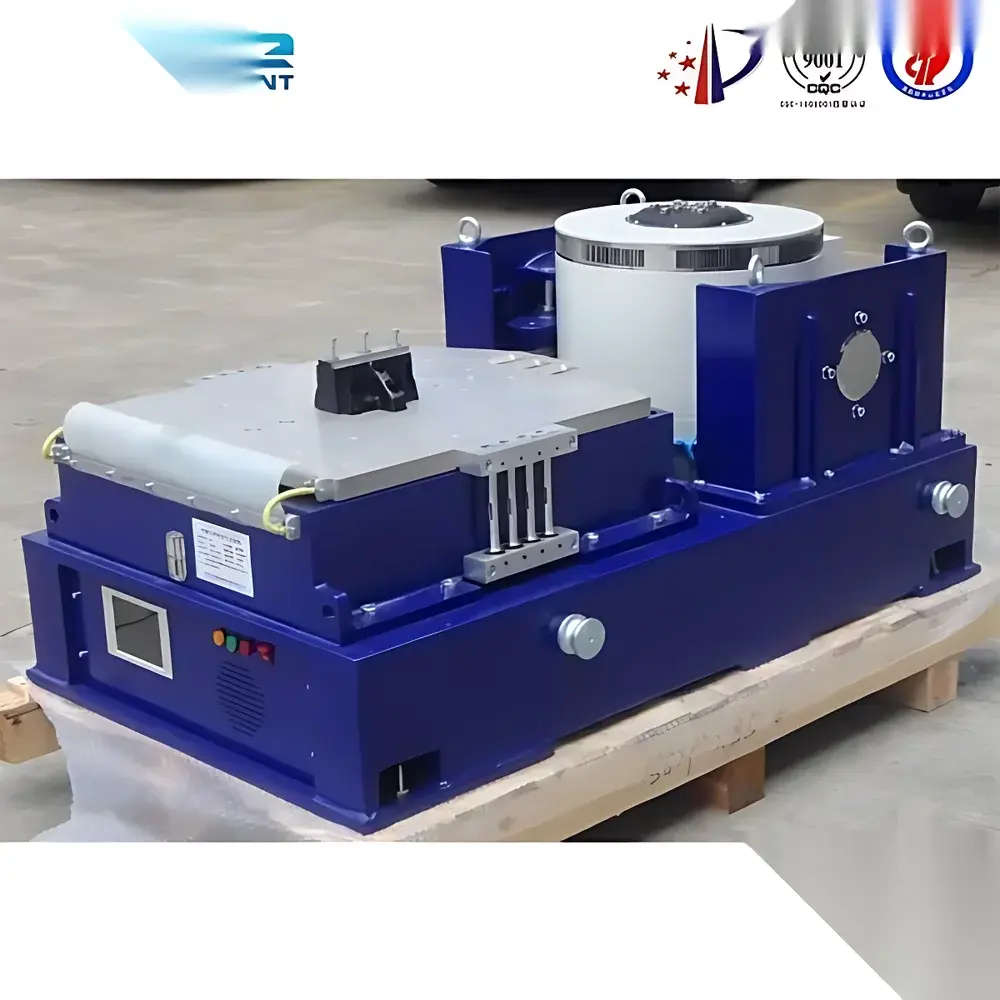
Custom-Built Large-Displacement Low-Frequency Vibration System
| Brand | OEM / Third-Party Manufacturer |
|---|---|
| Origin | Imported |
| Supplier Type | Authorized Distributor |
| Power Supply | AC 220 V, Single-Phase, 15 A |
| Platform Dimensions | 1000 mm × 1000 mm |
| Overall Dimensions | 1100 mm × 1200 mm × 650 mm |
| Weight | ~350 kg |
| Drive Mechanism | Motor-Cam Actuation |
| Maximum Displacement | ±25.4 mm (±1 inch) |
| Frequency Range | 2.00–5.00 Hz |
| Rotational Speed Range | 120–300 rpm |
| Continuous Operation Duration | 80 minutes per cycle |
| Cycles per Cycle | 14,500 |
| Operating Temperature | 23 °C ± 5 °C |
| Relative Humidity Limit | <80% RH (non-condensing) |
| Surface Finish | Anodized Aluminum-Magnesium Alloy |
| Mounting Thread Protection | Stainless Steel / Alloy Insert Sleeves |
| Noise Level | <74 dB(A) at 5 Hz |
| Platform Material | 19 mm (3/4") Structural Plate |
Overview
The Custom-Built Large-Displacement Low-Frequency Vibration System is an engineered electro-mechanical shaker platform designed for controlled, high-fidelity simulation of low-frequency mechanical excitations—particularly those encountered in transportation vibration testing, packaging integrity validation, and structural fatigue assessment under quasi-static to sub-resonant dynamic conditions. Unlike high-frequency electromagnetic shakers, this system employs a precision motor-cam actuation architecture to generate repeatable, sinusoidal or stepwise harmonic motion with large stroke amplitude (±25.4 mm) at frequencies between 2.00 and 5.00 Hz. Its rigid aluminum-magnesium alloy platform—die-cast and anodized for corrosion resistance and dimensional stability—ensures minimal phase lag and high spectral fidelity across the operational bandwidth. The system meets foundational mechanical test requirements aligned with ISO 2247, ASTM D999, and ISTA 3A for packaged-product vibration testing, and is routinely deployed in laboratories performing GLP-compliant durability verification for automotive components, industrial electronics, and heavy-duty logistics systems.
Key Features
- Structural platform fabricated from high-strength aluminum-magnesium die-cast alloy, optimized for stiffness-to-weight ratio and long-term dimensional retention.
- Anodized surface treatment providing enhanced wear resistance, electrical insulation, and extended service life under repeated loading cycles.
- Stainless steel and alloy-threaded insert sleeves integrated into all mounting holes to prevent thread galling, stripping, or fatigue-induced failure during high-torque fixture installation.
- Motor-cam drive mechanism delivering smooth, low-jerk displacement profiles with inherent mechanical damping—eliminating the need for external servo control while maintaining repeatability within ±0.5% amplitude deviation over 14,500 cycles.
- Acoustically engineered enclosure and vibration-isolated base yielding <74 dB(A) noise emission at 1 m distance during full-load operation at 5 Hz.
- Modular design supports platform dimension customization (standard: 1000 mm × 1000 mm), enabling integration into existing test cell infrastructure or bespoke environmental chamber configurations.
Sample Compatibility & Compliance
This vibration system accommodates test specimens up to 150 kg (static load) on its 19 mm-thick structural plate, with configurable fixture-mounting patterns compatible with standard ISO 2247 pallet adapters and ISTA-certified load restraints. It operates within ambient conditions compliant with ISO 17025 laboratory environmental monitoring guidelines (23 °C ± 5 °C, RH <80% non-condensing). While not inherently certified to IEC 61000-4-2 or MIL-STD-810H, the system’s mechanical output profile is traceable to NIST-traceable accelerometers and calibrated laser Doppler vibrometers. Documentation packages include calibration certificates, mechanical performance reports, and compliance matrices supporting internal audit readiness for ISO 9001:2015 and IATF 16949 quality management systems.
Software & Data Management
The embedded control interface enables programmable test sequencing without external PC dependency. Users may define test duration (up to 80 minutes continuous), motion axis configuration (single-axis vertical, single-axis lateral, dual-axis synchronous, or sequential uniaxial rotation), and dwell intervals between directional transitions. All parameter settings are stored in non-volatile memory with timestamped execution logs. Optional RS-232 or Ethernet connectivity allows integration with LabVIEW™, MATLAB® Data Acquisition Toolkits, or enterprise LIMS platforms for automated report generation—including CSV export of runtime metadata (cycle count, elapsed time, thermal drift status, and motor current draw). Audit trails comply with FDA 21 CFR Part 11 requirements when paired with validated user authentication modules.
Applications
- Transportation simulation: Replicating road, rail, and maritime vibration spectra for packaged goods per ISTA 3A, ASTM D4169, and ISO 13355.
- Structural endurance testing of chassis-mounted electronics, battery enclosures, and HVAC duct assemblies under low-frequency resonance exposure.
- Material fatigue evaluation of elastomeric mounts, composite laminates, and adhesive bonds subjected to cyclic shear and bending loads.
- Calibration reference platform for accelerometers, force transducers, and piezoelectric sensors operating below 10 Hz.
- Education and R&D labs requiring physically transparent, mechanically robust vibration sources for modal analysis and damping coefficient measurement.
FAQ
What is the maximum payload capacity for sustained operation?
The platform supports static loads up to 150 kg; dynamic load limits depend on center-of-gravity height and fixture rigidity—consult engineering documentation for moment-arm derating curves.
Can the system operate continuously beyond 80 minutes?
No—thermal protection logic enforces an 80-minute duty cycle followed by a mandatory cooldown period to preserve cam train longevity and motor winding insulation class.
Is third-party calibration available?
Yes—accredited metrology providers offer annual displacement amplitude and frequency traceability services per ISO/IEC 17025, with certificate issuance including uncertainty budgets.
Does the system support real-time data acquisition?
Native logging captures start/stop timestamps and mode selection; analog voltage outputs (±10 V) for acceleration and displacement feedback are available via optional signal conditioning module.
Are custom platform dimensions supported beyond 1000 × 1000 mm?
Yes—custom die-casting and structural reinforcement engineering is offered for platforms up to 1500 × 1500 mm, subject to lead-time and mechanical resonance modeling review.



