
Custom-Built Large-Scale Temperature and Humidity Controlled Environmental Test Chamber
| Brand | OEM / Private Label |
|---|---|
| Origin | Imported |
| Manufacturer Type | Authorized Distributor |
| Price | USD 2,650 (FOB) |
| Internal Dimensions (W×H×D) | 40×50×40 cm to 100×100×100 cm |
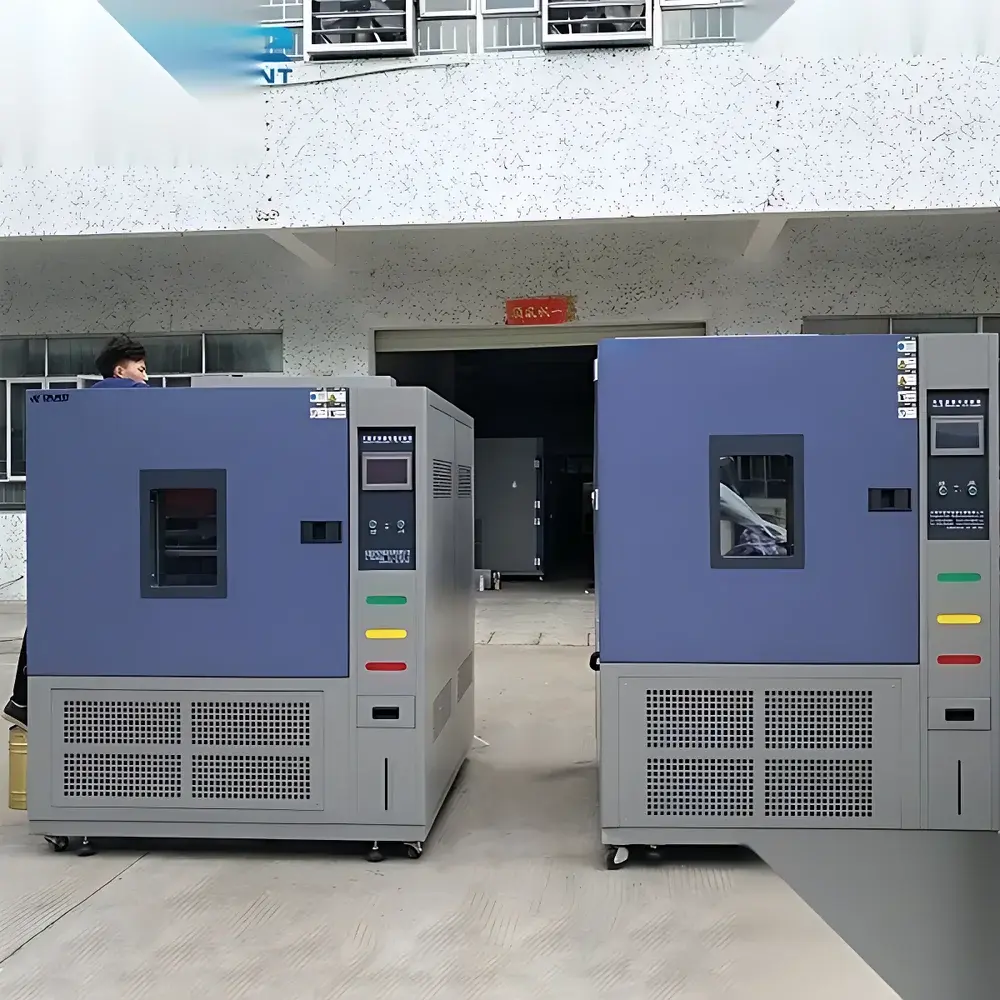
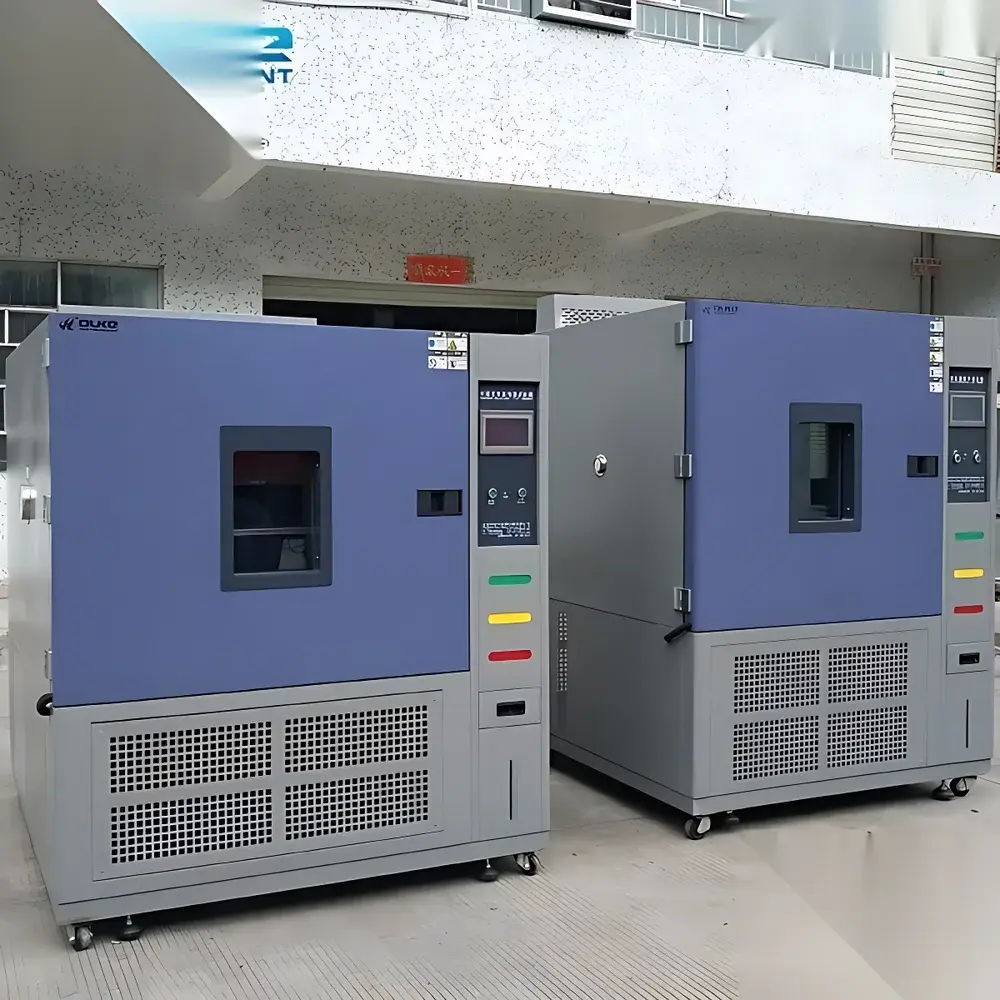
| External Dimensions (W×H×D) | 100×165×100 cm to 180×200×180 cm |
| Temperature Range | -70 °C to +150 °C (configurable in four standard tiers) |
| Humidity Range | 20–98 %RH (optional extension to 5–98 %RH) |
| Temperature Uniformity | ±0.5 °C |
| Humidity Uniformity | ±2.5 %RH |
| Temperature Fluctuation | ±2 °C |
| Humidity Fluctuation | +2–3 %RH |
| Resolution | 0.1 °C / 0.1 %RH |
| Ramp Rate | Heating ≈4.0 °C/min |
| Refrigeration System | Hermetic dual-stage compressor with eco-friendly R404A/R23 refrigerant blend |
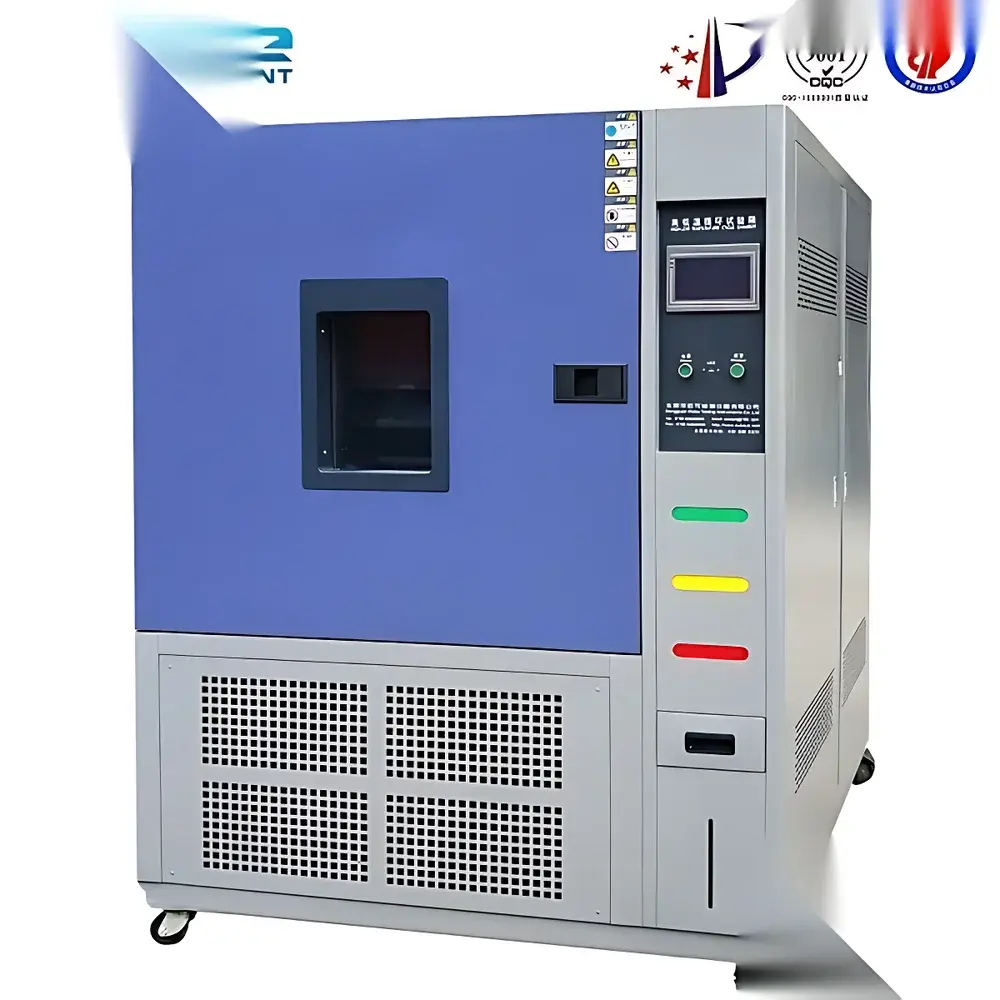
| Control Interface | Full-color LCD touchscreen controller with bilingual (English/Chinese) UI |
| Construction Material | Interior & exterior panels — AISI 304 stainless steel |
| Viewing Window | Multi-layer laminated tempered glass with conductive ITO film for anti-fog observation |
| Test Port | One Ø50 mm pass-through port (left side) |
| Standard Accessories | Two-tier 304 stainless steel shelves, four swivel casters with leveling feet, 2.5 m power cord (3-phase 5-wire, AC 380 V ±5 %, 50 Hz ±0.5 Hz) |
Overview
The Custom-Built Large-Scale Temperature and Humidity Controlled Environmental Test Chamber is an engineered solution for accelerated environmental stress testing of industrial components, electronic assemblies, aerospace subsystems, automotive modules, and advanced materials. Designed in strict accordance with the physical principles of thermodynamic equilibrium and psychrometric control, the chamber maintains precise, repeatable conditions across wide operational envelopes—enabling evaluation of product reliability under defined thermal and hygrothermal cycling per internationally recognized test standards. Its robust architecture supports both steady-state conditioning and dynamic profile execution—including ramp-hold-soak sequences—making it suitable for qualification, validation, and failure analysis workflows in R&D laboratories, quality assurance departments, and certified compliance testing facilities.
Key Features
- Full-color, programmable touchscreen controller with intuitive bilingual interface (English/Chinese), supporting multi-segment profiles, real-time data logging, and user-level access control.
- AISI 304 stainless steel construction throughout interior and exterior chambers ensures corrosion resistance, long-term dimensional stability, and compliance with cleanroom-compatible surface requirements.
- Multi-layer insulated observation window with integrated indium tin oxide (ITO) conductive film prevents condensation and enables unobstructed visual monitoring during high-humidity operation.
- Dual-stage hermetic refrigeration system utilizing R404A/R23 blended refrigerant delivers stable low-temperature performance down to −70 °C while meeting current EU F-Gas Regulation (EU No 517/2014) and EPA SNAP program requirements.
- Double-gasketed door seal with high-tensile silicone elastomer gaskets guarantees leak-tight integrity, minimizing humidity drift and energy loss during extended test cycles.
- Standard Ø50 mm test port (left-side mounted) facilitates external instrumentation integration—e.g., thermocouple feedthroughs, signal cables, or power leads—without compromising chamber sealing or thermal uniformity.
Sample Compatibility & Compliance
The chamber accommodates diverse sample geometries—from printed circuit board assemblies and battery packs to full-size automotive ECUs and coated metal panels—via customizable internal dimensions (40 L to 1000 L volume range). Its validated thermal and humidity uniformity (±0.5 °C / ±2.5 %RH) meets the spatial homogeneity criteria specified in ISO 16750-4 (road vehicles), IEC 60068-3-5 (environmental testing guidance), and MIL-STD-810H Method 502.7 (temperature shock). It is routinely deployed in GLP-compliant labs for testing per ASTM D4332 (conditioning of plastics), GB/T 2423.1–2022 (cold), GB/T 2423.2–2022 (dry heat), GB/T 2423.4–2022 (cyclic damp heat), and GJB 150.3A–2009 / GJB 150.4A–2009 (military environmental test methods). Optional audit-trail-enabled firmware supports FDA 21 CFR Part 11 compliance for regulated pharmaceutical and medical device applications.
Software & Data Management
The embedded controller records time-stamped temperature and humidity values at user-defined intervals (1 s to 60 min), storing up to 10,000 data points locally. Export options include CSV via USB flash drive or RS485/Modbus RTU for integration into SCADA or MES platforms. Optional PC-based software provides graphical trend analysis, alarm history review, deviation reporting, and PDF certificate generation—including test parameters, operator ID, and timestamped chamber status logs. All configuration changes are automatically logged with user attribution and timestamp, satisfying traceability requirements under ISO/IEC 17025:2017 Clause 7.7.
Applications
- Accelerated aging of polymer-based enclosures and conformal coatings under combined thermal-hygric stress.
- Functional verification of automotive sensors and ADAS modules across extreme ambient conditions (−40 °C to +85 °C, 95 %RH).
- Pre-conditioning of lithium-ion battery cells prior to electrical performance characterization per UN 38.3 Section 4.1.
- Stability assessment of optical lenses and precision mechanical assemblies subject to dew-point-induced micro-condensation.
- Validation of packaging integrity for sterile medical devices exposed to tropical storage environments (40 °C / 93 %RH per ISO 11607-1 Annex B).
FAQ
What temperature and humidity ranges are standard, and how are extended ranges implemented?
Standard configurations cover −20 °C to +150 °C and 20–98 %RH. Extended low-temperature capability (down to −70 °C) requires dual-stage refrigeration with R23 cascade stage; extended humidity range (5–98 %RH) adds a dedicated steam humidifier and chilled mirror dew-point sensor.
Can the chamber be integrated into an existing facility’s building management system (BMS)?
Yes—RS485 Modbus RTU output enables bidirectional communication with BMS platforms for remote monitoring, alarm forwarding, and centralized energy usage tracking.
Is calibration documentation provided with shipment?
Each unit ships with a factory calibration report traceable to NIST standards, covering temperature (−70 °C to +150 °C) and humidity (20–98 %RH) at three spatial locations using accredited reference probes.
What safety interlocks are included?
Hardware-based over-temperature cutoff, refrigerant pressure high/low alarms, door-open detection, and emergency power-off (EPO) circuit—all independently wired and monitored by the controller’s fail-safe watchdog timer.
Are custom internal configurations available beyond standard shelf layouts?
Yes—custom mounting rails, vibration-isolated platforms, airflow baffles, and non-reflective interior finishes can be engineered per client mechanical drawings and functional specifications.



