
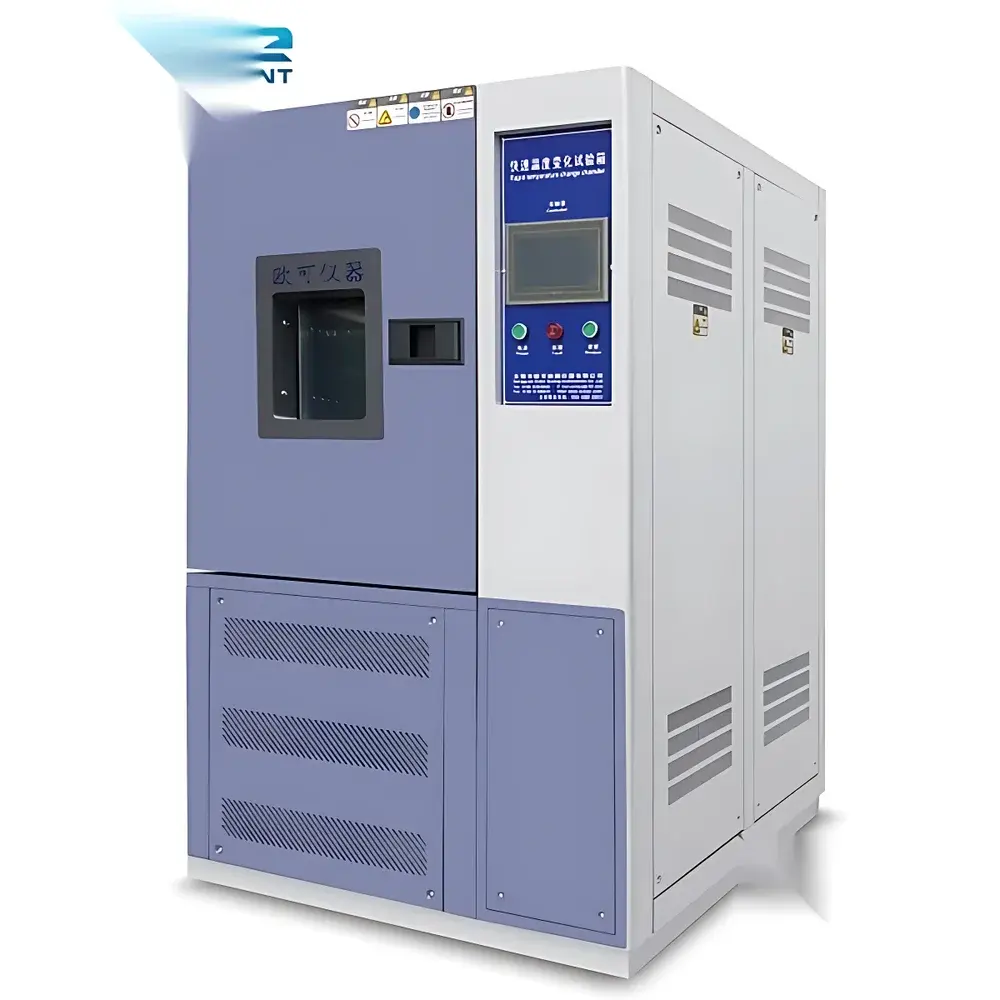
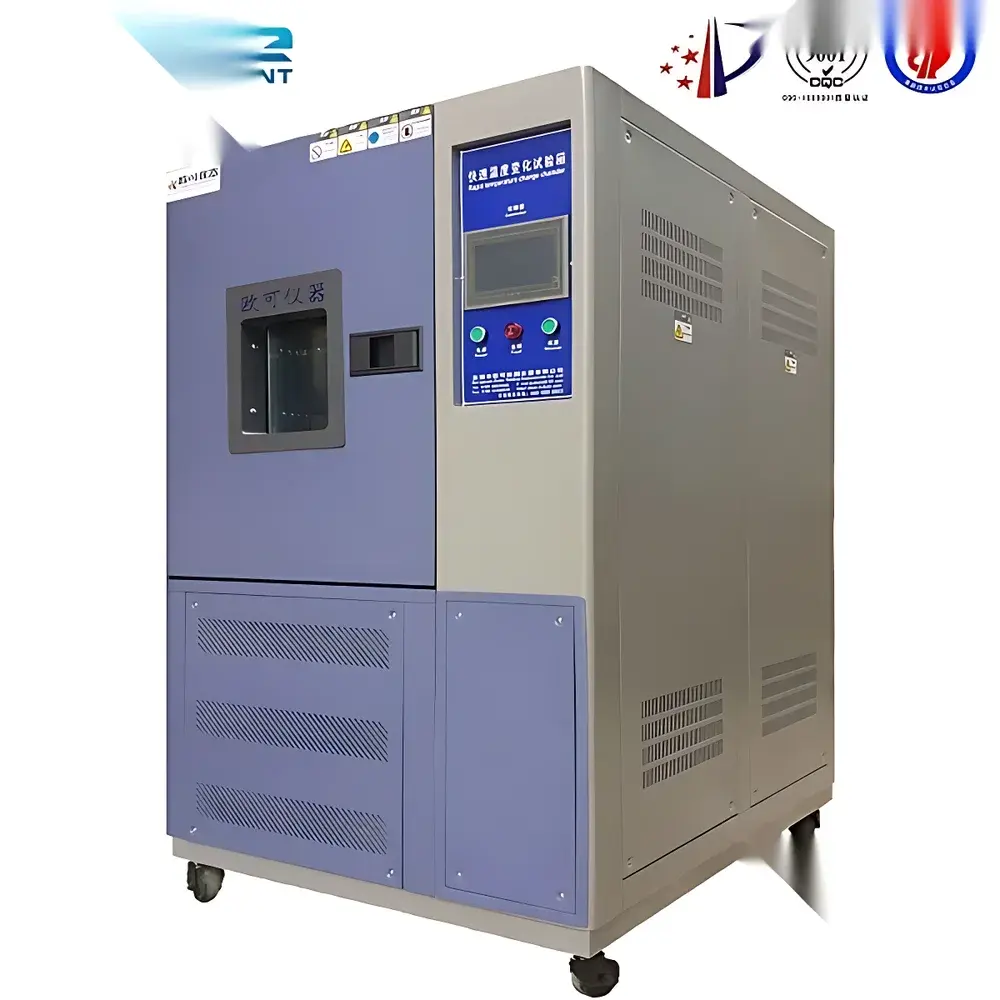
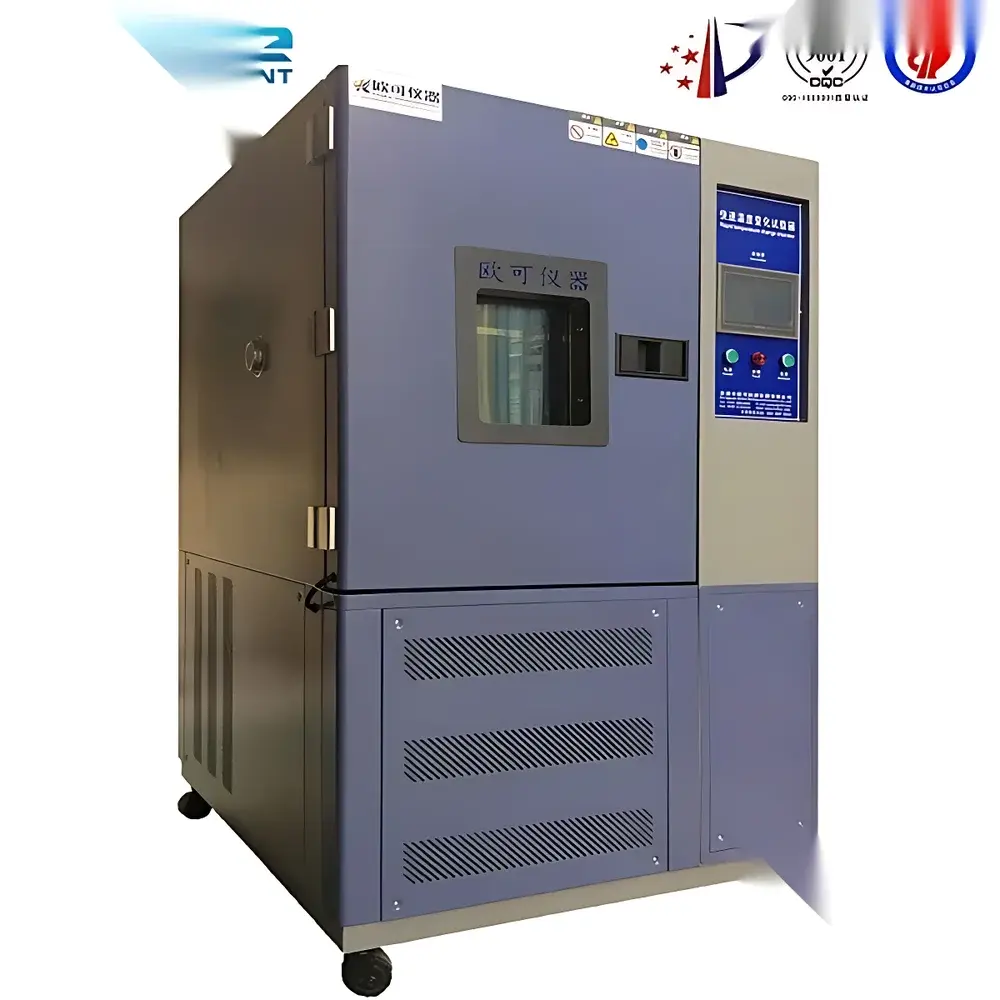
Custom-Built Rapid Temperature Change Test Chamber – OEM/ODM Manufacturer
| Key | Controller: Siemens PLC + color LCD touch panel |
|---|---|
| Temp. setpoint accuracy | ±0.1 °C |
| Temp. indication accuracy | ±0.1 °C |
| Sensor | PT100 Ω platinum RTD |
| Heating | independent Ni-Cr alloy resistive heaters |
| Refrigeration | French Tecumseh hermetic air-cooled single-stage or cascade compressor system |
| Air circulation | low-noise HVAC-grade motor with multi-blade centrifugal impeller |
| Internal dimensions | 600 × 500 × 500 mm (W×H×D) |
| External dimensions | 1500 × 2100 × 2250 mm (W×H×D) |
| Construction | SUS304 stainless steel interior & exterior |
| Insulation | high-density glass wool + rigid polyurethane foam |
| Door | single pneumatic-assisted access door |
| Accessories | cryo/heat-resistant silicone packing (−200 °C to +400 °C), dual-zone auto-switching mechanism, two adjustable stainless steel test trays |
| Compliance | Designed per IEC 60068-3-5, ASTM D3418, and ISO 16750-4 environmental stress testing protocols |
Overview
The Custom-Built Rapid Temperature Change Test Chamber is an engineered environmental stress screening (ESS) platform designed for precise, repeatable, and accelerated thermal cycling of electronic components, automotive modules, aerospace subsystems, and high-reliability materials. Unlike standard thermal chambers, this system implements either a two-chamber or single-chamber architecture—both configured to achieve rapid transition between extreme temperature extremes (typically −70 °C to +180 °C, configurable per application). The two-chamber variant utilizes pneumatically actuated isolation doors to shuttle test specimens between independently conditioned hot and cold zones, enabling sub-15-second transfer times and temperature recovery within ≤3 minutes (per IEC 60068-3-5 Annex B). The one-chamber configuration maintains specimen static positioning while modulating airflow via motorized dampers and dual evaporator/heater banks—ideal for in-situ monitoring, HALT/HASS integration, or vibration-coupled thermal profiling.
Key Features
- Siemens S7-series PLC-based control architecture with intuitive 10.4″ color TFT touchscreen HMI, supporting multi-segment ramp-soak profiles, real-time trend logging, and password-protected parameter management.
- High-fidelity thermal regulation: ±0.1 °C setpoint and indication accuracy maintained across full operating range, verified by traceable PT100 Class A sensors calibrated per ISO/IEC 17025 requirements.
- Dual-path thermal management: Independent heating (Ni-Cr alloy sheathed elements) and refrigeration (Tecumseh hermetic compressors with cascade option for sub-zero operation) ensure decoupled control authority and minimized thermal inertia.
- Structural integrity: Seamless SUS304 stainless steel chamber walls (interior and exterior), reinforced corner joints, and vacuum-formed insulation comprising ≥120 mm thick composite layer (glass wool + closed-cell PU foam) deliver exceptional thermal retention and condensation resistance.
- Pneumatic interface suite: Includes high-cycle-life solenoid valves, position feedback sensors, and fail-safe interlocks compliant with ISO 13857 safety distances—ensuring safe, repeatable chamber zone switching under automated test sequences.
Sample Compatibility & Compliance
This chamber accommodates test specimens up to 600 mm wide × 500 mm high × 500 mm deep, with load capacity optimized for PCB assemblies, ECUs, battery packs, optical sensors, and polymer composites. Two adjustable 304 stainless steel trays (load-rated to 25 kg each) provide flexible mounting options. All gasketing employs fluorosilicone elastomer rated for −200 °C to +400 °C service, eliminating outgassing risks in vacuum-compatible or cleanroom environments. The system is architected to support compliance validation against IEC 60068-2-14 (change of temperature), MIL-STD-810H Method 503.5, and automotive-specific standards including ISO 16750-4 and GMW 3172. Optional data acquisition interfaces enable audit-ready traceability aligned with FDA 21 CFR Part 11 and GLP/GMP documentation workflows.
Software & Data Management
Embedded firmware supports CSV export of time-stamped temperature, pressure, and cycle status data at user-defined intervals (100 ms to 10 s resolution). Optional PC-based software (Windows 10/11 compatible) provides advanced profile scripting, statistical process control (SPC) charting, alarm escalation via SMTP/SNMP, and electronic signature-enabled report generation. All logged data includes immutable timestamps, operator ID, and system calibration certificate references—meeting ALCOA+ principles for data integrity in regulated industries.
Applications
- Accelerated life testing of solder joints, conformal coatings, and thermal interface materials (TIMs).
- Thermal shock qualification of avionics hardware per DO-160 Section 4.9.
- Pre-conditioning of lithium-ion battery cells prior to electrical performance characterization.
- Material coefficient of thermal expansion (CTE) mapping using digital image correlation (DIC) synchronized with chamber triggers.
- Reliability screening of MEMS devices, LED packages, and RF front-end modules subjected to repeated thermal excursions.
FAQ
What temperature ranges are achievable with the cascade refrigeration option?
Standard configuration supports −40 °C to +150 °C; cascade upgrade extends low-temperature capability to −70 °C with sustained stability.
Can the chamber be integrated into a factory MES or SCADA system?
Yes—Modbus TCP and OPC UA server interfaces are available as factory-installed options for seamless plant-level connectivity.
Is third-party calibration certification included with delivery?
A NIST-traceable as-delivered calibration report covering temperature uniformity, stability, and sensor linearity is provided; ISO/IEC 17025 accredited calibration is available upon request.
What maintenance intervals are recommended for the refrigeration system?
Compressor oil and filter replacement every 12 months or 4,000 operating hours—whichever occurs first—under normal usage conditions.
Are custom internal fixtures or mounting rails supported?
Yes; structural modifications, cable feedthroughs, optical viewports, and instrumentation ports can be incorporated during build-to-order manufacturing.



