
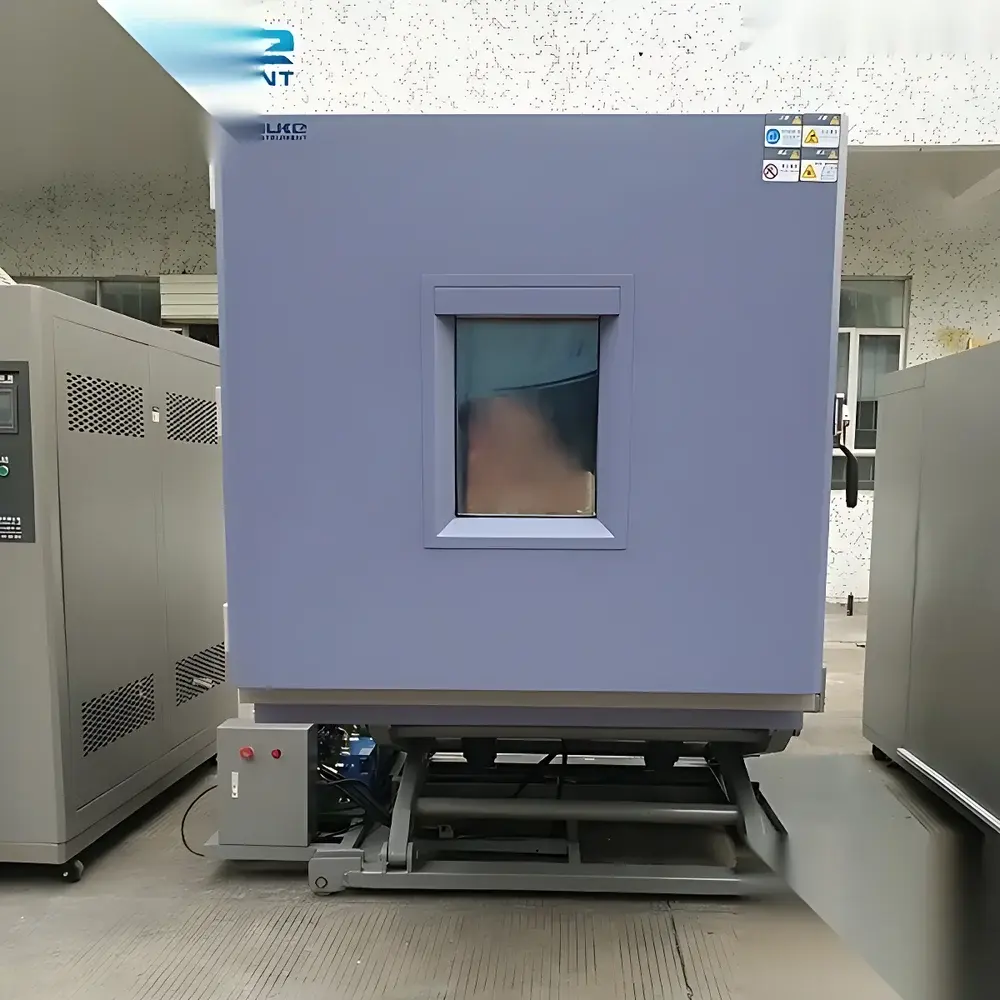
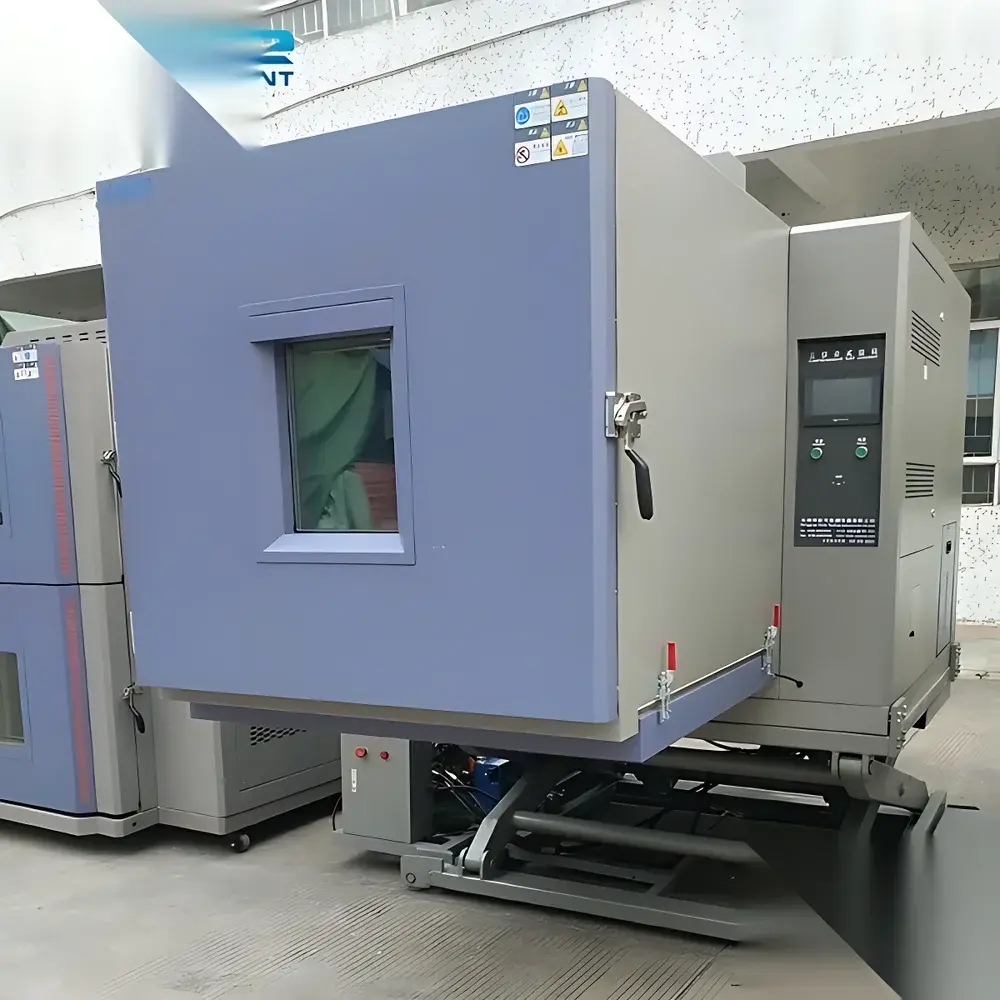
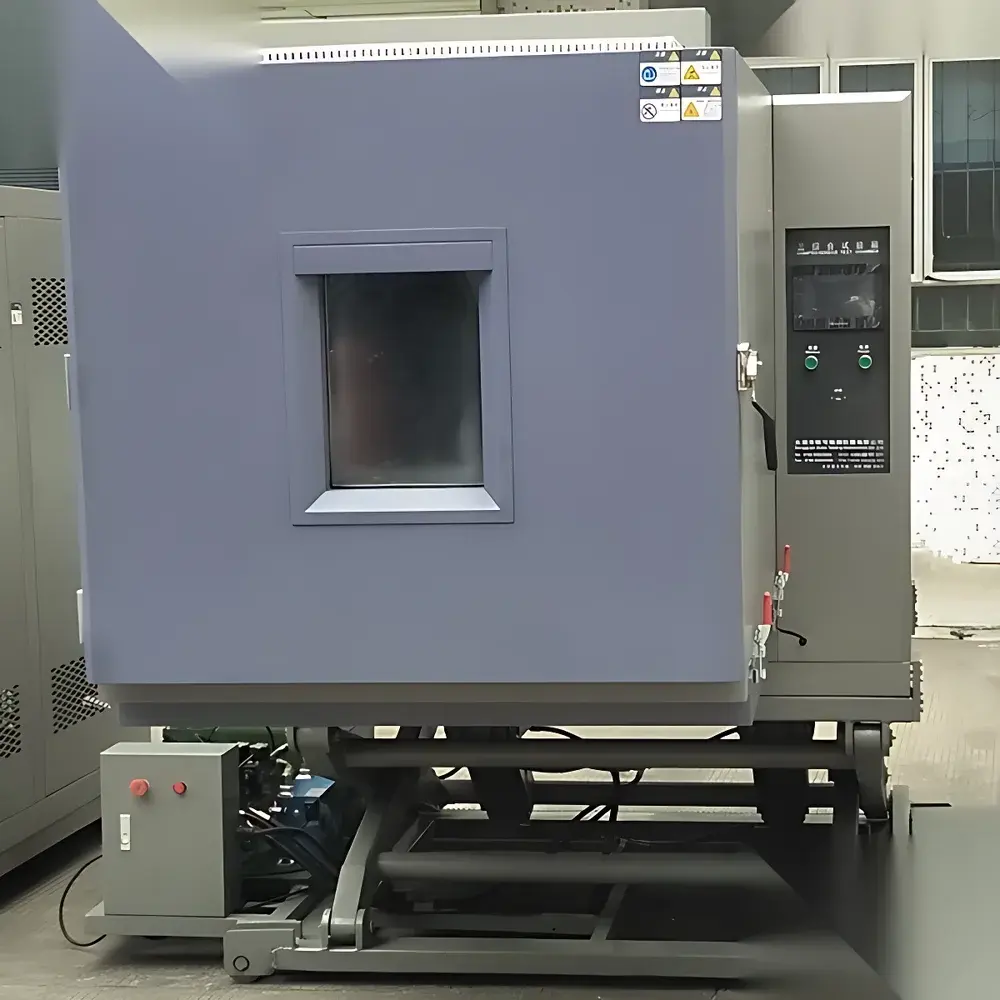
Custom Combined Temperature-Humidity-Vibration Test Chamber
| Brand | Custom OEM |
|---|---|
| Origin | Imported |
| Manufacturer Type | Authorized Distributor |
| Price | USD 21,500 (FOB) |
| Temperature Range | −70 °C to +150 °C |
| Humidity Range | 5–98% RH |
| Temp. Control Accuracy | ±0.5 °C |
| Humidity Control Accuracy | ±2.5% RH |
| Temp. Ramp Rate | +4.0 °C/min (heat), −1.0 °C/min (cool) |
| Humidity Resolution | 0.1% RH |
| Temp. Resolution | 0.1 °C |
| Vibration Interface | Integrated electrodynamic or servo-hydraulic shaker mounting with dynamic load transfer optimization |
| Controller | 7″ TFT LCD touchscreen, embedded real-time OS, programmable profiles (sine, random, swept-sine, resonance dwell), RS-232/RS-485, optional Ethernet & USB data export |
| Safety Systems | Dual-stage compressor high/low pressure cut-off, over-temperature/over-humidity protection, phase failure detection, water shortage alarm, redundant thermal fuses, fault logging with timestamped event history |
Overview
The Custom Combined Temperature-Humidity-Vibration Test Chamber is an integrated environmental stress screening (ESS) system engineered for simultaneous application of thermal, hygric, and mechanical stimuli under tightly controlled laboratory conditions. Based on the principle of accelerated life testing (ALT), it subjects electronic assemblies, automotive ECUs, aerospace components, and medical devices to synergistic stress profiles that replicate field-relevant degradation mechanisms—including solder joint fatigue, polymer creep, condensation-induced corrosion, and microcrack propagation at material interfaces. Unlike sequential single-stress chambers, this triaxial platform maintains strict metrological traceability across all three domains during concurrent operation, enabling correlation of failure modes under realistic multi-physics loading. The chamber architecture complies with fundamental design requirements outlined in MIL-STD-810H Method 514.7 (vibration), Method 502.7 (temperature), and Method 507.6 (humidity), while supporting test execution per IEC 60068-2 series standards.
Key Features
- Modular thermal section featuring dual-stage cascade refrigeration (R404A/R23) for stable operation down to −70 °C; single-stage configuration available for −20 °C applications
- Steam-based humidification system with PID-controlled stainless steel boiler and precision dew-point sensor feedback loop, delivering repeatable humidity control from 5% to 98% RH
- Structurally isolated vibration interface—compatible with standard electrodynamic shakers (up to 100 kN peak force) or hydraulic exciters—mounted via kinematically optimized flange with multi-layer elastomeric and epoxy-sealed gasketing to preserve chamber integrity under 10–2000 Hz excitation
- 7-inch industrial-grade resistive touchscreen controller running deterministic real-time firmware; supports up to 99 programmable test segments per profile, including step, ramp, dwell, and looping logic
- Double-door sealing system with dual-lip silicone gaskets and magnetic latch mechanism achieving ≤0.5 Pa·m³/s leak rate per ISO 10648-2 Class 3 specifications
- Internal workspace lined with electropolished SUS304 stainless steel (Ra ≤ 0.4 µm); external enclosure finished with powder-coated A3 steel for corrosion resistance and ESD-safe grounding
- Integrated 50 mm diameter feedthrough port (left-side, center-mounted) with removable brass plug and O-ring seal, rated for 1000 VAC insulation and 50 N axial load capacity
Sample Compatibility & Compliance
This chamber accommodates DUTs up to 600 mm × 600 mm × 600 mm (W×D×H) with maximum mass loading of 50 kg on the vibration table. Samples requiring electrical biasing, optical access, or real-time thermography may utilize the optional quartz observation window (200 mm × 200 mm, AR-coated, 3 mm thickness) or additional feedthroughs (up to four 12 mm diameter ports). All thermal and humidity sensors are NIST-traceable and calibrated annually per ISO/IEC 17025 requirements. The control system logs full parameter history with millisecond timestamp resolution and supports audit trails compliant with FDA 21 CFR Part 11 when paired with validated software packages (e.g., NI TestStand or Keysight PathWave). Mechanical vibration channels meet ISO 5347-18 calibration protocols for transducer sensitivity verification.
Software & Data Management
The embedded controller provides native support for profile import/export in CSV and XML formats compatible with MATLAB, Python (via PySerial), and LabVIEW. Optional PC-based software enables remote monitoring, automated report generation (PDF/Excel), and statistical process control (SPC) charting—including X-bar/R charts for temperature uniformity and Cp/Cpk analysis for humidity stability. Data archives are stored on internal 16 GB eMMC memory with automatic rollover and configurable backup intervals. All logged parameters—chamber setpoints, actual readings, alarm events, and shaker drive signals—are time-synchronized to UTC via NTP client functionality. Exported datasets include metadata headers compliant with ASTM E2911-22 for environmental test data exchange.
Applications
- Qualification testing of avionics modules per DO-160G Sections 22 (vibration), 24 (temperature), and 25 (humidity)
- Reliability assessment of battery management systems (BMS) under combined thermal cycling and mechanical shock
- Validation of hermetic seals in MEMS packaging using humidity soak followed by vibrational stress screening
- Accelerated aging of conformal coatings on PCBAs exposed to cyclic condensation and resonant excitation
- Development testing of autonomous vehicle sensors (LiDAR, radar) subjected to thermal gradients and road-induced vibrations
- Pre-compliance screening for IEC 60721-3-3 Class 3K5 and 3K6 environmental classifications
FAQ
What vibration standards can this chamber support?
It natively executes tests per ISO 10816-1 (machine vibration severity), ISO 22773 (hand-arm vibration), and MIL-STD-810H Methods 514.7 (classical vibration) and 527 (acoustic noise), provided the selected shaker meets required force/displacement envelopes.
Is remote diagnostics and firmware update capability included?
Yes—the controller supports secure SSH/Telnet access and Over-The-Air (OTA) firmware updates via encrypted HTTPS push, with rollback capability and versioned changelog storage.
Can the chamber be integrated into a larger HALT/HASS test system?
Absolutely. It features digital I/O expansion ports (8-channel opto-isolated inputs/outputs), Modbus TCP server mode, and API documentation for third-party orchestration platforms such as Q-SYS or NI VeriStand.
What maintenance schedule is recommended for long-term reliability?
Compressor oil analysis every 2000 operational hours, refrigerant purity verification annually, and humidity sensor recalibration every 6 months—documented in accordance with ISO 13374-2 for condition monitoring systems.



