
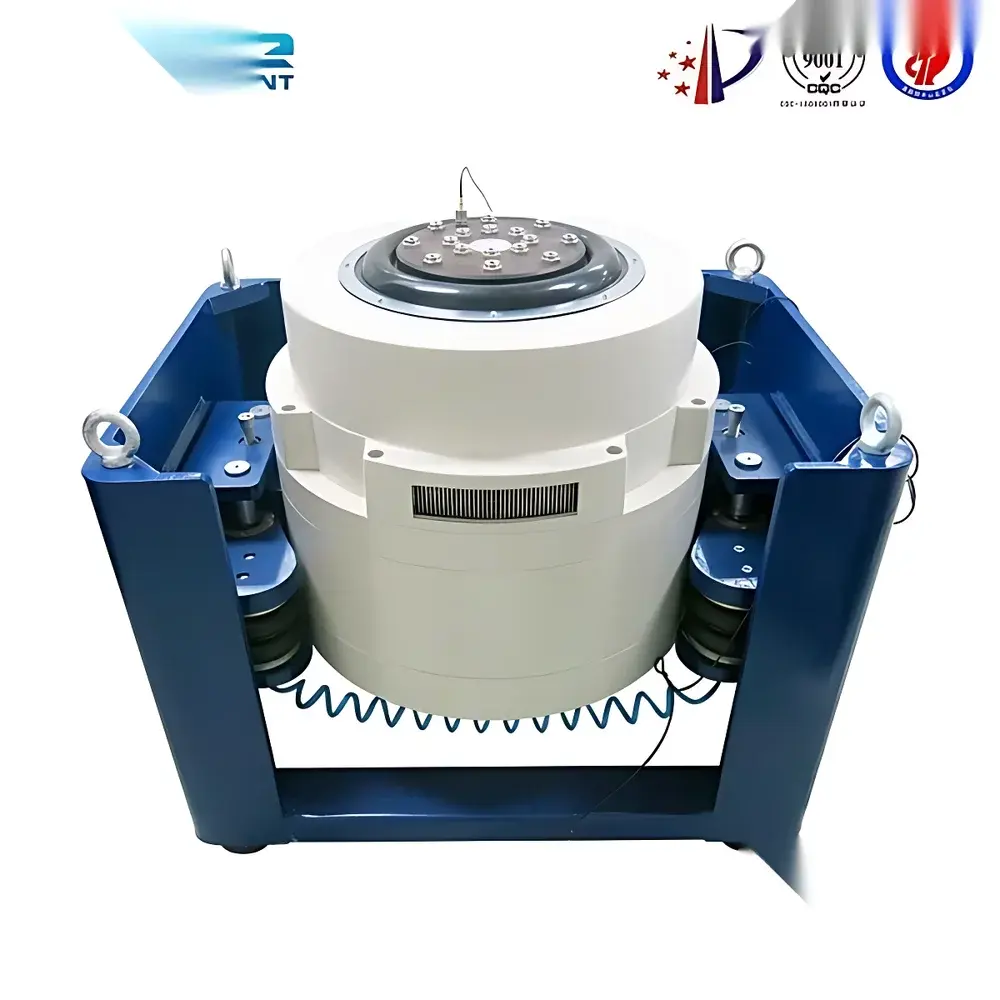
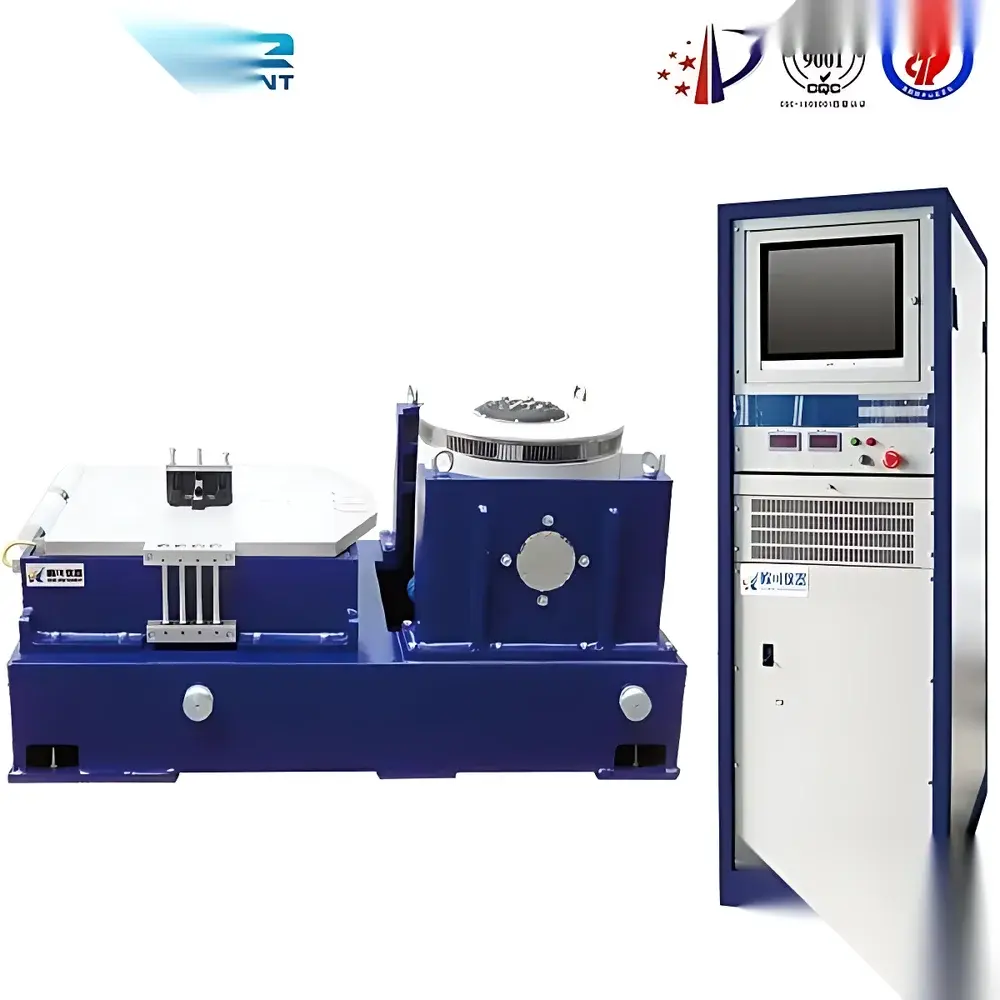
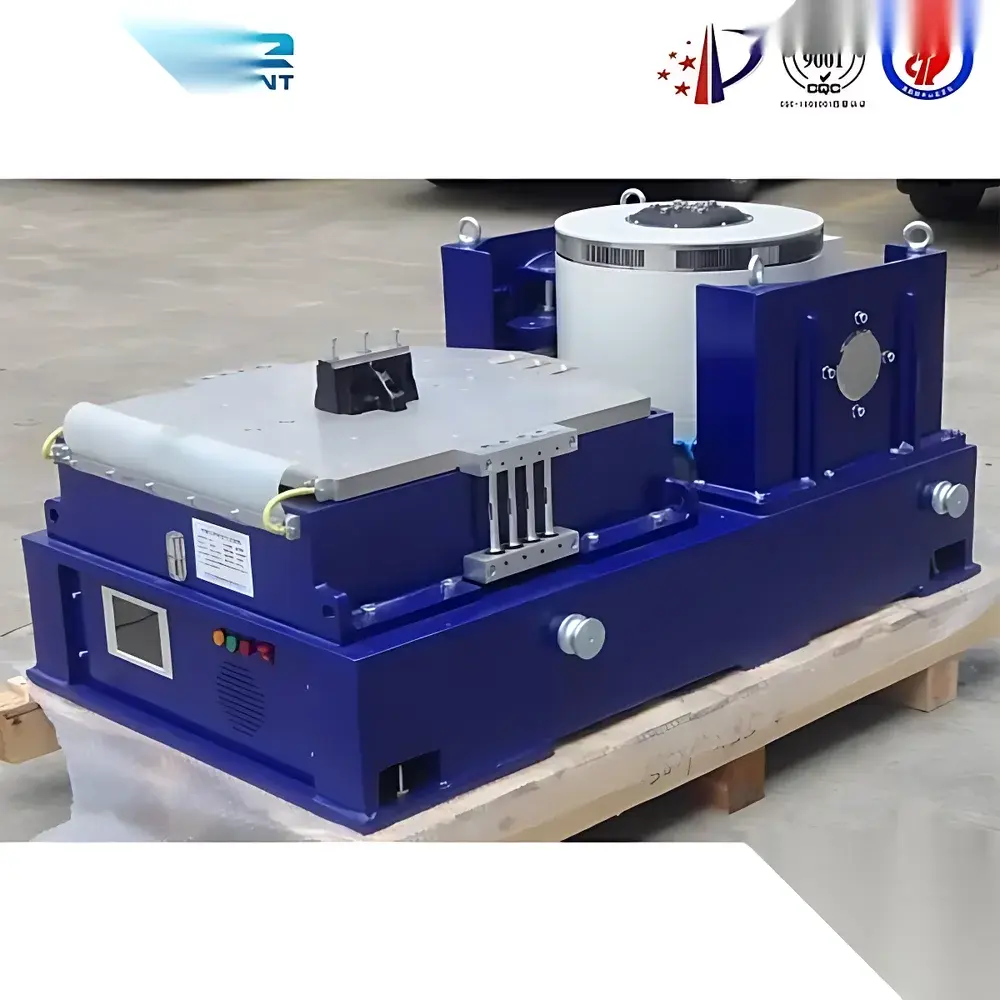
Custom Electromagnetic Horizontal & Vertical Vibration Shaker System
| Key | Table Surface Dimensions: 500 × 500 mm |
|---|---|
| Vibration Axes | Dual-axis (horizontal + vertical) |
| Max Payload | 100 kg |
| Frequency Range | 1–600 Hz |
| Sweep Frequency Range | 1–600 Hz |
| Displacement Amplitude | 0–5 mm peak-to-peak |
| Max Acceleration | 20 g (rms) |
| Time Control Resolution | 1 second (programmable up to 1 year) |
| Waveforms | Sine, Half-sine |
| Drive Power | 2.2 kVA |
| Input Voltage | 220 V ±10% AC, 50/60 Hz |
| Max Current Draw | 5 A |
| Frequency Display Resolution | 0.01 Hz |
| Shaker Body Dimensions (vertical unit) | 500 × 500 × 160 mm |
Overview
The Custom Electromagnetic Horizontal & Vertical Vibration Shaker System is an engineered dual-axis electrodynamic vibration test platform designed for rigorous mechanical stress evaluation under controlled dynamic loading conditions. Operating on the principle of Lorentz-force actuation—where coil current interacting with a permanent magnetic field generates precise, repeatable inertial forces—the system delivers high-fidelity sinusoidal and half-sinusoidal excitation across two orthogonal axes. Unlike single-axis shakers, this configuration enables simultaneous or independent horizontal (X/Y) and vertical (Z) motion, replicating real-world multi-directional vibration environments encountered in automotive component validation, aerospace avionics screening, and military-grade electronics qualification. The system is optimized for early-life failure detection (e.g., solder joint fatigue, connector loosening, PCB microcrack initiation), structural resonance mapping, and durability assessment per MIL-STD-810H Method 514.7, ISO 16750-3, and IEC 60068-2-6. Its electromagnetic architecture ensures low harmonic distortion (<3% THD at rated output), minimal thermal drift, and long-term amplitude stability—critical for GLP-compliant reliability testing.
Key Features
- Dual-axis electrodynamic shaker assembly with mechanically decoupled horizontal and vertical actuation modules, enabling synchronized or asynchronous excitation profiles
- High-stiffness 500 × 500 mm aluminum alloy table surface with T-slots (M6) for secure fixture mounting and modal uniformity across full payload range (up to 100 kg)
- Wide operational bandwidth from 1 Hz to 600 Hz, supporting both low-frequency structural mode identification and high-frequency component resonance analysis
- Precision digital frequency synthesis with 0.01 Hz resolution and real-time closed-loop control via integrated accelerometer feedback
- Programmable time-based test sequencing with duration settings from 1 second to 365 days, supporting stepped-sweep, resonant dwell, and random vibration profiles (when paired with optional controller)
- Thermally stabilized voice coil design rated for continuous 2.2 kVA operation; peak acceleration capability of 20 g (rms) at 100 kg load
- Integrated safety interlocks including over-temperature cutoff, over-current protection, and emergency stop circuit compliant with IEC 61508 SIL2
Sample Compatibility & Compliance
The shaker accommodates test specimens ranging from small PCB assemblies to full ECUs, instrument clusters, and compact subassemblies. Fixture design follows ASTM D999 and ISO 13373-1 guidelines to minimize boundary condition artifacts. The system meets electromagnetic compatibility requirements per EN 61000-6-3 (emissions) and EN 61000-6-2 (immunity). All mechanical interfaces conform to ISO 5344 mounting standards. Documentation packages include traceable calibration certificates (NIST-traceable accelerometers), FAT/SAT reports, and compliance matrices for ISO/IEC 17025-accredited laboratories conducting vibration qualification per US DoD, NASA-STD-7003, and automotive OEM specifications (e.g., GMW14872, Ford CETP 00.00-L-467).
Software & Data Management
Control and data acquisition are managed via a Windows-based real-time test executive software suite supporting IEEE 1588 Precision Time Protocol synchronization. The software provides ISO 20483-compliant FFT analysis, waterfall/spectrogram generation, and transmissibility ratio calculation. Audit trails record all parameter changes, user logins, and test execution events in accordance with FDA 21 CFR Part 11 requirements—including electronic signatures, role-based access control, and immutable data archiving. Export formats include CSV, UFF58, and MATLAB .mat for post-processing in third-party FEA or signal analysis tools. Optional integration with LabVIEW™ or Python APIs enables automated test sequence orchestration within larger HALT/HASS workflows.
Applications
- Pre-shipment environmental stress screening (ESS) of consumer electronics and telecom hardware
- Vibration fatigue life prediction for automotive sensors, ADAS modules, and infotainment systems
- Structural integrity verification of satellite subsystems during launch vehicle qualification
- Resonance avoidance analysis for medical imaging equipment enclosures and portable diagnostic devices
- Material damping characterization through forced oscillation decay measurement
- Validation of packaging systems against ISTA 3A and ASTM D4728 transport vibration profiles
FAQ
What standards does this shaker support for automotive qualification?
It complies with GMW14872, Ford CETP 00.00-L-467, and ISO 16750-3 for road-induced vibration simulation.
Can the system perform random vibration testing?
Yes—when configured with the optional digital controller and power amplifier upgrade, it supports Gaussian random, narrowband random, and transient shock synthesis per ISO 10326-1.
Is remote monitoring and control available?
The system includes Ethernet (TCP/IP) and RS-485 interfaces; web-based HMI and SNMP status polling are supported via optional firmware module.
What maintenance intervals are recommended?
Annual recalibration of force and displacement transducers is advised; voice coil inspection and bearing lubrication every 2,000 operating hours.
Does the shaker meet cleanroom compatibility requirements?
Standard units are not ISO Class 5 certified, but optional stainless-steel table finishes and non-outgassing cabling are available for Class 7/8 environments.



