
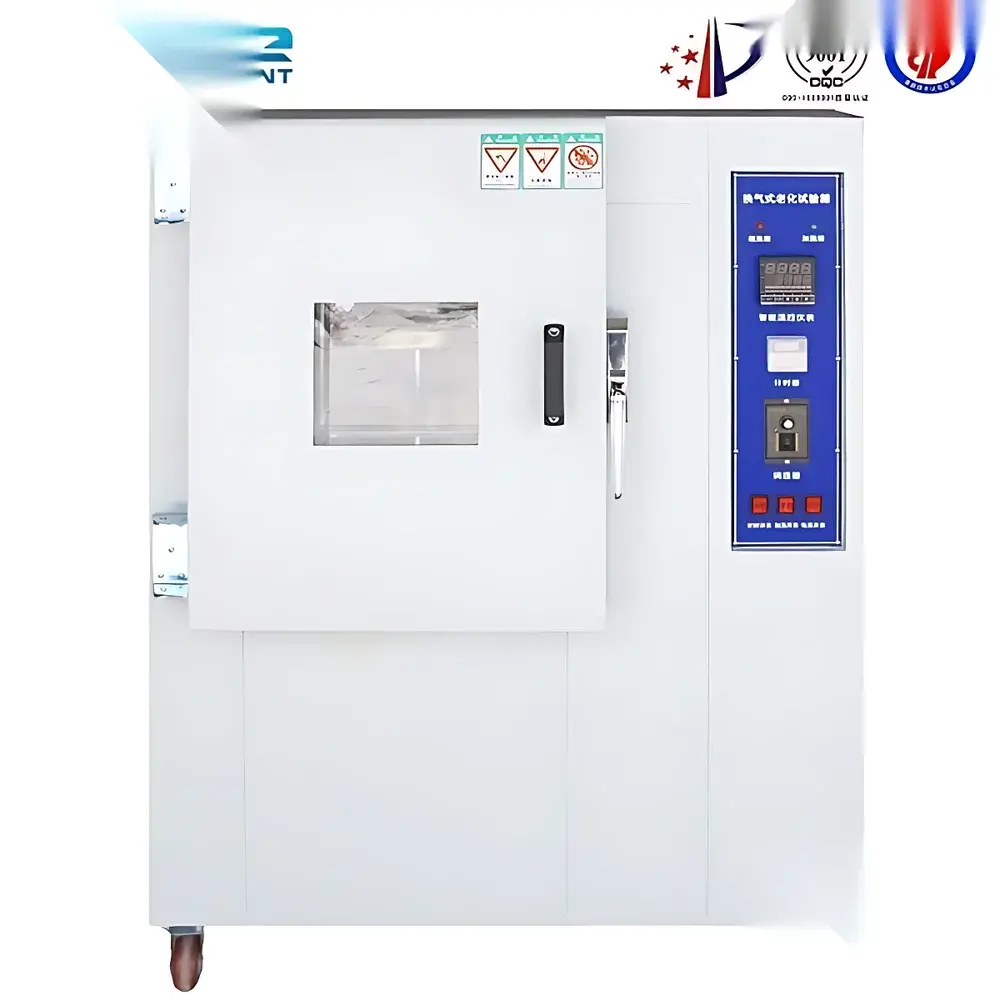
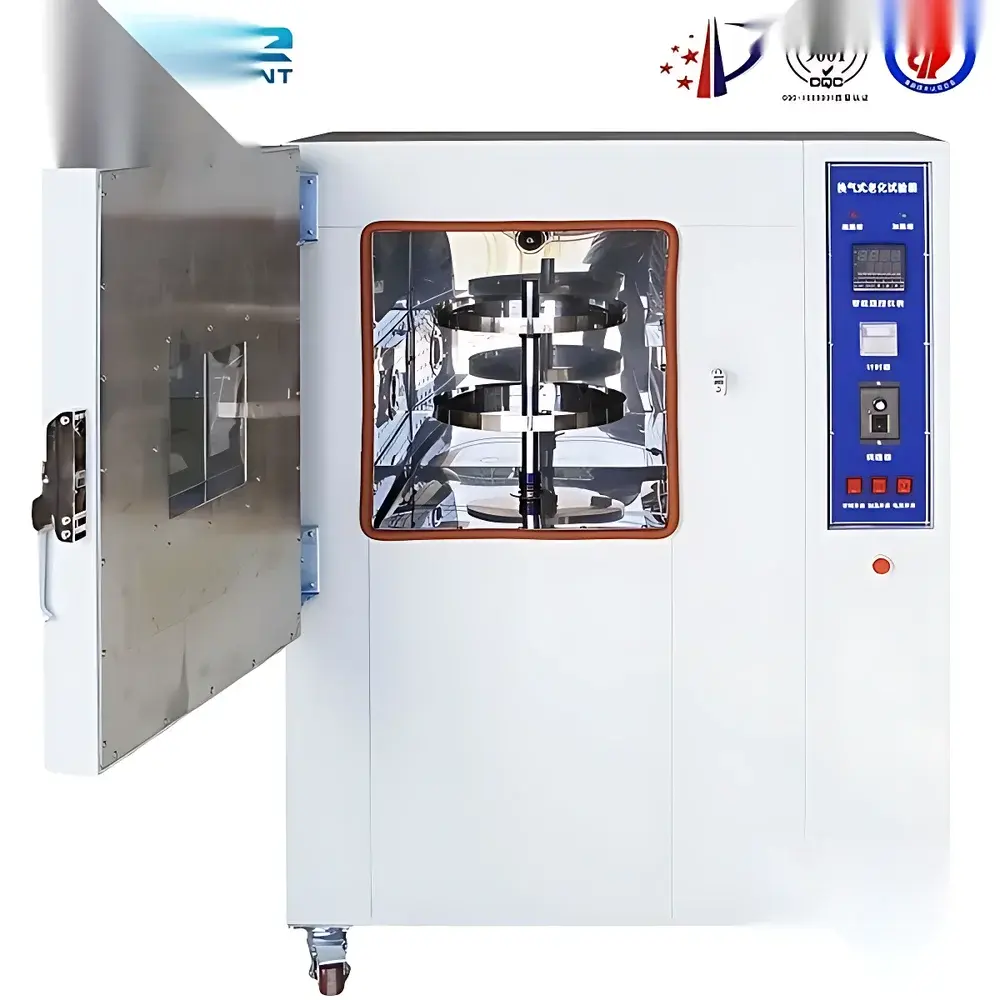
Custom High-Temperature Air Aging Test Chamber
| Brand | OEM / Custom-Built |
|---|---|
| Origin | Imported |
| Manufacturer Type | Authorized Distributor |
| Price | USD 2,600 (FOB, indicative only — final quotation subject to configuration, certification, and delivery terms) |
Overview
The Custom High-Temperature Air Aging Test Chamber is an engineered environmental test system designed for accelerated thermal aging of polymeric, elastomeric, and insulating materials under controlled, ventilated hot-air conditions. It operates on the principle of forced-convection thermal oxidation, where specimens are exposed to elevated temperatures (RT+10 °C to 300 °C) within a precisely regulated air exchange environment. This method replicates long-term service degradation mechanisms—such as chain scission, crosslinking, and volatilization—in compressed timeframes, enabling predictive assessment of material lifetime, stability, and compliance with international electrical insulation and safety standards. The chamber conforms structurally and functionally to ASTM D5423-09 (Type II Forced-Ventilation Laboratory Oven), ASTM D5374-93(2005), UL 1581, IEC 60811, GB/T 2951, JIS C 3005, and VDE 0472—making it suitable for QC laboratories, R&D centers, and third-party testing facilities engaged in cable, wire, rubber, textile, and plastic component qualification.
Key Features
- Precision-engineered air exchange control system: Adjustable ventilation rate from 2 to 100 cycles per hour, with programmable interval timing (1 minute to 99 hours), ensuring reproducible oxidative stress profiles per ASTM D5423.
- Uniform temperature distribution: Horizontal forced-air circulation with dual adjustable airflow baffles and high-temperature-rated centrifugal blower delivers ±2 °C temperature uniformity across the working chamber.
- Robust thermal containment: Double-wall construction with SUS304 stainless steel interior (mirror-finish or argon-welded option) and A3 steel exterior with electrostatic powder coating; insulated with high-density ultra-fine glass fiber (thermal conductivity ≤0.04 W/m·K).
- Intelligent microprocessor-based controller: LED-display PID + SSR digital temperature regulator with 0.1 °C setpoint/resolution accuracy, ±0.5 °C steady-state fluctuation tolerance, and integrated timer (1–9999 minutes).
- Operational safety architecture: Dual-stage over-temperature protection, motor overheat detection, leakage current interruption, short-circuit cutoff, and over-current relay—fully compliant with IEC 61000-6-2/6-4 EMC requirements.
- Functional accessibility: 50 mm diameter test port (left-side, sealed with silicone gasket), reinforced tempered observation window with built-in LED illumination, ergonomic non-latching handle, and optional rotating turntable (Φ250–Φ700 mm) for dynamic specimen exposure.
Sample Compatibility & Compliance
The chamber accommodates flat, cylindrical, and flexible specimens—including insulated wires, rubber hoses, PVC sheaths, textile laminates, and thermoplastic films—without dimensional restriction beyond internal workspace limits (models range from 100 L to 800 L). All configurations meet mandatory calibration traceability requirements under ISO/IEC 17025-accredited laboratory practice. Temperature uniformity and air exchange rate verification procedures align with ASTM E742 and IEC 60068-3-5. Optional documentation packages include factory calibration certificates (NIST-traceable RTD sensors), IQ/OQ protocol templates, and GLP-compliant audit trails for FDA 21 CFR Part 11–enabled controllers (upon request).
Software & Data Management
While the standard configuration features a standalone LED/PID controller, optional RS485 Modbus RTU interface enables integration with LabVIEW, MATLAB, or enterprise MES systems for remote monitoring, real-time data logging, and automated report generation (CSV/PDF). Optional software modules support alarm event timestamping, deviation tracking, and configurable pass/fail thresholds aligned with USP , ISO 11357, and IEC 60216 protocols. Audit trail functionality—including user login history, parameter modification logs, and calibration event records—is available for GMP/GLP-regulated environments.
Applications
- Accelerated aging of low-voltage and medium-voltage cable insulation (XLPE, EPR, PVC, TPE)
- Thermal endurance evaluation of elastomers per IEC 60216 and IEEE 98
- Oxidative stability screening of automotive interior trim, gaskets, and under-hood components
- Pre-compliance testing for UL 1581 Section 1060 (heat resistance of wire insulation)
- Material selection support for aerospace wiring harnesses per SAE AS4373
- Quality conformance verification in accordance with GB/T 2951.12–2008 and JIS C 3005–2014
FAQ
What temperature uniformity can be verified across the working volume?
Per ASTM D5423 Annex A2, uniformity is validated at ≥9 points using calibrated Class A PT100 probes; typical measured deviation is ≤±2.0 °C at 150 °C and ≤±2.5 °C at 300 °C.
Is the air exchange rate independently measurable and traceable?
Yes—the integrated digital anemometer and volumetric flow calculation algorithm allow direct determination of actual air changes per hour (ACH), with verification possible via tracer gas (SF₆) decay method per ISO 16000-8.
Can the chamber be configured for continuous unattended operation over 72+ hours?
All models support extended runtime with redundant over-temperature cutoff, thermal fuse backup, and optional uninterruptible power supply (UPS) interface for critical validation studies.
Are calibration certificates and IQ/OQ documentation included by default?
Factory calibration reports are provided standard; IQ/OQ execution support, 3Q validation packages, and NIST-traceable sensor certificates are available as value-added services.
Does the unit comply with CE marking requirements for machinery and electromagnetic compatibility?
Yes—certified to EN 61000-6-2 (immunity) and EN 61000-6-4 (emissions), and EN 61010-1 (safety), with Declaration of Conformity supplied upon shipment.



