
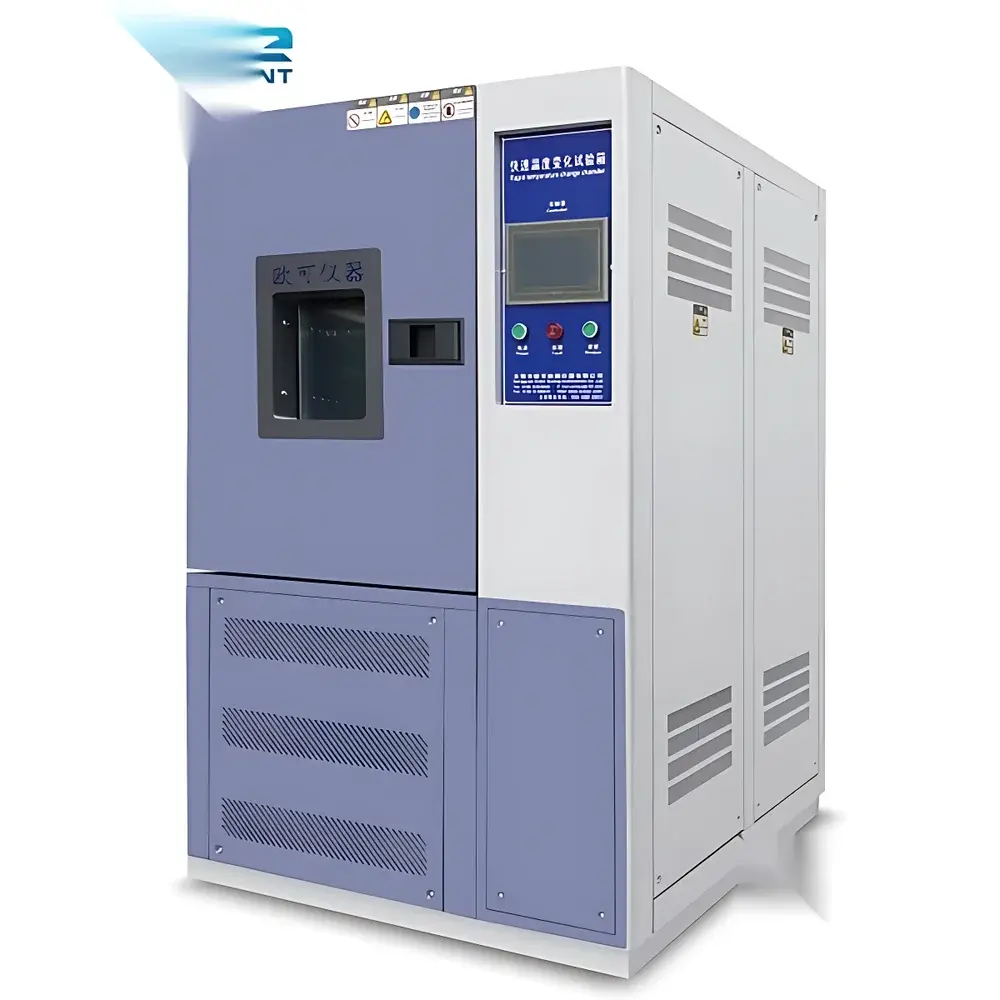
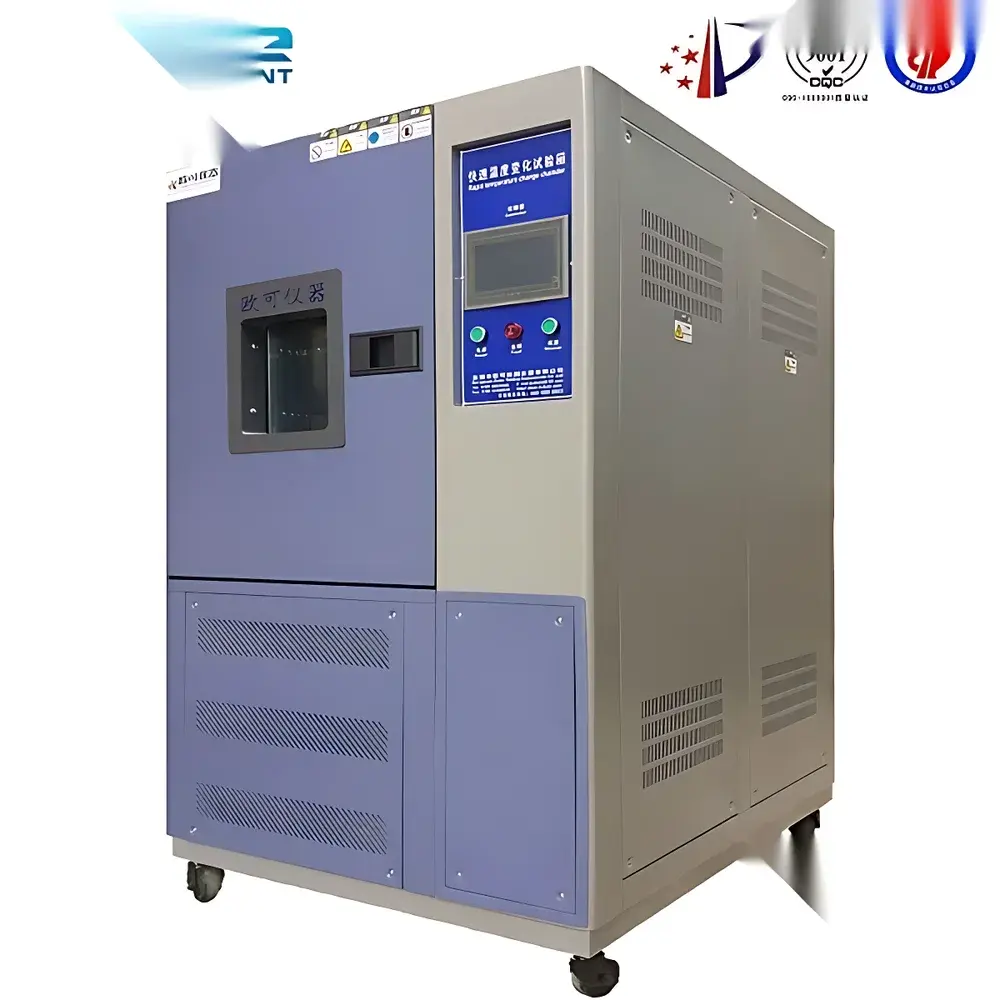
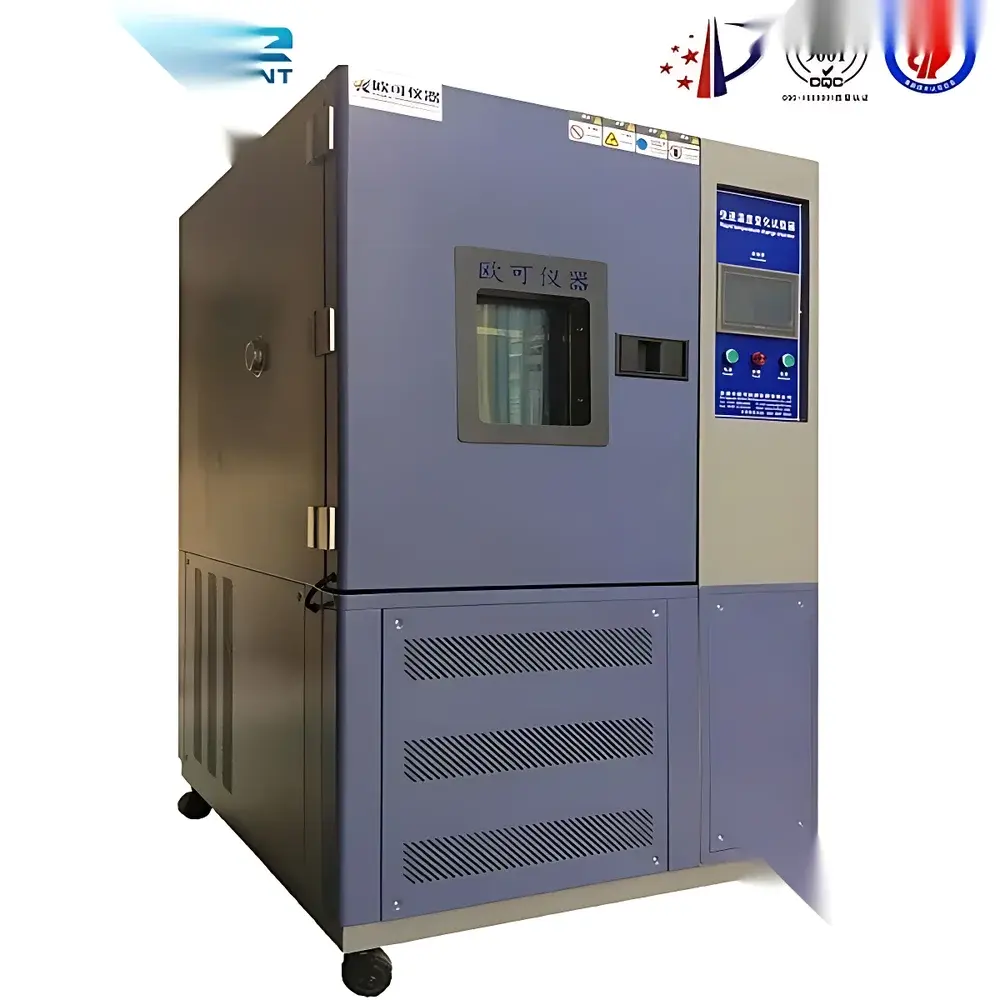
Custom Rapid Temperature Change Test Chamber Manufacturer
| Key | Temperature Range: -70°C to +150°C |
|---|---|
| Humidity Range (optional) | 20–98% RH |
| Rapid TC Range | -45°C to +85°C |
| Rapid TC Accuracy | ±3.0°C |
| Ramp Rates | 5–30°C/min (selectable A–F types) |
| Temp. Control Accuracy | ±0.5°C |
| Humidity Control Accuracy | ±2.5% RH |
| Temp. Uniformity | ±2.0°C |
| Humidity Uniformity | ±3.0% RH |
| Temp. Resolution | 0.1°C |
| Humidity Resolution | 0.1% RH |
| Construction | SUS304 inner chamber, stainless steel or SECC cold-rolled steel with powder coating outer shell |
| Insulation | High-density polyurethane foam |
| Cooling | Water-cooled |
| Compressor Options | Tecumseh (France), Bitzer (Germany) |
| Power Supply | AC380V, 3-phase 5-wire, 50/60 Hz |
| Weight Range | 950–2300 kg |
| Compliance | GB/T 2423.1, GB/T 2423.2, GB/T 2423.22, GJB 150.5, GJB 360.7, IEC 60068-2-14 (Test N), QC/T 17, EIA-364-32 |
| Safety Protections | High/low pressure cut-off, over-temperature/over-humidity protection, compressor overload protection, fuse, water shortage alarm, fault warning system |
Overview
The Custom Rapid Temperature Change Test Chamber is an engineered environmental simulation system designed for accelerated thermal stress evaluation of industrial components and materials under precisely controlled, high-dynamic-range temperature transitions. Based on the principle of forced-air convection combined with dual-stage refrigeration and electric heating, it delivers programmable linear or non-linear temperature profiles across a wide operational envelope—from cryogenic (-70°C) to elevated (+150°C) conditions—with optional humidity control (20–98% RH). Its core function is to replicate real-world thermal shock and cyclic exposure scenarios encountered during product lifecycle operation—especially critical in validating reliability margins for electronics, automotive ECUs, aerospace avionics, semiconductor packaging (e.g., BGA, CSP), PCB substrates, and polymer-based structural components. The chamber’s architecture supports both single-zone (one-box) and dual-zone (two-box moving basket) configurations, enabling strict adherence to standardized thermal shock test protocols including IEC 60068-2-14 (Test N), MIL-STD-810G Method 503, and GJB 150.5.
Key Features
- Programmable ramp rates from 5°C/min up to 30°C/min (six selectable grades: A–F), configurable for linear or non-linear thermal transitions per test requirement
- High-fidelity climate control with ±0.5°C temperature accuracy and ±2.5% RH humidity accuracy (when equipped), supported by 0.1°C/0.1% RH resolution
- Dual-compressor cooling system with water-cooled condensation; compatible with premium compressors including Tecumseh (France) and Bitzer (Germany)
- Robust thermal insulation using high-density polyurethane foam (chlorinated ethyl carbamate-based), minimizing heat leakage and improving energy efficiency
- Corrosion-resistant internal chamber constructed from polished SUS304 stainless steel; external enclosure available in either stainless steel or SECC cold-rolled steel with epoxy-powder coating
- Comprehensive safety suite: refrigerant high/low pressure switches, over-temperature and over-humidity cutoffs, compressor overload protection, fuse isolation, water shortage detection, and real-time fault diagnostics
- Modular expansion capability—including optional observation window with double-glazed tempered glass door, analog/digital data logger, dehumidifier integration, and ultra-pure water purification unit for humidity generation
Sample Compatibility & Compliance
This chamber accommodates diverse sample geometries and mass loads—from small IC packages and sensor modules to full-scale automotive assemblies and military-grade enclosures—under strictly defined empty-chamber performance criteria. All operational parameters comply with internationally recognized environmental testing standards, including but not limited to: GB/T 2423.1 (cold), GB/T 2423.2 (dry heat), GB/T 2423.22 (temperature change), IEC 60068-2-14 (thermal shock), GJB 150.5 (military temperature shock), QC/T 17 (automotive component weathering), and EIA-364-32 (thermal cycling for electronic connectors). It meets GLP-aligned validation requirements when paired with calibrated reference sensors and audit-trail-capable software. Optional IQ/OQ documentation packages are available to support FDA 21 CFR Part 11–compliant qualification in regulated manufacturing environments.
Software & Data Management
Equipped with a touchscreen HMI controller featuring embedded PID algorithms and multi-segment profile programming, the system enables precise definition of dwell times, transition slopes, cycle counts, and conditional branching logic. Data logging occurs at user-selectable intervals (1s–600s), with time-stamped records stored internally and exportable via USB or Ethernet to CSV or XML formats. Optional PC-based software provides advanced analysis tools—including deviation mapping, statistical process control (SPC) charting, and automated report generation compliant with ISO/IEC 17025 reporting guidelines. Audit trail functionality logs all operator actions, parameter modifications, and system alarms—ensuring traceability for quality assurance and regulatory audits.
Applications
- Qualification testing of printed circuit boards (PCBs) and integrated circuits (ICs) subjected to solder reflow-induced thermal gradients
- Validation of thermal expansion coefficient (CTE) mismatch effects in multi-material assemblies such as chip-scale packages (CSP) and flip-chip interconnects
- Accelerated life testing of automotive infotainment systems, ADAS sensors, and battery management units (BMUs) under extreme ambient cycling
- Evaluation of elastomeric seals, gaskets, and composite housings for long-term dimensional stability and microcrack initiation
- Material science research on phase transitions, crystallinity shifts, and aging kinetics in thermoplastics and thermosets
- Pre-certification screening for compliance with JEDEC JESD22-A104 (temperature cycling) and A106 (highly accelerated temperature/humidity stress test)
FAQ
What is the difference between linear and non-linear temperature ramping in this chamber?
Linear ramping maintains a constant rate (e.g., 15°C/min) throughout the entire transition, while non-linear ramping allows variable rates within a single profile—enabling simulation of real-world thermal inertia effects or device-specific thermal response curves.
Can the chamber perform temperature-humidity combined cycling?
Yes—when configured with the optional humidity system, it supports simultaneous or sequential temperature and humidity cycling per IEC 60068-2-30 (damp heat, cyclic), though humidity control bandwidth is intentionally decoupled from rapid temperature transients to preserve stability.
Is calibration certification included with shipment?
Standard delivery includes factory calibration verification against NIST-traceable references. Full ISO/IEC 17025-compliant calibration certificates with uncertainty budgets are available as an add-on service.
How is thermal uniformity validated inside the working volume?
Uniformity is verified per IEC 60068-3-5 using nine calibrated PT100 sensors placed on a 3×3 grid at mid-height; results are documented in the Performance Qualification (PQ) report provided with each unit.
What maintenance intervals are recommended for the refrigeration system?
Compressor oil and filter replacement every 24 months; refrigerant leak checks every 6 months; condenser coil cleaning quarterly in high-dust environments; full system performance verification annually.
Related Products



