
Customized Combined Temperature-Humidity-Vibration Test Chamber – OEM Manufacturer
| Key | Max Load: 100 kg (customizable) |
|---|---|
| Frequency Range | 1–5000 Hz (0.01 Hz resolution) |
| Sweep Range | 1–5000 Hz (duration: 1 s to 30 days) |
| Peak-to-Peak Amplitude | 0–5 mm |
| Max Acceleration | 20 g |
| Vibration Axes | Vertical + Horizontal |
| Waveform | Sinusoidal |
| Programmable Segments | Up to 15 segments, each with user-defined frequency/time |
| Octave Sweeps | 5-segment logarithmic (low→high, high→low, low→high→low, repeatable) |
| Table Surface | 50 × 50 cm (customizable) |
| Cabinet Dimensions (Vertical Mode) | 50 × 20 × 50 cm (L×H×W) |
| Power Supply | 220 V ±20%, 5 A, 2.2 kW |
| Control Modes | Programmable, sweep, logarithmic, octave, amplitude/acceleration regulation, time-based termination |
| Compliance | Designed for IEC 60068-2-6, IEC 60068-2-64, MIL-STD-810H, ISO 16750-3, GB/T 2423.10, GB/T 2423.3, GB/T 2423.17 |
Overview
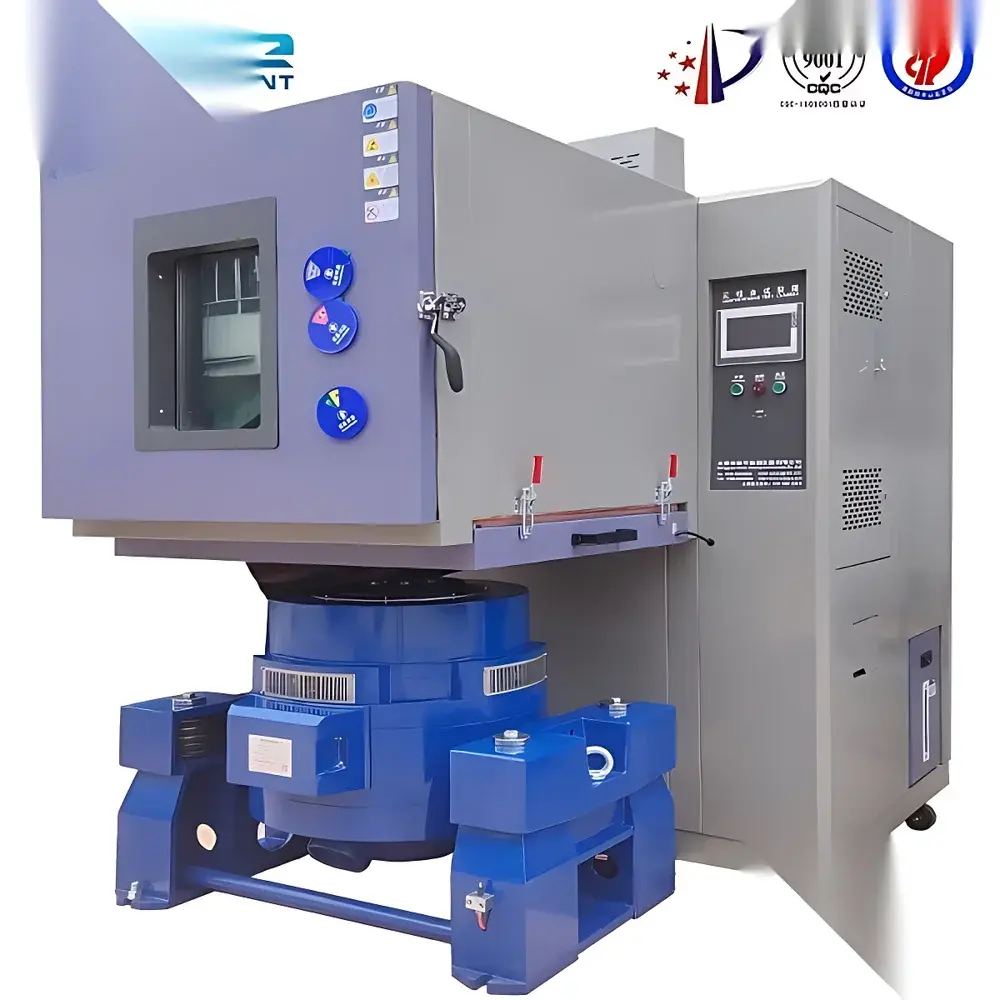
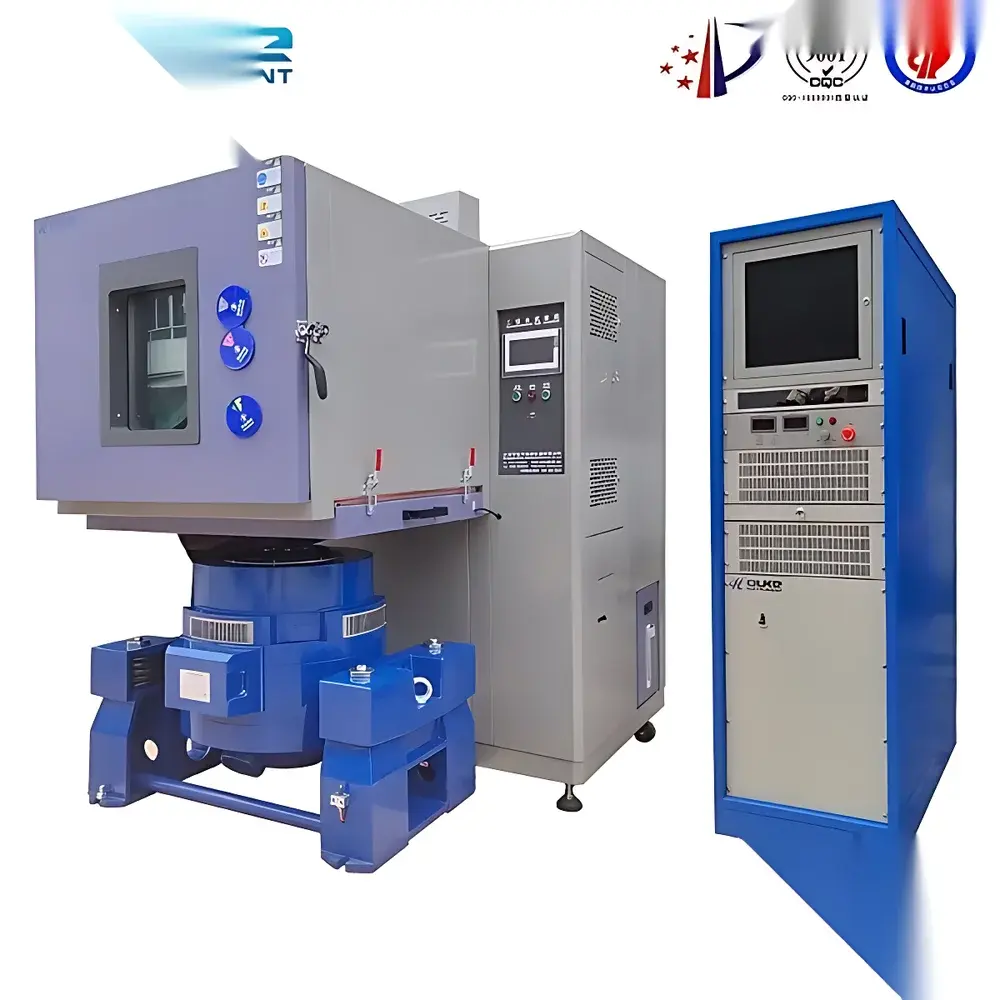
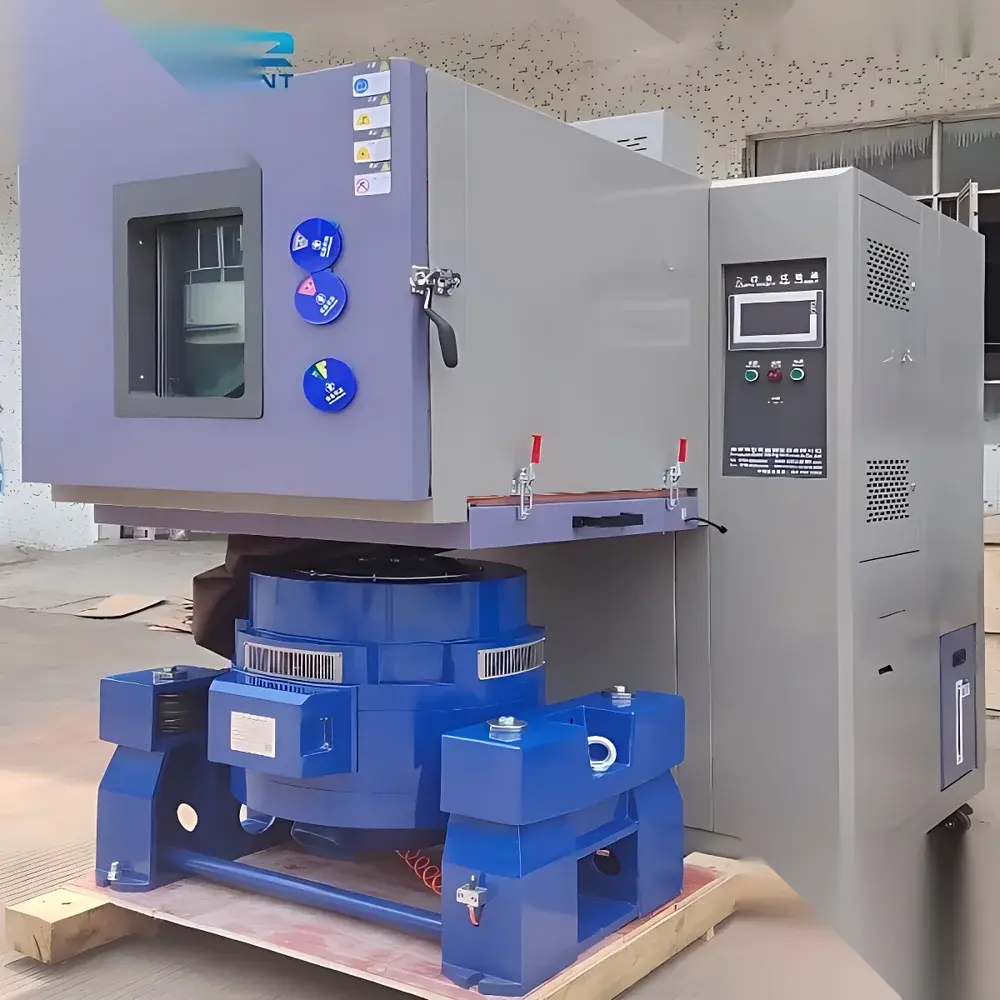
The Customized Combined Temperature-Humidity-Vibration Test Chamber is an integrated environmental simulation system engineered for rigorous reliability validation of electronic components, automotive modules, aerospace subsystems, and industrial equipment subjected to real-world transport and operational stresses. Unlike standalone thermal, humidity, or vibration testers, this tri-combined chamber simultaneously applies controlled temperature (−70 °C to +180 °C), relative humidity (10–98% RH), and mechanically coupled sinusoidal vibration—enabling accelerated life testing under multi-stress synergistic conditions. Its core vibration subsystem employs electromagnetic shaker technology compliant with classical Couette flow excitation principles, delivering precise acceleration control across a broad dynamic bandwidth (1–5000 Hz) with sub-0.01 Hz frequency resolution. The chamber’s structural architecture integrates reinforced stainless-steel insulation, double-wall construction with vacuum-gap thermal barriers, and active humidity control via chilled-mirror dew point regulation—ensuring traceable, repeatable, and stable environmental profiles per IEC 60068-3 series guidelines.
Key Features
- Simultaneous triple-stress application: programmable temperature, humidity, and vibration within a single test cycle—eliminating sequential test artifacts and capturing true multi-factor degradation mechanisms.
- High-fidelity vibration control: digital servo amplifier with real-time closed-loop feedback; supports sine, swept-sine, random (via optional upgrade), and programmable multi-segment waveforms (up to 15 independent frequency/time blocks).
- Low-noise mechanical drive: synchronous toothed-belt transmission system reduces acoustic emission below 65 dB(A) at 1 m—critical for lab environments requiring minimal ambient interference.
- Modular load interface: precision-machined aluminum table (standard 50 × 50 cm, customizable up to 100 × 100 cm) with T-slot rails and quick-clamp fixtures for rapid, repeatable DUT mounting and alignment verification.
- Robust mechanical foundation: heavy-duty C-channel base frame with high-damping elastomeric isolation pads ensures stable operation at peak 20 g acceleration without resonance coupling into facility infrastructure.
- Full-cycle time governance: integrated timer logic supports test durations from 1 second to 365 days, with automatic termination, data logging triggers, and fail-safe thermal/vibration interlocks.
Sample Compatibility & Compliance
This chamber accommodates test specimens up to 100 kg (mass-dependent on frequency range and amplitude settings), including ECUs, PCB assemblies, battery packs, sensor housings, and molded plastic enclosures. Mounting adaptability is ensured via standardized ¼”-20 and M6 threaded inserts across the table surface. The system meets essential regulatory and industry-standard requirements for environmental stress screening (ESS), including IEC 60068-2-6 (vibration), IEC 60068-2-30 (damp heat cyclic), ISO 16750-3 (road vehicle vibration), and MIL-STD-810H Method 514.7 (vibration) and Method 507.6 (humidity). All control firmware and calibration records are maintained in accordance with GLP documentation practices, supporting audit readiness for ISO/IEC 17025-accredited laboratories.
Software & Data Management
Control and monitoring are executed via a dedicated Windows-based application featuring dual-mode operation: local touchscreen HMI (10.1″ capacitive display) and remote Ethernet/IP access. The software provides full traceability—including timestamped parameter logs, real-time FFT spectral views, alarm history with cause-code tagging, and exportable CSV/Excel reports. Audit trail functionality complies with FDA 21 CFR Part 11 requirements when configured with user-role authentication, electronic signatures, and immutable log archiving. Calibration certificates for temperature, humidity, and acceleration sensors are NIST-traceable and include as-found/as-left data, uncertainty budgets, and ISO/IEC 17025 accreditation statements from third-party metrology labs.
Applications
- Automotive electronics qualification per AEC-Q200 and OEM-specific durability specifications (e.g., Ford WERS, GM GMW3172).
- Accelerated life testing of lithium-ion battery modules under combined thermal cycling and road-simulation vibration profiles.
- Validation of solder joint integrity in high-density PCBAs using resonant dwell and harmonic sweep protocols.
- Environmental stress screening (ESS) of avionics hardware prior to flight certification (DO-160 Section 21 & 22).
- Reliability assessment of medical device enclosures and connectors under simulated shipping conditions (ISTA 3A/3E).
- Material fatigue analysis of polymer-based housings exposed to humid aging followed by mechanical shock-vibration sequences.
FAQ
What standards does this chamber support for combined environmental testing?
It is fully compatible with IEC 60068-2-64 (combined vibration and temperature), IEC 60068-2-52 (salt mist + humidity + vibration), and custom profiles defined in automotive OEM engineering specifications.
Can the system perform random vibration testing?
The base configuration supports only deterministic waveforms (sine, sweep, programmable). Random vibration capability requires optional PSD spectrum controller hardware and software license.
Is remote monitoring and control supported over corporate networks?
Yes—via secure HTTPS web interface and OPC UA server integration, enabling SCADA-level data ingestion and centralized fleet management.
How is temperature/humidity uniformity validated inside the chamber during vibration?
Uniformity mapping is performed per IEC 60068-3-5 using 9-point sensor arrays at multiple load configurations; typical deviation is ≤ ±1.5 °C and ≤ ±3% RH across working volume.
What maintenance intervals are recommended for long-term operational stability?
Vibration actuator coil inspection every 2,000 operating hours; humidity system desiccant replacement quarterly; full system calibration annually or after 500 cumulative test hours—whichever occurs first.
Related Products



