
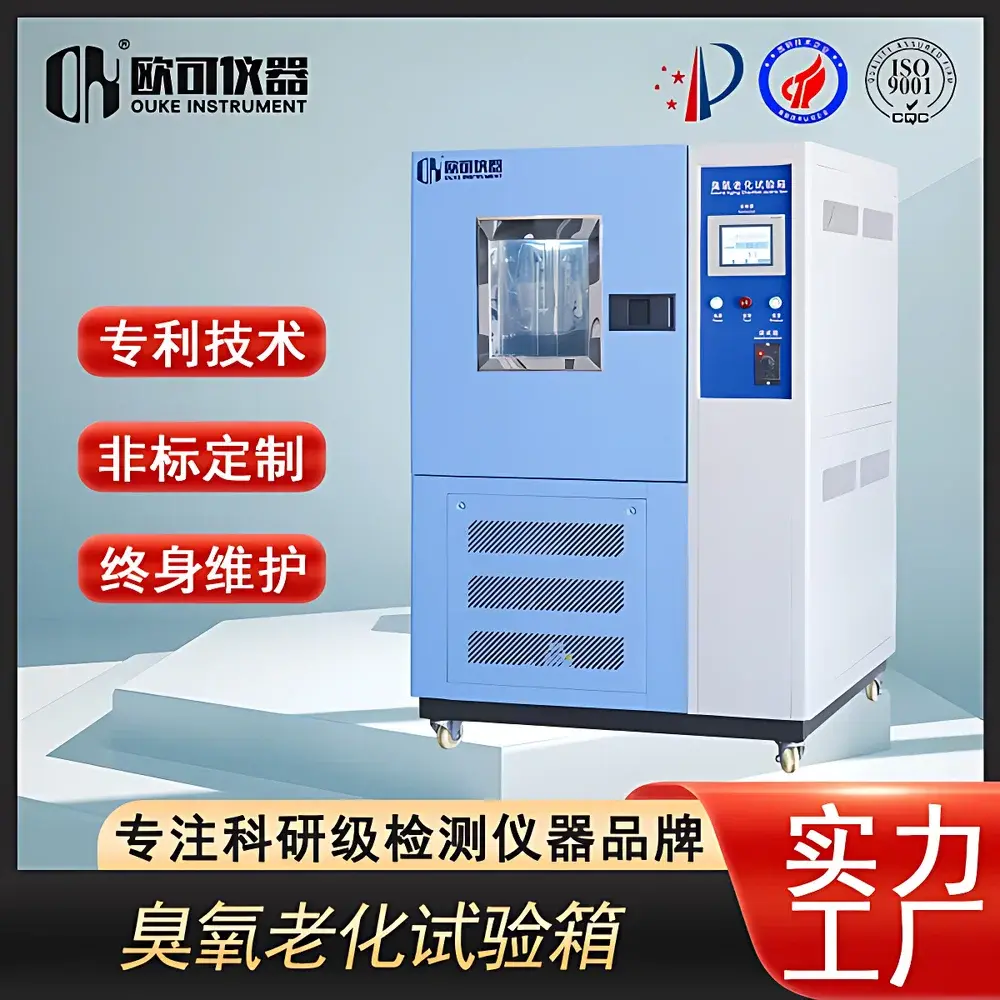
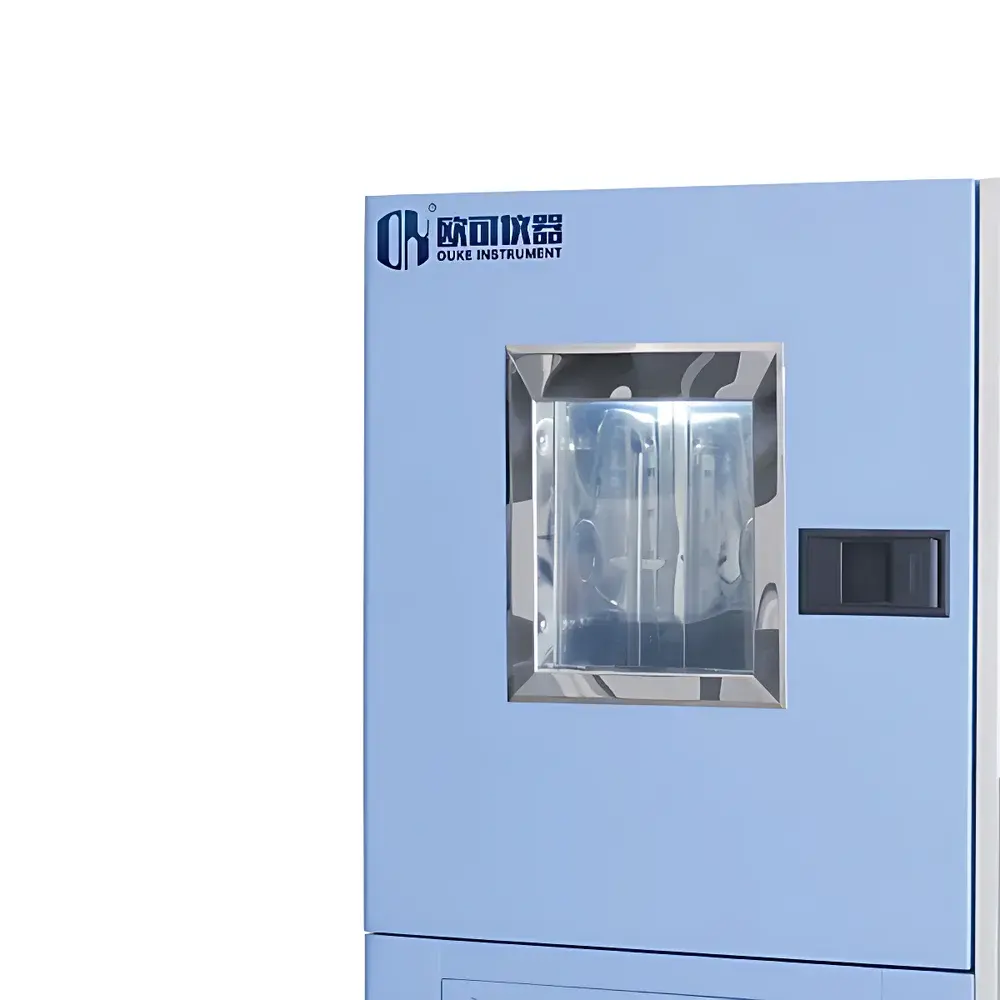
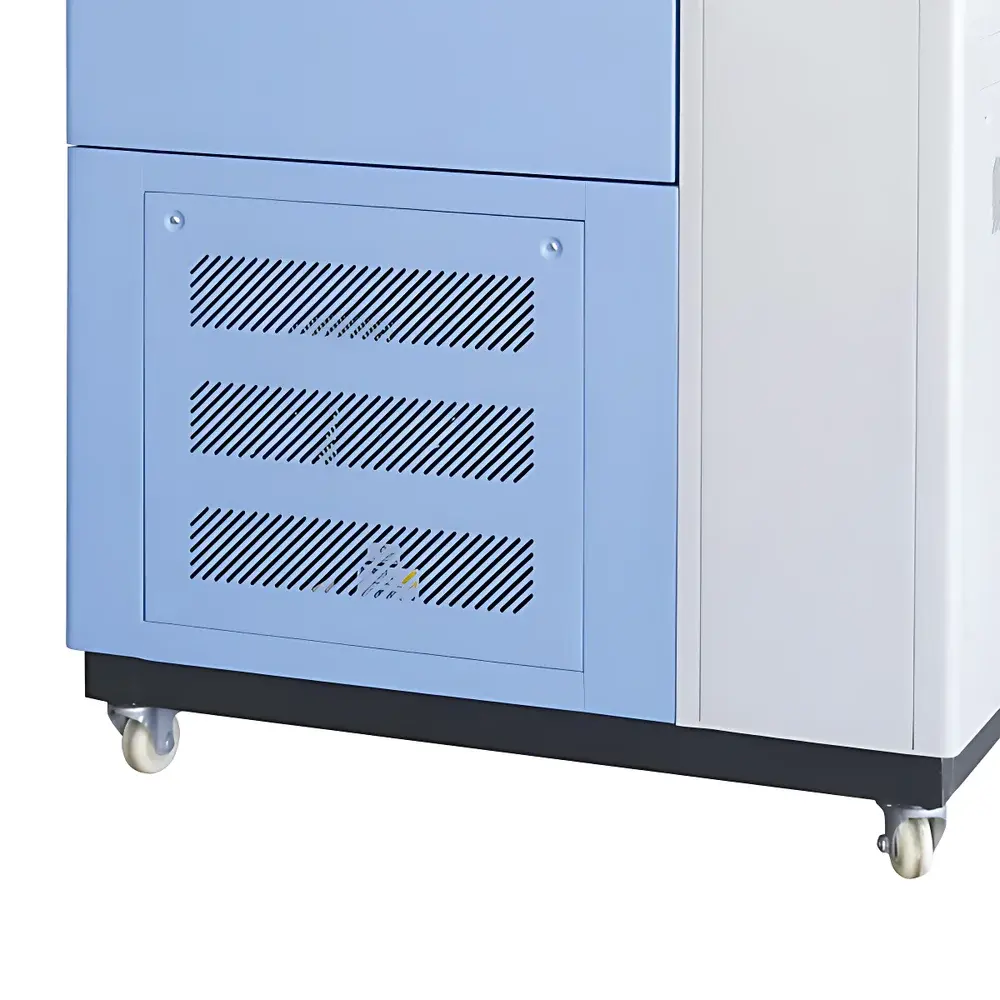
OK-CY-100 Ozone Aging Test Chamber
| Brand | OK Instruments |
|---|---|
| Origin | Guangdong, China |
| Manufacturer Type | Direct Manufacturer |
| Model | OK-CY-100 |
| Price | USD 4,950 (FOB Guangdong) |
| Ozone Concentration Range | 0.01–100 ppm |
| Control Accuracy | ±5% of setpoint (closed-loop PID) |
| Temperature Range | 20–60 °C (±1 °C stability) |
| Humidity Range | 30–80% RH (±3% RH stability) |
| Static Stretch Range | 5–40% |
| Dynamic Stretch Frequency | 0–0.5 Hz |
| Chamber Volume | 100 L |
| Exhaust Treatment | Activated Carbon + UV Photolysis |
| Compliance | GB/T 7762-2014, ISO 1431-1:2004, ASTM D1149-19, SAE J1201-2018 |
Overview
The OK-CY-100 Ozone Aging Test Chamber is an engineered environmental reliability testing system designed to accelerate and quantify ozone-induced degradation in unsaturated polymeric materials. It operates on the fundamental principle of controlled oxidative aging: ozone (O₃), a highly reactive triatomic allotrope of oxygen, selectively attacks carbon–carbon double bonds (C=C) in elastomers and thermoplastics—initiating chain scission or crosslinking that manifests as surface cracking (ozone cracking), embrittlement, hardness increase, and loss of elongation at break. Unlike general-purpose climate chambers, the OK-CY-100 integrates three tightly coupled control domains—ozone concentration, thermal-hygrometric environment, and mechanical strain state—to replicate real-world service conditions with metrological fidelity. Its core architecture employs silent corona discharge ozone generation from dry air or oxygen feed gas, enabling precise, stable output across 0.01–100 ppm—a range validated for standard rubber testing per GB/T 7762 and ISO 1431-1. The chamber’s 100 L working volume accommodates up to 30 standard dumbbell specimens (100 × 25 mm), while its closed-loop ozone monitoring system—featuring electrochemical sensors and real-time PID feedback—ensures concentration deviation remains within ±5% of setpoint throughout test duration.
Key Features
- High-fidelity ozone generation via corona discharge with integrated drying and filtration; no nitrogen oxide byproducts.
- Closed-loop ozone concentration control with electrochemical sensor feedback and auto-compensation for ozone decay over time.
- Independent dual-channel temperature and humidity regulation: 20–60 °C (±1 °C uniformity) and 30–80% RH (±3% RH accuracy), both programmable with ramp/soak profiles.
- Dual-mode sample loading system: static stretch fixture (adjustable 5–40% strain) and optional dynamic cyclic stretch stage (0–0.5 Hz frequency, ±0.01 Hz repeatability).
- Integrated exhaust abatement: multi-stage treatment combining activated carbon adsorption and 185 nm UV photolysis to decompose residual ozone into ambient-grade O₂ prior to venting.
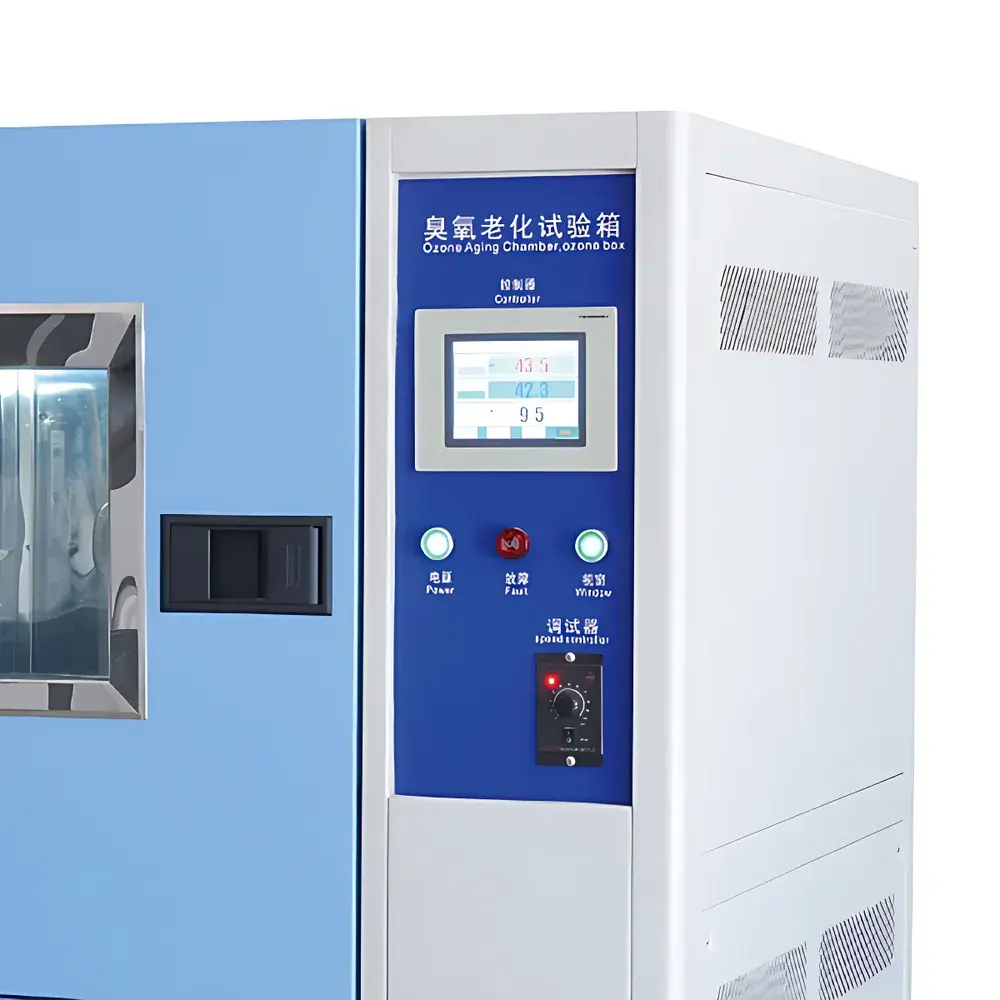
- Industrial-grade PLC controller with 7-inch resistive touchscreen interface; supports up to 99 program steps, data logging (time-stamped ozone, T/RH, alarm events), and USB export.
- Safety-critical interlocks: ozone leakage alarm (triggered at ≥0.1 ppm), over-temperature cutoff, door-open ozone shutoff, and power-fail memory retention.
Sample Compatibility & Compliance
The OK-CY-100 is optimized for standardized evaluation of vulcanized rubbers (e.g., NR, SBR, BR, EPDM), thermoplastic elastomers, cable jacketing compounds (PVC, CPE, TPE), and automotive sealing profiles. It fully supports static tensile aging per GB/T 7762-2014 and ISO 1431-1:2004, as well as dynamic fatigue protocols per GB/T 13642-2015 and ISO 1431-3:2010. Test methods align with ASTM D1149-19 (Standard Test Method for Rubber Deterioration—Ozone Cracking in Air) and automotive OEM requirements including SAE J1201-2018. All operational parameters—including ozone setpoint, temperature ramp rate, and stretch amplitude—are traceable and auditable, supporting GLP-compliant documentation workflows. The chamber’s construction adheres to IEC 61000-6-3 (EMC emission limits) and meets CE machinery directive essential health and safety requirements (2006/42/EC).
Software & Data Management
The embedded control firmware records all critical process variables—including ozone concentration (ppm), chamber temperature (°C), relative humidity (%RH), elapsed time, and alarm status—at user-defined intervals (1 s to 10 min resolution). Data is stored internally (≥30 days at 1-min logging) and exportable via USB flash drive in CSV format for post-test statistical analysis. While the base system does not include PC-based analytical software, its structured ASCII output is compatible with common laboratory data systems (LIMS), MATLAB, Python pandas, and JMP. For regulated environments, optional 21 CFR Part 11-compliant audit trail modules are available—providing electronic signatures, role-based access control, and immutable record archiving. All calibration events (ozone sensor, PT100 probes) are logged with operator ID and timestamp, satisfying ISO/IEC 17025 documentation requirements for accredited testing laboratories.
Applications
This chamber serves as a primary qualification tool in R&D and QC labs across multiple sectors. In tire and rubber manufacturing, it validates anti-ozonant efficacy in sidewall compounds and assesses crack initiation thresholds under static strain. Automotive suppliers use it to verify durability of door seals, brake hoses, and engine mounts per VW TL 52387 and Ford WSK-M4D472-A2 specifications. Wire & cable producers apply it to evaluate insulation integrity of outdoor-rated photovoltaic cables and EV charging conductors per GB/T 2951.21 and UL 1581. Additionally, it supports formulation screening for UV-stabilized PVC window profiles and high-performance fluoropolymers used in aerospace gaskets where synergistic ozone–temperature–mechanical stress interactions must be quantified.
FAQ
What ozone concentration range is recommended for standard rubber testing?
For most vulcanized elastomers (e.g., natural rubber, SBR), the industry-standard range is 0.1–50 ppm, with 50 ppm commonly used for accelerated qualification per GB/T 7762.
Can the OK-CY-100 perform dynamic ozone aging tests?
Yes—the base model includes static stretch capability; dynamic cycling (0–0.5 Hz) is available as a factory-installed option with servo-controlled actuation and position feedback.
Is UV photolysis alone sufficient for ozone abatement?
No—UV at 185 nm generates ozone; effective decomposition requires 254 nm UV combined with catalytic carbon. The OK-CY-100 employs both technologies in series for >99.9% destruction efficiency.
How often should the ozone sensor be calibrated?
We recommend quarterly verification against a NIST-traceable ozone calibrator and full recalibration every six months to maintain ±5% accuracy.
Does the chamber support third-party integration (e.g., with tensile testers)?
Yes—RS-485 Modbus RTU and discrete I/O signals enable hardware-level synchronization with external mechanical testers for automated pre-/post-test property measurement.



