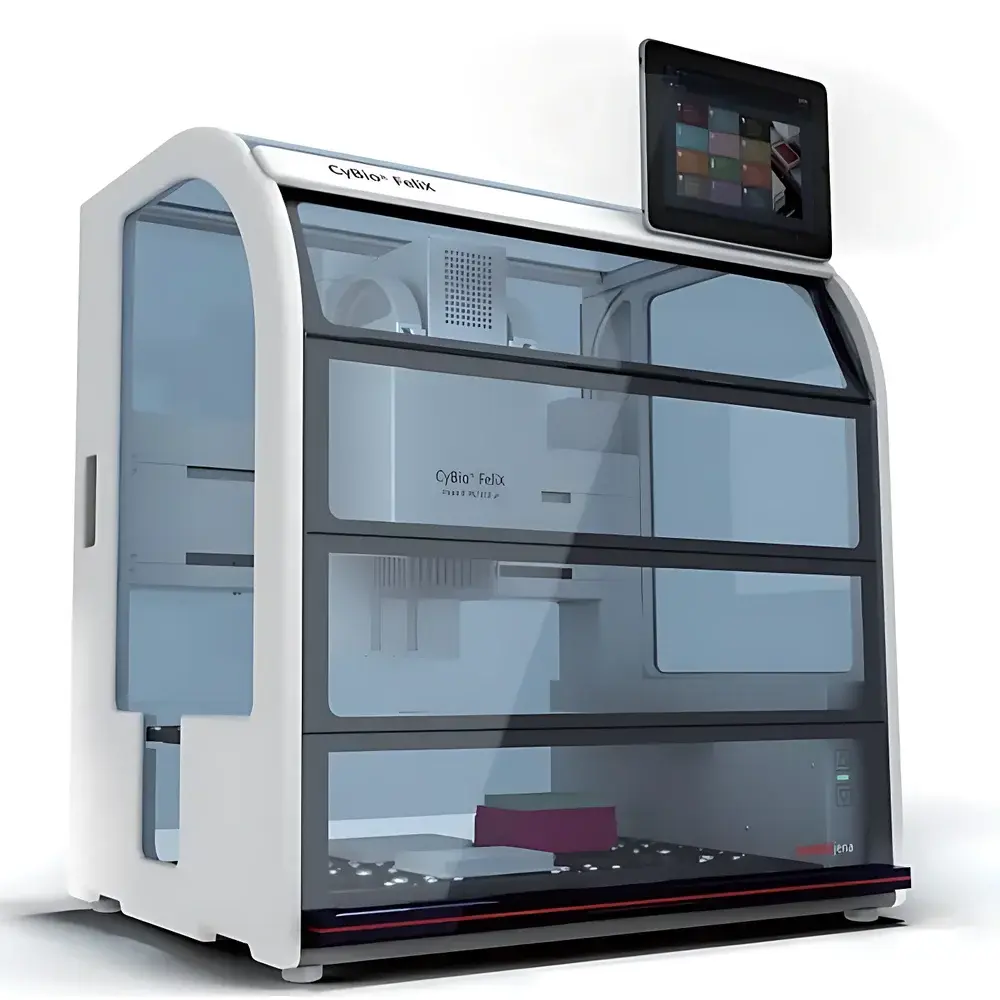
CyBio FeliX High-Throughput Automated Nucleic Acid Extraction System
| Brand | Analytik Jena |
|---|---|
| Origin | Germany |
| Manufacturer | Analytik Jena AG |
| Country of Origin | Germany |
| Model | CyBio FeliX |
| Pricing | Available upon Request |
Overview
The CyBio FeliX High-Throughput Automated Nucleic Acid Extraction System is an integrated, walk-away platform engineered for precision, reproducibility, and regulatory compliance in nucleic acid isolation workflows. Developed by Analytik Jena AG in Jena, Germany, the system employs a proprietary surface-binding chemistry principle—distinct from conventional magnetic bead, silica-membrane, phenol-chloroform, or ion-exchange methodologies—to capture nucleic acids directly onto chemically intelligent, functionalized surfaces within standard 96-well plates or tubes. This mechanism eliminates reliance on solid-phase carriers that require post-extraction removal, thereby circumventing residual bead contamination and associated downstream inhibition risks. The instrument operates under fully enclosed processing conditions, integrating UV-C irradiation (254 nm), filtered pipette tips, and pre-sealed, barcode-tracked reagent cartridges to enforce physical and procedural barriers against cross-contamination. Designed for GLP- and GMP-aligned laboratories, the CyBio FeliX supports end-to-end traceability, audit-ready electronic records, and seamless integration into LIMS environments.
Key Features
- Patented Dual-Buffer (DC) Lysis Technology: Optimized dual-component lysis buffers preserve Proteinase K activity while enhancing cell wall/membrane disruption across diverse sample matrices—including fibrous plant tissues, Gram-positive bacteria, and formalin-fixed samples.
- Surface-Binding Nucleic Acid Capture: Eliminates magnetic beads, spin columns, silica membranes, and organic solvents; binding occurs directly on chemically tailored surfaces via reversible electrostatic and hydrophobic interactions—enabling rapid, low-shear elution without centrifugation or wash-step carryover.
- Zero Magnetic Residue Output: Integrated magnetic base immobilizes beads exclusively during binding/wash steps; supernatant transfer is performed via positive-displacement pipetting using sterile, filter-tipped tips—ensuring eluates are free of particulate carryover and immediately compatible with qPCR, NGS library prep, and enzymatic reactions.
- Full Process Enclosure & Contamination Control: Sealed deck architecture with HEPA-filtered air circulation, programmable UV decontamination cycles between runs, and single-use, pre-aliquoted reagent cassettes with tamper-evident seals.
- 96-Channel Parallel Processing: Supports 1–96 samples per run with cycle times as low as 40 minutes for full 96-well DNA extractions; independent channel control allows simultaneous processing of heterogeneous sample types (e.g., blood + soil + cultured cells) under distinct protocols.
Sample Compatibility & Compliance
The CyBio FeliX demonstrates validated performance across >30 sample categories, including whole blood (EDTA/Na-citrate), buffy coat, saliva, buccal swabs, bacterial pellets (Gram±), viral lysates (inactivated), FFPE tissue sections, fresh/frozen animal tissues, plant leaves/stems/roots/seeds, soil suspensions, fecal slurries, and cultured mammalian/insect cells. All extraction kits are CE-IVD marked and compliant with ISO 13485:2016 manufacturing standards. The platform meets requirements for ISO/IEC 17025:2017 method validation frameworks and supports FDA 21 CFR Part 11-compliant electronic signatures, audit trails, and data integrity controls when operated with optional CyBio Control Suite v4.x software.
Software & Data Management
CyBio Control Suite provides role-based user access, protocol versioning, real-time run monitoring, and automated report generation (PDF/CSV). Each run logs timestamped metadata—including tip lot numbers, reagent expiration dates, environmental sensor readings (temperature/humidity), and robotic arm positional accuracy—stored locally with optional encrypted cloud backup. The software supports IQ/OQ/PQ documentation packages and integrates with major LIMS platforms via ASTM E1384-compliant HL7 and RESTful API interfaces. All data files are SHA-256 hashed and digitally signed to fulfill ALCOA+ principles (Attributable, Legible, Contemporaneous, Original, Accurate, Complete, Consistent, Enduring, Available).
Applications
- High-volume clinical diagnostics: SARS-CoV-2, HPV, HBV, and HIV nucleic acid testing in CAP-accredited labs.
- Biobanking & cohort studies: Standardized extraction from longitudinal biospecimens under ISO 20387:2018 biobank accreditation criteria.
- Microbiome research: Simultaneous DNA/RNA co-extraction from complex metagenomic samples with minimal bias.
- Plant genomics: Robust recovery of high-MW genomic DNA from polyphenol- and polysaccharide-rich species without CTAB precipitation.
- Pharma QC: Release testing of viral vectors and plasmid DNA intermediates per ICH Q5A(R2) and USP <1043>.
FAQ
Does the CyBio FeliX require magnetic bead removal steps or post-extraction centrifugation?
No. The system’s surface-binding chemistry eliminates magnetic beads entirely from the final eluate; no bead removal, ethanol precipitation, or centrifugation is required.
Can the same instrument process both DNA and RNA from the same sample type in one run?
Yes—protocol-specific reagent cassettes enable concurrent DNA-only, RNA-only, or dual-DNA/RNA extraction modes without hardware modification.
Is method validation support available for regulatory submissions?
Analytik Jena provides application notes, IQ/OQ/PQ templates, and third-party verification reports aligned with CLSI EP12-A2, ISO 20387, and FDA Bioanalytical Method Validation Guidance.
What maintenance intervals are recommended for routine operation?
Preventive maintenance is scheduled every 6 months or 1,000 runs; includes calibration of liquid handling accuracy (±1.5% CV at 10 µL), UV lamp intensity verification, and seal integrity testing of reagent cassettes.
How is software update validation handled in regulated environments?
All firmware and software updates undergo change control per ISO 13485 Annex A.2, with impact assessments, regression testing summaries, and version-controlled release notes provided prior to deployment.