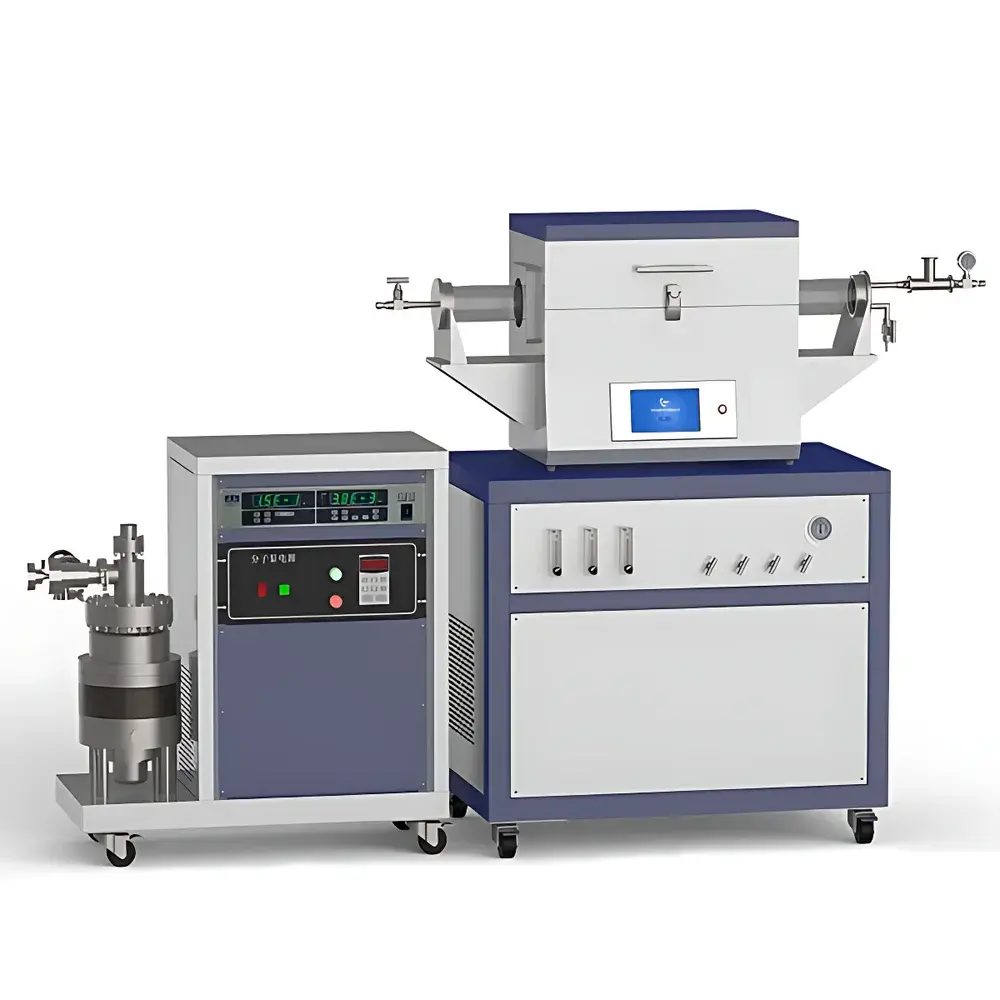
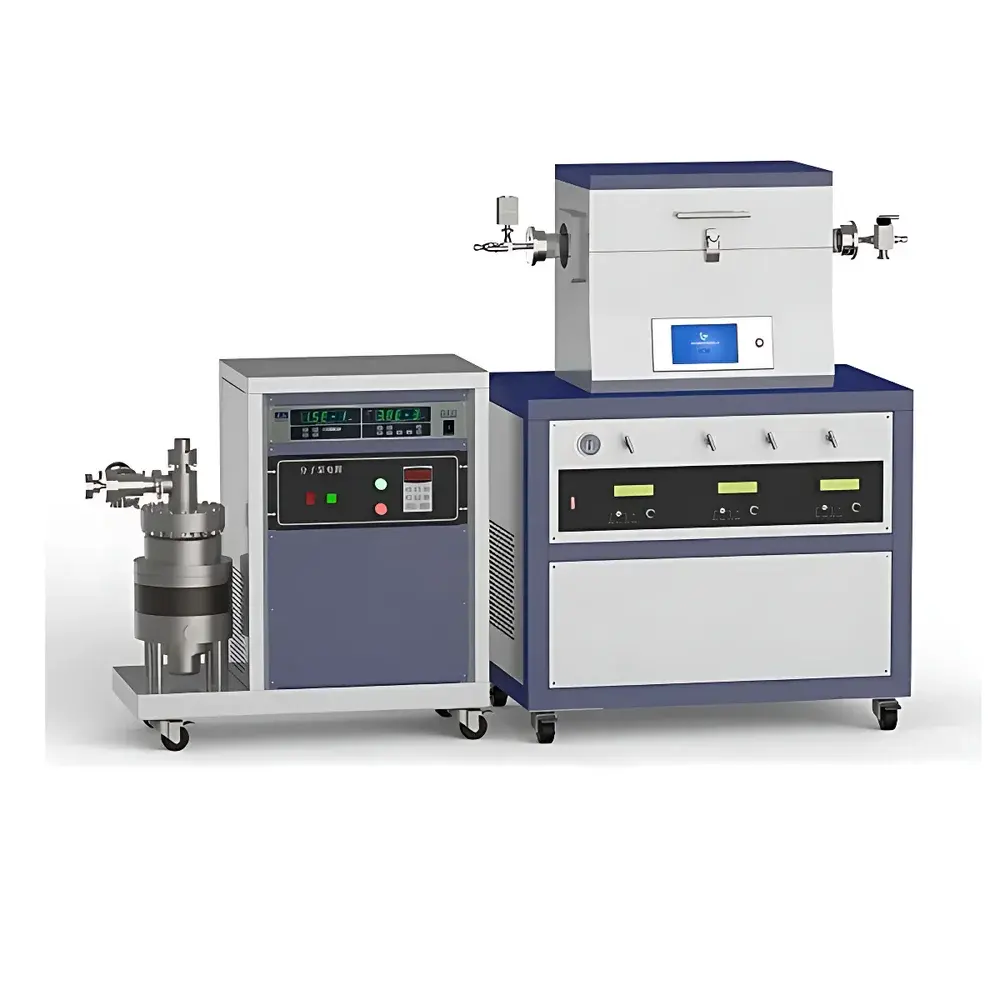
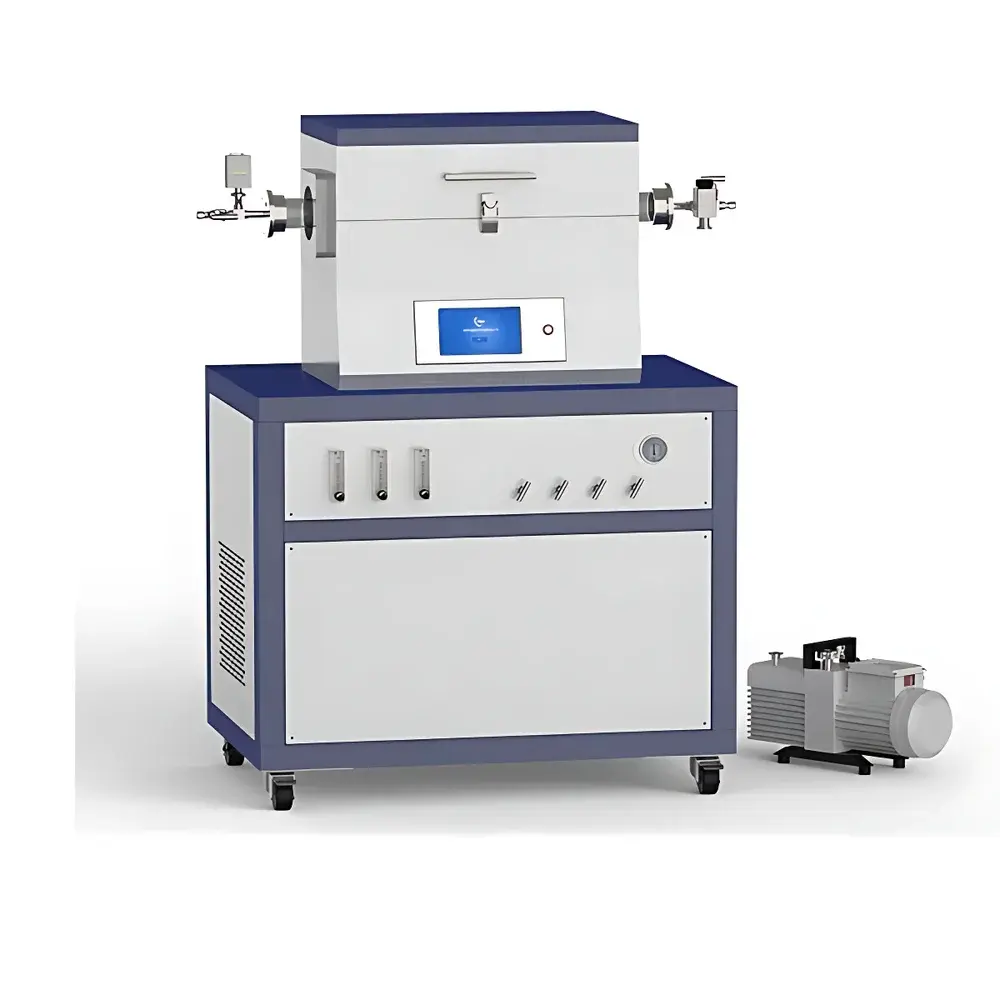
CYKY CY-CVD1200-50 Dual-Zone High-Vacuum Chemical Vapor Deposition System
| Brand | CYKY |
|---|---|
| Origin | Henan, China |
| Manufacturer Type | Direct Manufacturer |
| Model | CY-CVD1200-50 |
| Heating Method | Resistive Tube Furnace (Dual Independent Zones) |
| Maximum Operating Temperature | 1100 °C |
| Vacuum Level | ≤1.0 × 10⁻³ Pa (with Molecular Pumping System) |
| Tube Dimensions | Ø50 mm × 1000 mm (quartz), optional diameters up to Ø100 mm |
| Heating Zone Configuration | 2 × 200 mm independent zones |
| Temperature Uniformity | ±5 °C over 100 mm zone length |
| Temperature Control | 50-segment programmable PID |
| Gas Channels | 3 (N₂, H₂, Ar configurable) |
| Mass Flow Accuracy | ±2.0% FS |
| Gas Inlet/Outlet Interface | 1/4″ VCR + KF16/KF25/KF40 vacuum flanges |
| Pressure Measurement Range | 10⁵ Pa to 1 × 10⁻⁵ Pa (composite gauge) |
| Power Supply | AC 220 V, 50/60 Hz |
Overview
The CYKY CY-CVD1200-50 is a dual-zone, high-vacuum chemical vapor deposition (CVD) system engineered for controlled thin-film synthesis under precisely regulated thermal and atmospheric conditions. It integrates two independently programmable resistive heating zones within a high-purity fused quartz tube, enabling axial temperature gradients critical for staged precursor decomposition, graded film growth, or sequential multi-layer deposition. The system achieves base pressures down to 1.0 × 10⁻³ Pa using a dedicated 600 L/s turbomolecular pump backed by a 1.1 L/s rotary vane pump—significantly exceeding the performance of standard mechanical pumping alone and minimizing residual hydrocarbon and water vapor contamination. This vacuum integrity supports reproducible CVD processes for silicon-based dielectrics including SiO₂, Si₃N₄, and SiON, where stoichiometric control and interfacial cleanliness directly impact film density, refractive index, and etch resistance. Designed for laboratory-scale process development rather than production-line throughput, the CY-CVD1200-50 serves as a flexible platform for materials science research, semiconductor process optimization, and functional coating prototyping in academic and industrial R&D environments.
Key Features
- Dual independent heating zones (2 × 200 mm) with ±1 °C setpoint stability and 50-segment programmable temperature profiles for precise thermal ramping, dwell, and cooling control.
- High-purity fused quartz reaction tube (Ø50 mm × 1000 mm), optionally available in Ø60/80/100 mm configurations to accommodate varied substrate loading and gas residence time requirements.
- Triple-channel mass flow-controlled gas delivery system with calibrated float meters (N₂: 16–160 mL/min; H₂: 0–100 mL/min; Ar: 25–250 mL/min), each equipped with 304 stainless steel needle valves and VCR-compatible 1/4″ inlet/outlet ports.
- Integrated composite vacuum measurement system (Pirani + cold cathode ionization gauge) covering 10⁵ Pa to 1 × 10⁻⁵ Pa, enabling real-time monitoring across roughing, high-vacuum, and process-pressure regimes.
- Robust vacuum architecture featuring 304 stainless steel flanges, KF16/KF25/KF40 quick-connect interfaces, and metal-sealed VCR fittings—designed for long-term leak integrity and compatibility with UHV-compatible accessories.
- Intuitive 7-inch full-color touch HMI interface with on-screen parameter logging, alarm history, and password-protected user access levels for operational traceability.
Sample Compatibility & Compliance
The CY-CVD1200-50 accommodates substrates up to 45 mm in diameter (within Ø50 mm tube) and supports planar wafers, powders, fibers, and custom fixtures mounted on high-purity quartz boats or susceptor plates. Its vacuum-tight construction and low-outgassing internal surfaces meet baseline requirements for Class 1000 cleanroom-compatible operation. While not certified to ISO 9001 or ASME BPVC by default, the system’s mechanical design, pressure containment (rated to 3 MPa), and component traceability align with common pre-qualification criteria for GLP-compliant thin-film process development. All gas-handling components comply with ASTM F2219 for stainless steel tubing and ASTM E1527 for vacuum system cleanliness standards. The furnace controller logs timestamped temperature and pressure data—supporting audit-ready records when paired with external data acquisition software.
Software & Data Management
The embedded controller stores up to 100 complete process recipes with full temperature ramp/dwell sequences and associated gas flow setpoints. Real-time parameters—including zone temperatures, chamber pressure, and flow meter outputs—are displayed simultaneously and logged at user-selectable intervals (1–60 s). Data export is supported via USB 2.0 to CSV format for post-processing in MATLAB, Python (Pandas), or Excel. Optional RS485 Modbus RTU communication enables integration into centralized lab automation systems (e.g., LabVIEW or DeltaV) for remote monitoring and scheduled run execution. No proprietary cloud service or subscription is required; all firmware updates are delivered as signed binary files via secure FTP upon request.
Applications
- Growth of thermally stable SiO₂ gate dielectrics on silicon wafers via TEOS/O₃ or silane/O₂ chemistry under sub-10⁻³ Pa conditions.
- Low-temperature Si₃N₄ deposition using NH₃/SiH₄ precursors with controlled nitrogen incorporation for passivation layers in photovoltaic and MEMS devices.
- SiON alloy film synthesis for tunable optical waveguides and anti-reflective coatings, leveraging dual-zone thermal gradients to modulate O/N ratio across film thickness.
- Pre-deposition surface conditioning and in-situ annealing of metal oxides (e.g., ITO, ZnO) under N₂/H₂ forming gas atmospheres.
- Fundamental kinetic studies of precursor adsorption, surface reaction, and desorption mechanisms using pressure-resolved rate profiling.
FAQ
What vacuum level can the system achieve without the molecular pump?
With only the rotary vane pump installed, the system reaches ~4.4 × 10⁻³ Pa—sufficient for many atmospheric-pressure CVD variants but insufficient for high-purity dielectric deposition requiring sub-10⁻² Pa environments.
Can the system be configured for reactive gases such as NH₃ or O₂?
Yes. All wetted parts (stainless steel body, VCR fittings, needle valves) are compatible with NH₃, O₂, and diluted silane. Custom flow meters and corrosion-resistant seals are available upon specification at order entry.
Is the quartz tube included with thermal insulation?
The system includes the fused quartz tube and a ceramic fiber insulation jacket surrounding the heating elements—but does not include external furnace casing insulation. External thermal shielding is recommended for operator safety and ambient heat management.
Does the controller support ASTM E29 or ISO 8601 timestamp formatting?
Yes. All logged timestamps adhere to ISO 8601 (YYYY-MM-DDTHH:MM:SSZ) and include UTC offset information for cross-laboratory data correlation.
What maintenance intervals are recommended for the molecular pump?
Per manufacturer specifications, the turbomolecular pump requires bearing inspection every 12 months or 5,000 operating hours, whichever occurs first; oil changes for the backing pump are recommended every 6 months under continuous use.