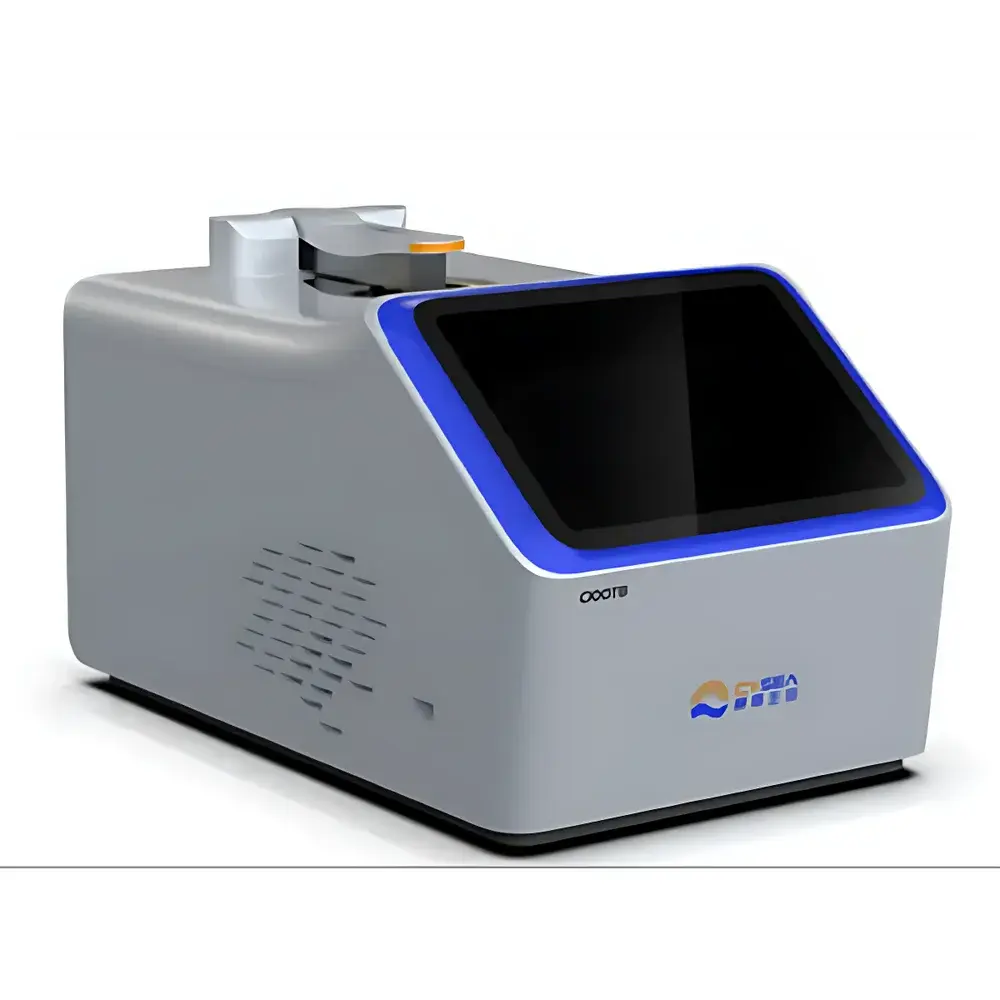
CYSEA C100TB/C100TF Label-Free Cell Counter
| Brand | CYSEA |
|---|---|
| Origin | Beijing, China |
| Manufacturer Type | Direct Manufacturer |
| Product Origin | Domestic (China) |
| Model | C100TB / C100TF |
| Detection Time | 60 s |
| Cell Concentration Range | 1×10⁴–3×10⁷ cells/mL |
| Sample Volume | 50 µL / 100 µL |
| Throughput | 12 or 24 samples per run |
| Detectable Cell Diameter | 4–200 µm |
Overview
The CYSEA C100TB and C100TF are label-free, consumable-free cell counters engineered for precision, reproducibility, and operational efficiency in academic, clinical, and industrial cell culture laboratories. Unlike traditional hemocytometer-based or disposable-slide-dependent systems, these instruments utilize high-resolution brightfield and fluorescence imaging coupled with adaptive depth-of-field optimization to perform quantitative morphometric analysis without dyes, slides, or cartridges. The core measurement principle relies on digital image acquisition at multiple focal planes, followed by AI-assisted segmentation and classification of intact, non-stained cells based on optical contrast, edge gradient, and geometric features—including diameter, circularity, and aggregation state. This enables accurate enumeration and viability assessment across a broad dynamic range of suspension cultures, including mammalian adherent-line derivatives, primary isolates, yeast, microalgae, and other eukaryotic or prokaryotic cells within the 4–200 µm size envelope.
Key Features
- True consumable-free operation: Eliminates reliance on proprietary slides, chambers, or staining reagents—reducing per-test cost and environmental footprint.
- Adaptive focus scanning: Automatically adjusts focal plane depth based on sample concentration and particle size distribution to maximize image clarity and segmentation fidelity.
- Multi-modal detection: Supports simultaneous brightfield (total count, diameter, circularity, clumping index), trypan blue exclusion (viability), and dual-channel fluorescence (acridine orange/propidium iodide or GFP-tagged populations).
- Intuitive visualization: Real-time histogram display of cell diameter and circularity distributions; overlay-enabled comparison of sequential runs.
- Robust architecture: Solid-state optics, thermally stabilized CMOS sensor, and sealed optical path ensure long-term calibration stability under routine lab conditions.
- Regulatory-ready design: Audit trail logging, user access levels, and timestamped metadata generation support GLP/GMP-aligned workflows.
Sample Compatibility & Compliance
The C100TB/C100TF accommodates a wide spectrum of biological suspensions—including adherent-cell trypsinizations, PBMC preparations, hybridoma cultures, CHO lines, stem cell aggregates (as single-cell dispersions), yeast (S. cerevisiae, P. pastoris), and freshwater/marine microalgae (e.g., Chlorella, Scenedesmus). It complies with ISO 21501-4 for particle characterization methodology and aligns with ASTM E2877-21 guidelines for automated cell counting validation. All image and numerical outputs meet minimum requirements for traceability under FDA 21 CFR Part 11 when deployed with enabled electronic signature and audit log functions.
Software & Data Management
The embedded CYSEA CountStudio™ software provides full local control via touchscreen interface and optional remote access through secure HTTPS. Each assay generates a structured .csv and .pdf report containing raw images, segmented masks, concentration values (cells/mL), viability %, mean diameter (µm), coefficient of variation (CV%), and clump index. Data is stored with immutable timestamps, operator ID, instrument serial number, and environmental metadata (ambient temperature, humidity if logged). Export formats include CSV, PNG, TIFF, and PDF—compatible with LIMS integration via RESTful API. Version-controlled firmware updates ensure continuous compliance with evolving data integrity standards.
Applications
- Cell culture QC: Routine passage verification, seeding density standardization, and bioreactor inoculum preparation.
- Transfection & gene editing: Quantification of GFP/RFP-positive populations pre- and post-sorting; viability monitoring during CRISPR-Cas9 electroporation recovery.
- Immunology & oncology: PBMC yield assessment, tumor spheroid dissociation efficiency, and CAR-T expansion kinetics.
- Bioprocess development: Monitoring yeast fermentation titers, algal biomass productivity, and microbial contamination screening in upstream processes.
- Educational labs: Teaching core concepts in cell biology, statistics, and image-based quantification without recurring consumable costs.
FAQ
Does the C100TB/C100TF require calibration with NIST-traceable beads?
Yes—initial factory calibration uses ISO 11171-certified polystyrene microspheres (4–200 µm); users may perform periodic verification using supplied reference standards.
Can the system distinguish between cell debris and intact cells?
Yes—through combined intensity thresholding, convex hull analysis, and minimum area filtering, optimized for distinguishing viable somas from subcellular fragments.
Is data export compatible with Excel and GraphPad Prism?
All numeric outputs are natively generated as UTF-8 CSV files with header annotations, directly importable into spreadsheet and statistical analysis platforms.
What is the recommended maintenance interval?
Optical path cleaning every 3 months; full performance verification annually or after 500 runs—documented in the built-in service log.
How does the instrument handle highly viscous or mucinous samples?
Viscosity-sensitive protocols automatically reduce stage speed and extend exposure time; optional dilution guidance is provided in real time based on initial image SNR assessment.