
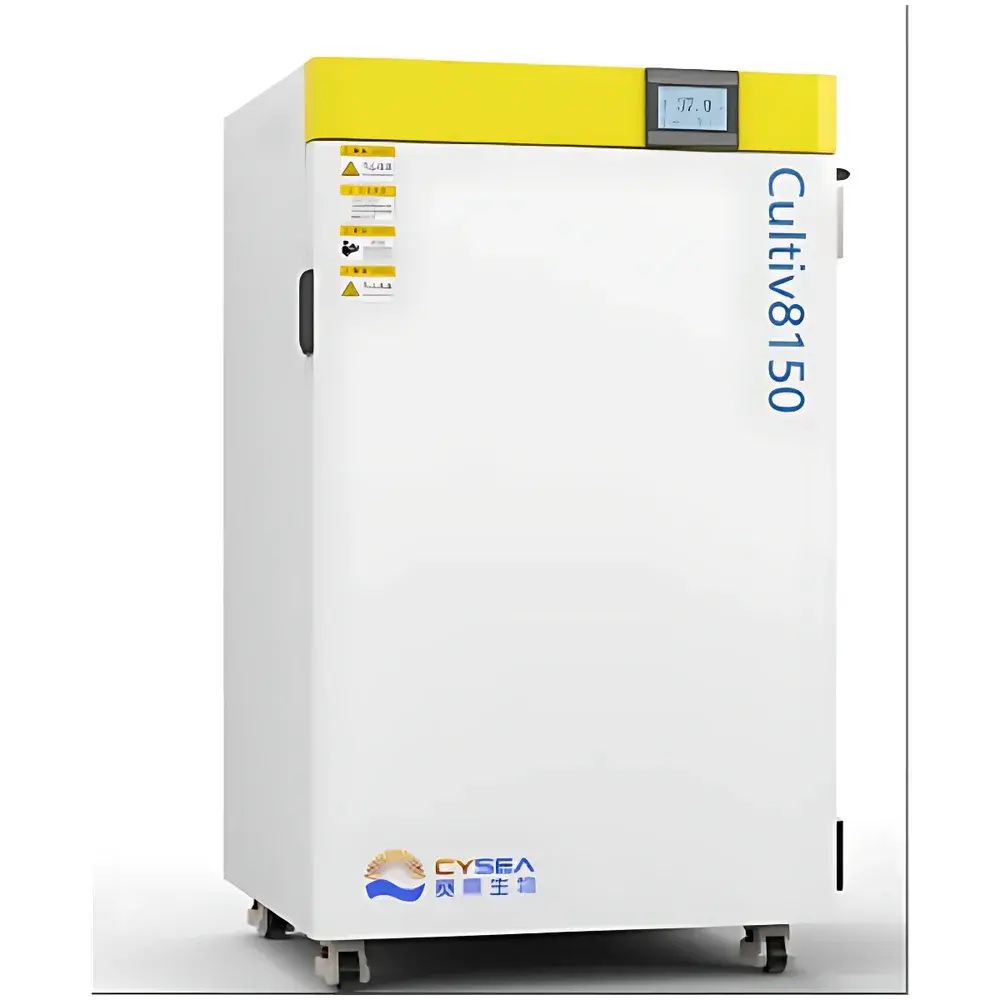
CYSEA Cultiv8 Series Carbon Dioxide Incubator
| Brand | CYSEA |
|---|---|
| Origin | Beijing, China |
| Manufacturer Type | Direct Manufacturer |
| Instrument Type | Air-Jacketed CO₂ Incubator |
| CO₂ Detection | Infrared (IR) Sensor |
| Temperature Control Range & Accuracy | Ambient +3°C to 55°C (at 25°C ambient), ±0.1°C at 37°C |
| Temperature Uniformity | ±0.3°C at 37°C (25°C ambient) |
| CO₂ Concentration Control Range & Accuracy | 0–20% vol, ±0.1% at 5% CO₂ (37°C) |
| Dimensions | Cultiv8150 — Depth 560 mm × Width 540 mm × Height 580 mm |
Overview
The CYSEA Cultiv8 Series Carbon Dioxide Incubator is an air-jacketed, microprocessor-controlled environmental chamber engineered for reliable, long-term mammalian cell culture under tightly regulated physiological conditions. It operates on the principle of precise gas-phase equilibrium control—maintaining stable CO₂ concentration (typically 5% v/v), temperature (commonly 37°C), and relative humidity (>90% RH) to replicate in vivo extracellular matrix conditions. Unlike water-jacketed systems, the air-jacket architecture provides rapid thermal recovery after door openings and eliminates risks associated with water leakage or microbial contamination in jacket reservoirs. The incubator integrates real-time infrared (IR) CO₂ sensing with automatic temperature and pressure compensation algorithms—ensuring measurement integrity across ambient fluctuations and altitude variations. Its six-sided heating system, coupled with a dual-path forced-air circulation design, establishes uniform thermal distribution without reliance on natural convection—critical for reproducible monolayer expansion, suspension culture scalability, and sensitive stem cell or primary cell applications.
Key Features
- Six-surface heating elements with independent PID control deliver ±0.3°C temperature uniformity at 37°C—validated per ISO 13408-2 Annex B protocols for incubator qualification.
- Infrared (IR) CO₂ sensor with built-in temperature/pressure compensation ensures ±0.1% accuracy at 5% setpoint; drift <0.02% per month (typical), eliminating need for frequent recalibration.
- Integrated UV-C irradiation in recirculation ducts enables continuous decontamination during operation—reducing airborne bioburden without interrupting culture timelines.
- One-touch dry-heat sterilization cycle (160–180°C, 3–6 hr duration) achieves ≥6-log reduction of bacterial endospores (e.g., Geobacillus stearothermophilus) per ISO 14644-1 Class 5 cleanroom requirements; no component disassembly required.
- Dual independent air circuits—separate paths for temperature-regulated air and humidified CO₂-enriched air—minimize cross-gradient interference and stabilize both humidity and gas composition simultaneously.
- Natural evaporation-based humidification via stainless-steel water pan maintains >92% RH at 37°C without ultrasonic misting, avoiding mineral deposition or localized condensation that may compromise sterility or sensor function.
Sample Compatibility & Compliance
The Cultiv8 series supports standard T-flasks (up to T225), multi-well plates (6–96-well), Petri dishes, roller bottles, and custom bioreactor inserts. All internal surfaces are electropolished 304 stainless steel (Ra ≤ 0.4 µm), compliant with ISO 10993-5 cytotoxicity standards. The unit meets IEC 61010-1:2010 safety requirements for laboratory equipment and conforms to EN 61326-1:2013 for electromagnetic compatibility. Optional data logging modules support 21 CFR Part 11-compliant audit trails—including user ID, timestamped parameter changes, alarm events, and sterilization cycle records—for GLP/GMP-aligned workflows. CO₂ and temperature validation reports are provided with IQ/OQ documentation packages upon request.
Software & Data Management
The embedded controller features a 7-inch capacitive touchscreen interface with multilingual support (English, German, Japanese, Simplified Chinese). Real-time graphs display CO₂ concentration, chamber temperature, relative humidity, and sterilization status over configurable time windows (1 hr to 30 days). Historical data export is available via USB 2.0 (CSV format) or optional Ethernet/Wi-Fi connectivity for integration into LIMS or MES platforms. Alarm thresholds are fully programmable—triggering visual/audible alerts and email/SMS notifications (via SMTP gateway) for deviations exceeding ±0.2°C or ±0.2% CO₂. Firmware updates are performed offline to maintain regulatory integrity during production use.
Applications
- Mammalian cell line maintenance (HEK293, CHO, HeLa, A549) and expansion for bioproduction.
- Stem cell culture (hESC, iPSC) requiring stringent O₂/CO₂ stability and low particulate exposure.
- Primary cell isolation and co-culture experiments where microenvironmental consistency directly impacts differentiation outcomes.
- Microbiological studies involving facultative anaerobes or CO₂-dependent pathogens (e.g., Campylobacter jejuni, Neisseria gonorrhoeae).
- Regulatory batch release testing under USP , EP 2.6.27, and ISO 13408-2 for cell therapy manufacturing environments.
FAQ
Does the Cultiv8 series support hypoxic (low-O₂) culture conditions?
No—this model is configured exclusively for CO₂ regulation and does not include O₂ monitoring or nitrogen/air blending capabilities. Hypoxia-capable variants are available under the Cultiv8-HX product line.
Is third-party calibration certification included with shipment?
Factory calibration certificates (traceable to NIST standards) are provided. UKAS or ISO/IEC 17025-accredited on-site calibration services can be arranged separately.
Can the incubator be integrated into a central building management system (BMS)?
Yes—via Modbus RTU (RS-485) or optional BACnet/IP protocol module for remote status monitoring and alarm forwarding.
What is the recommended maintenance interval for the IR CO₂ sensor?
Sensor performance verification is advised every 6 months; full replacement is typically required every 24–36 months depending on usage intensity and ambient air quality.
Are HEPA filters standard or optional?
A 0.3-µm, 99.97% efficient HEPA filter is integrated into the intake path as standard; ULPA (U15) upgrade is available upon request.



