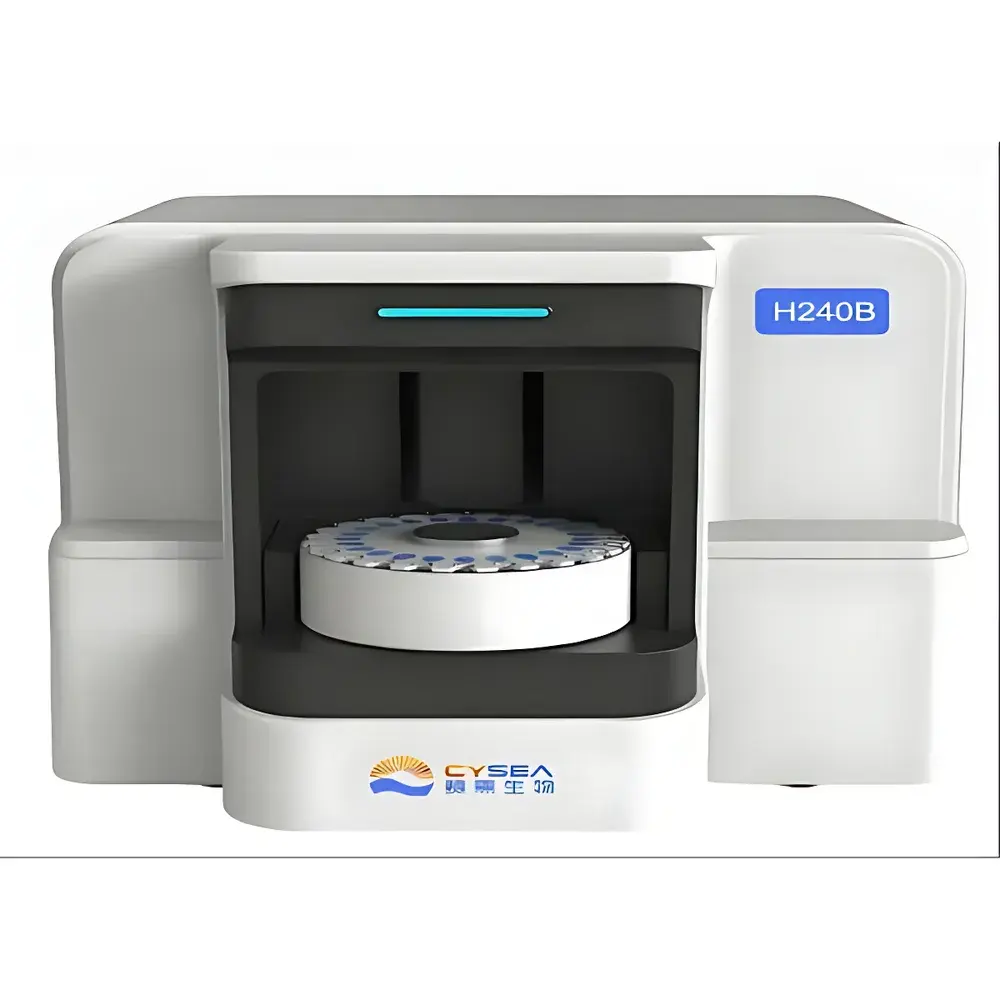
CYSEA H120B High-Throughput Automated Cell Counter
| Brand | CYSEA |
|---|---|
| Origin | Beijing, China |
| Manufacturer Type | Original Equipment Manufacturer (OEM) |
| Product Origin | Domestic (China) |
| Model | H120B |
| Detection Time | 60 s per sample |
| Cell Concentration Range | 1×10²–2×10⁷ cells/mL |
| Sample Volume | 50 µL or 100 µL |
| Throughput Options | 12-well or 24-well sample carousel |
| Detectable Cell Diameter | 1–80 µm |
Overview
The CYSEA H120B High-Throughput Automated Cell Counter is an engineered solution for rapid, standardized, and regulatory-compliant cell enumeration in biopharmaceutical development, cell therapy manufacturing, and academic research laboratories. Utilizing high-resolution brightfield and dual-channel fluorescence imaging—based on acridine orange (AO) and propidium iodide (PI) staining—the instrument quantifies viable and non-viable cells by leveraging morphological and membrane-integrity contrast. Unlike manual hemocytometer-based methods or semi-automated counters requiring user-defined thresholds, the H120B integrates a permanent fused-silica flow cell and AI-driven image segmentation trained on >10,000 annotated biological samples. This architecture eliminates inter-operator variability and ensures consistent optical path geometry, illumination uniformity, and exposure timing across all measurements—critical for longitudinal studies and process validation.
Key Features
- Fully automated workflow: Integrated reagent dispensing, vortex-assisted mixing, precision microfluidic aspiration, real-time image acquisition, and post-run cleaning—all executed without manual intervention.
- High-speed throughput: Single-sample processing (from loading to report generation) completed within ≤60 seconds; supports 12- or 24-position sample carousels for batched analysis.
- Dual-modality detection: Brightfield mode with trypan blue exclusion for immortalized cell lines; fluorescence mode (AO/PI) for primary cells (e.g., PBMCs, dissociated tissues, whole blood), enabling robust discrimination against debris, platelets, and apoptotic fragments.
- Permanent quartz flow cell: Eliminates disposable slide dependency, reduces consumable cost, and enhances measurement reproducibility (CV <3% across repeated runs of identical samples).
- Regulatory-ready software: Compliant with FDA 21 CFR Part 11 requirements—including role-based user authentication, electronic signatures, audit trails, immutable data logging, and secure backup protocols.
- No-parameter AI image analysis: Pre-trained convolutional neural network (CNN) model automatically identifies cell contours, classifies viability status, and rejects artifacts—no user-adjustable thresholding or manual gating required.
Sample Compatibility & Compliance
The H120B accommodates diverse sample types including suspension cultures (CHO, HEK293, Jurkat), primary isolates (PBMCs, MSCs, T cells), enzymatically digested tissues, and diluted whole blood—provided cells fall within the 1–80 µm diameter range and are suspended in compatible buffers (e.g., PBS, saline, culture medium). All assays adhere to ISO 20387:2018 (biobanking), ASTM E2877-22 (cell counting standardization), and USP (cell-based assay validation). The system supports IQ/OQ/PQ documentation packages and is designed for GLP- and GMP-aligned environments, including QC release testing of viral vectors, CAR-T products, and monoclonal antibody production batches.
Software & Data Management
The embedded H120B Control Suite provides a validated Windows-based interface with three-tiered user permissions (Administrator, Analyst, Viewer), time-stamped electronic records, and encrypted local database storage. Raw images, metadata (exposure time, gain, focus position), and analytical logs are retained with checksum integrity verification. Export options include CSV, PDF reports with embedded thumbnails, and LIMS-compatible XML schemas. Scheduled backups can be directed to network drives or NAS devices; archived datasets remain searchable via sample ID, operator, date range, or viability metric filters.
Applications
- Cell therapy manufacturing: Release testing of final drug product (FDP) for total viable count (TVC), viability %, and concentration prior to cryopreservation or infusion.
- Bioprocess monitoring: In-process sampling during upstream bioreactor runs to track expansion kinetics and harvest timing decisions.
- Vaccine and mAb development: Quantification of host cell lines pre-transfection and post-purification to support yield calculations and lot consistency assessment.
- Academic and translational research: Standardized enumeration for CRISPR editing efficiency assays, organoid dissociation optimization, and immune cell functional assays.
- Contract development and manufacturing organizations (CDMOs): Cross-site method transfer enabled by hardware/software standardization and built-in performance qualification tools.
FAQ
Does the H120B require disposable counting chambers or slides?
No—the instrument uses a permanently installed, optically polished fused-silica flow cell that undergoes automated cleaning between samples.
Can the system validate cell viability in heterogeneous primary samples such as whole blood?
Yes—fluorescence mode with AO/PI enables selective nuclear staining and membrane permeability discrimination, minimizing interference from erythrocytes, platelets, and cellular debris.
Is the software qualified for use in FDA-submitted regulatory filings?
Yes—the software includes full 21 CFR Part 11 compliance features, and CYSEA provides IQ/OQ documentation templates and PQ support services.
What maintenance is required beyond daily cleaning cycles?
Routine maintenance includes quarterly calibration verification using NIST-traceable microsphere standards and annual optical alignment checks performed by certified field service engineers.
How does the AI algorithm handle clumped or irregularly shaped cells?
The CNN model was trained on morphologically diverse populations—including adherent cell aggregates, dendritic cells, and tumor spheroids—and applies adaptive watershed segmentation to resolve touching objects while preserving viability classification accuracy.