
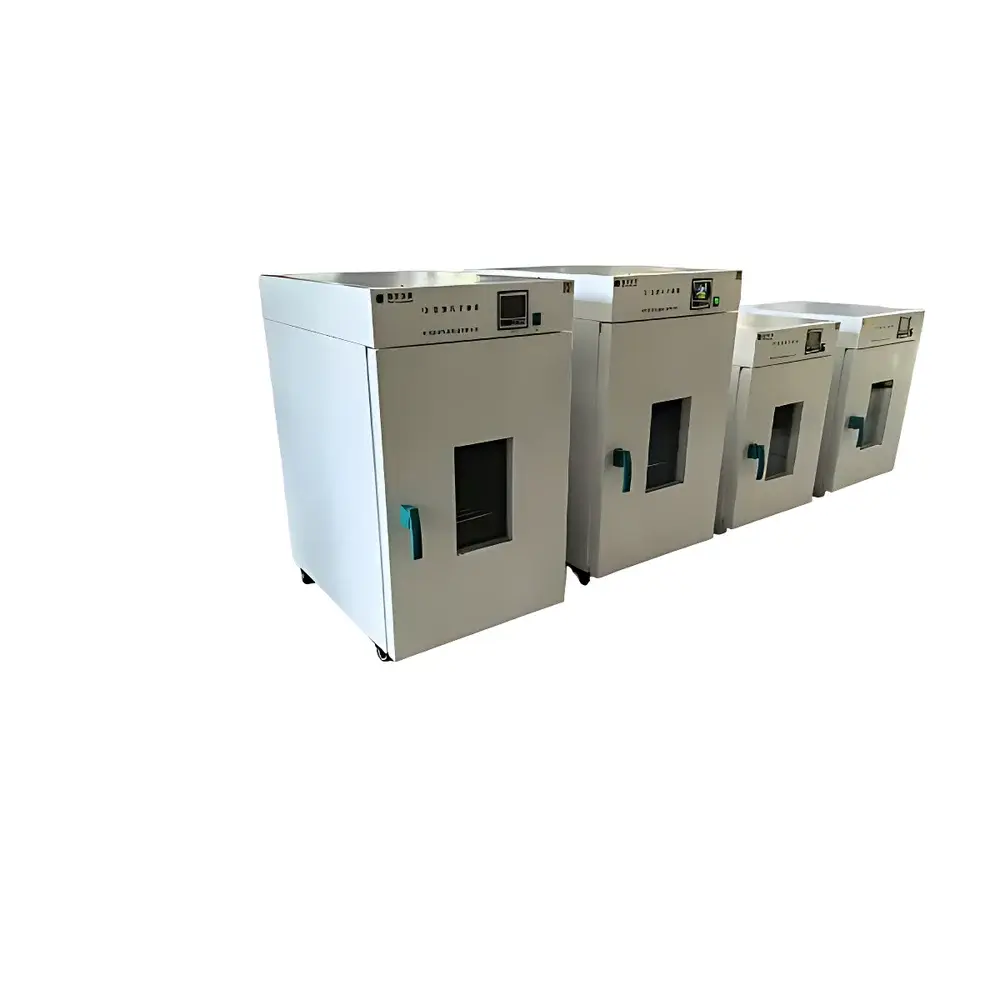
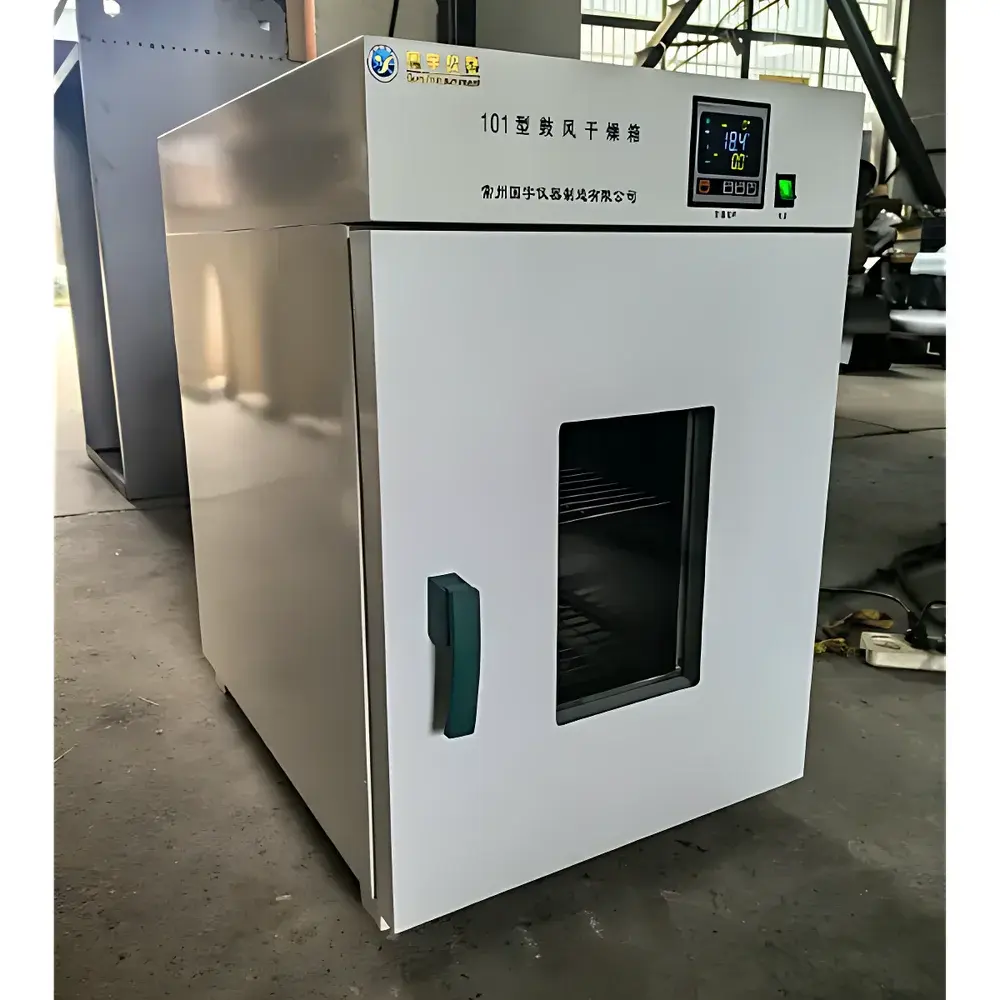
CZGY 101-1A Forced-Air Precision Drying Oven
| Brand | CZGY |
|---|---|
| Origin | Jiangsu, China |
| Manufacturer Type | Direct Manufacturer |
| Product Category | Domestic |
| Model | 101-1A |
| Instrument Type | Precision Drying Oven |
| Temperature Range | RT+10 to 300 °C |
| Temperature Fluctuation | ±0.5 °C |
| Control Range | RT+10 to 300 °C |
| Chamber Dimensions (W×D×H) | 350 × 350 × 450 mm |
| Temperature Resolution | 0.1 °C |
| Interior Material | Stainless Steel |
| Heating Method | Forced-Air Circulation |
| Temperature Uniformity | ±2 °C |
Overview
The CZGY 101-1A Forced-Air Precision Drying Oven is an engineered solution for controlled thermal processing in research laboratories, quality control environments, and industrial R&D settings. Designed around the principle of convective heat transfer via a rear-mounted heating element and axial fan-driven air circulation, this oven ensures rapid thermal equilibration and stable maintenance of setpoint temperatures across the entire working chamber. Unlike bottom-heated ovens—whose radiant heat distribution poses elevated fire risk due to direct contact between heating elements and flammable samples or containers—the 101-1A employs a rear-wall heating configuration with dedicated airflow ducting. This architecture eliminates hot-spot accumulation at the chamber floor, enhances operator safety, and simplifies heater replacement during routine maintenance. The unit complies with fundamental electrical safety standards for laboratory-grade Class II equipment (IEC 61010-1) and supports continuous operation under GLP-compliant workflows when integrated with validated documentation protocols.
Key Features
- Rear-mounted heating system with forced-air circulation—eliminates floor-level ignition hazards associated with bottom-heating designs
- Stainless steel interior chamber (304 grade) resistant to corrosion, oxidation, and repeated thermal cycling
- Double-walled construction with rock wool insulation between outer cold-rolled steel shell and inner chamber, minimizing thermal loss and external surface temperature rise
- High-transparency, high-temperature tempered glass observation window centered on the door for real-time visual monitoring without opening the chamber
- Digital segment LCD controller with fuzzy PID algorithm enabling precise temperature regulation (±0.5 °C fluctuation) and 0.1 °C resolution
- Adjustable timer function supporting programmable durations from 0 to 9999 minutes (or hours), with auto-shutdown capability
- Uniform airflow path design ensuring ±2 °C temperature uniformity across the full 350 × 350 × 450 mm working volume
Sample Compatibility & Compliance
The 101-1A accommodates standard laboratory sample formats including Petri dishes, weighing boats, glass desiccators, metal trays, and polymer-coated substrates. Its RT+10 to 300 °C operating envelope supports moisture removal, pre-baking of substrates, thermal aging of polymers, residual solvent evaporation, and gravimetric analysis per ASTM E121–22 and ISO 787-2. The stainless steel chamber resists degradation from mild organic solvents and aqueous residues, though prolonged exposure to halogenated or strongly acidic vapors is not recommended without supplemental ventilation. While the unit itself does not carry CE marking or UL certification out-of-the-box, it meets baseline mechanical and thermal safety requirements referenced in EN 61010-1 and can be commissioned for use in ISO/IEC 17025-accredited laboratories when operated within documented SOPs and subjected to periodic calibration verification against NIST-traceable reference thermometers.
Software & Data Management
The 101-1A operates via embedded firmware without proprietary software dependency. All temperature setpoints, timer values, and operational status are managed through the front-panel interface. For integration into networked lab environments, optional RS-485 or analog 4–20 mA output modules (available as factory-installed accessories) enable connection to SCADA systems or centralized data loggers. When used in regulated environments requiring audit trails—such as pharmaceutical QC labs governed by FDA 21 CFR Part 11—the oven must be paired with external validation-grade recording devices that capture time-stamped temperature readings, user access logs, and alarm events. CZGY provides calibration certificates upon request, traceable to national metrology institutes, supporting compliance with ISO/IEC 17025 Clause 6.4 and GMP Annex 15 requirements for equipment qualification.
Applications
- Moisture content determination in pharmaceutical excipients, food powders, and ceramic precursors per USP <731> and AOAC 950.46
- Baking and curing of thin-film coatings, printed circuit board substrates, and sensor dielectrics
- Pre-conditioning of filters, membranes, and chromatographic media prior to gravimetric or flow testing
- Accelerated thermal stability testing of adhesives, encapsulants, and composite laminates
- Drying of biological specimens, soil samples, and botanical materials under controlled low-humidity conditions
- Preheating of crucibles, volumetric glassware, and analytical balances prior to high-precision weighing
FAQ
What safety certifications does the 101-1A hold?
The unit conforms to IEC 61010-1 for electrical safety in laboratory equipment but does not carry CE, UL, or CSA marks unless customized and third-party certified per customer specification.
Can the oven be calibrated internally?
No internal calibration is supported; users must perform external verification using a NIST-traceable thermometer placed at multiple chamber locations per ISO 17025 Section 6.5.
Is the temperature uniformity verified at load or no-load conditions?
Published ±2 °C uniformity is specified under no-load conditions per manufacturer test protocol; loaded uniformity depends on rack configuration and sample thermal mass.
Does the unit support ramp-soak programming?
No—this model features only single-setpoint control with timer-based shutdown; multi-step profiles require external programmable controllers.
What maintenance intervals are recommended for the fan and heating element?
Inspect fan blades and airflow ducts quarterly; replace heating elements only if measured resistance deviates >10% from nominal value—typically beyond 5,000 operational hours.



