
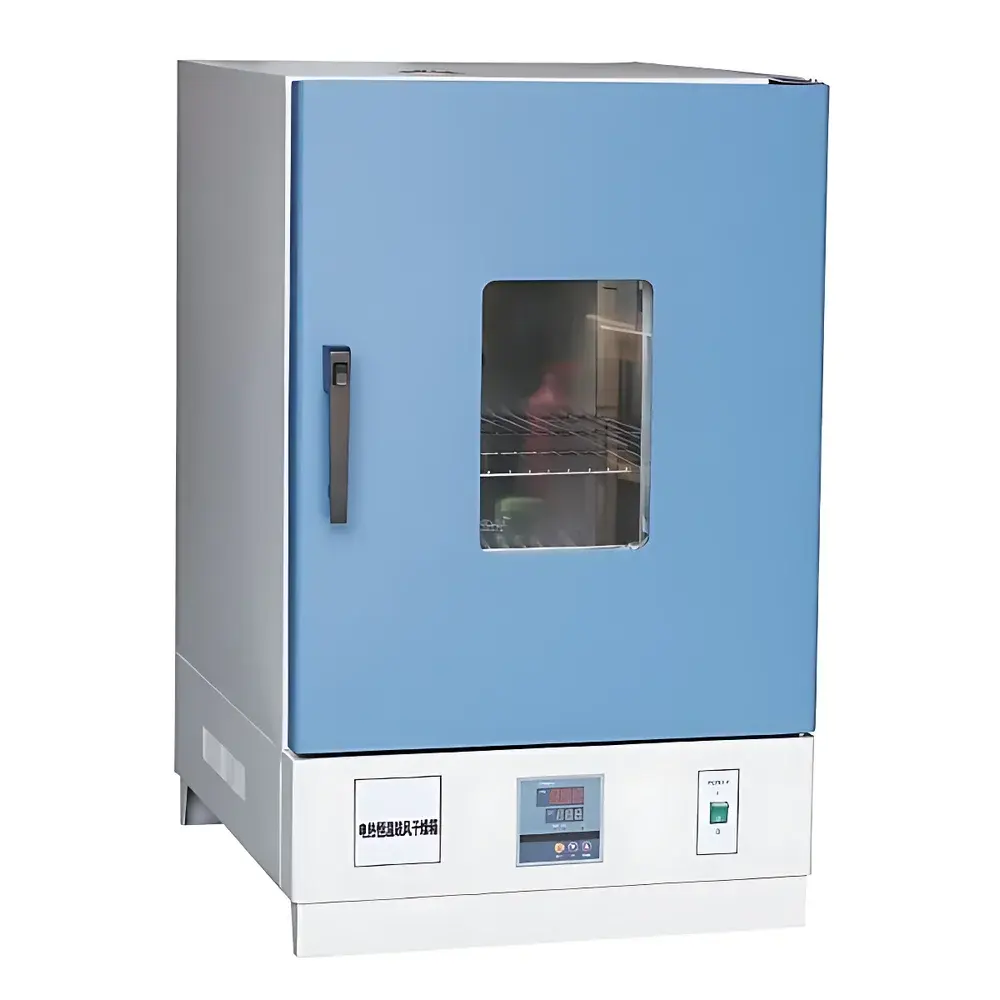
CZGY 101 Series Forced-Air Electric Oven
| Brand | CZGY |
|---|---|
| Origin | Jiangsu, China |
| Manufacturer Type | Direct Manufacturer |
| Country of Origin | China |
| Model | 101-0A |
| Temperature Range | RT+10°C to 300°C |
| Temperature Uniformity | ±1°C |
| Humidity Control | Not Available |
| Chamber Dimensions (H×W×D) | 350×350×350 mm |
| Power Supply | 220 V ±10%, 1.2 kW |
| Heating Rate | ≤100 min (to 200°C) |
| Temperature Fluctuation | ±1°C |
| Resolution | 0.1°C |
| Timer Range | 0–999 min |
| Construction | Cold-rolled steel exterior with powder coating |
| Viewing Window | Tempered glass |
| Control System | Segment LCD display with fuzzy PID algorithm |
Overview
The CZGY 101 Series Forced-Air Electric Oven is a precision-engineered laboratory drying and heat-treatment instrument designed for consistent thermal processing across research, quality control, and production environments. Operating on the principle of forced convection, the unit employs a bottom-mounted heating element coupled with a high-efficiency axial fan to drive heated air through calibrated ducts into the working chamber. This active airflow architecture ensures rapid thermal equilibration and minimizes vertical and horizontal temperature gradients—critical for applications requiring uniform thermal exposure, such as moisture content determination (per ASTM D2231, ISO 787-2), gravimetric residue analysis, pre-conditioning of samples prior to chromatography or spectroscopy, and sterilization of non-critical labware. The oven’s robust mechanical design integrates a cold-rolled steel outer shell with electrostatic powder coating, a fully welded 304 stainless steel inner chamber, and high-density mineral wool insulation between walls—delivering structural integrity, corrosion resistance, and thermal efficiency. A centrally mounted tempered glass observation window enables real-time visual monitoring without compromising chamber integrity or thermal stability.
Key Features
- Forced-air convection system with rear-mounted axial fan and optimized internal air duct geometry for enhanced temperature uniformity (±1°C across full chamber volume)
- Fuzzy PID digital temperature controller with segment LCD interface, 0.1°C resolution, and programmable timer (0–999 minutes)
- Stainless steel interior chamber (304 grade) resistant to oxidation, acid fumes, and repeated thermal cycling
- Thermal insulation layer composed of non-combustible mineral wool (density ≥100 kg/m³), minimizing external surface temperature rise and energy loss
- Front-access dual-layer door with silicone gasket seal and mechanical latch to maintain chamber integrity during operation
- Over-temperature protection circuit with independent mechanical cut-off switch (non-resettable at >320°C)
- Grounded power input with dedicated earth terminal (yellow-orange wire) compliant with IEC 61000-6-3 EMC emission standards
Sample Compatibility & Compliance
The CZGY 101 Series is intended for non-explosive, non-volatile, and non-corrosive solid or powdered samples only. It is not rated for Class I, II, or III hazardous locations per NEC Article 500 or ATEX Directive 2014/34/EU. Users must strictly avoid placement of flammable solvents, peroxides, lithium batteries, or organic peroxides inside the chamber. The instrument meets general-purpose laboratory safety requirements under GB/T 2893.1–2020 (safety color coding) and GB 4793.1–2019 (safety requirements for electrical equipment for measurement, control, and laboratory use). While not certified to UL 61010-1 or EN 61010-1, its construction and control architecture align with baseline functional safety expectations for Class B laboratory ovens. Routine calibration verification may be performed using NIST-traceable PT100 probes per ISO/IEC 17025-accredited procedures.
Software & Data Management
This model operates via embedded firmware without external software dependency. All operational parameters—including setpoint, real-time chamber temperature, elapsed time, and timer status—are displayed locally on the segment LCD. The controller supports manual parameter entry via membrane keypad and requires explicit confirmation (SET key press) for any modification—a design feature supporting GLP-aligned procedural discipline. Audit trail functionality is not integrated; however, users may document operational logs manually or integrate external data loggers (e.g., Omega OM-DAQPRO-5300 series) via the optional analog output port (0–5 V DC proportional to chamber temperature). For regulated environments requiring electronic records, third-party validation packages are available to support FDA 21 CFR Part 11 compliance when paired with validated data acquisition systems.
Applications
- Drying biological tissues, filter papers, and polymer films prior to gravimetric analysis (ASTM D2231, USP <631>)
- Pre-drying soil, feed, or pharmaceutical excipients for moisture content quantification (AOAC 950.46, Ph. Eur. 2.2.32)
- Conditioning reference standards and calibration weights in metrology labs
- Heat-aging tests of packaging materials per ASTM D3045
- Baking ceramic crucibles and quartz ware to remove organic residues
- Pre-heating glassware and metal tools in microbiology and histology workflows
- Stabilization of hygroscopic reagents before analytical weighing
FAQ
Is this oven suitable for sterilization of medical devices?
No. It lacks steam generation, pressure control, and validated cycle mapping required for sterility assurance per ISO 17665 or EN 285. It may be used for dry-heat depyrogenation of glassware only under user-defined, validated protocols.
Can humidity be controlled in this model?
No. The 101 Series is a dry-heat convection oven with no integrated humidification or dehumidification subsystem.
What is the recommended maintenance interval?
Inspect fan operation, door seal integrity, and terminal tightness every 6 months. Clean interior surfaces with mild detergent after each use involving volatile residues; perform full chamber wipe-down with isopropyl alcohol quarterly.
Does the unit comply with FDA 21 CFR Part 11?
Not natively. Electronic signature and audit trail capabilities require integration with validated third-party data logging and software platforms.
What safety certifications does it hold?
It conforms to Chinese national standard GB 4793.1–2019 for laboratory electrical equipment safety. CE marking is not applied; export configurations require customer-specified regional certification.




