
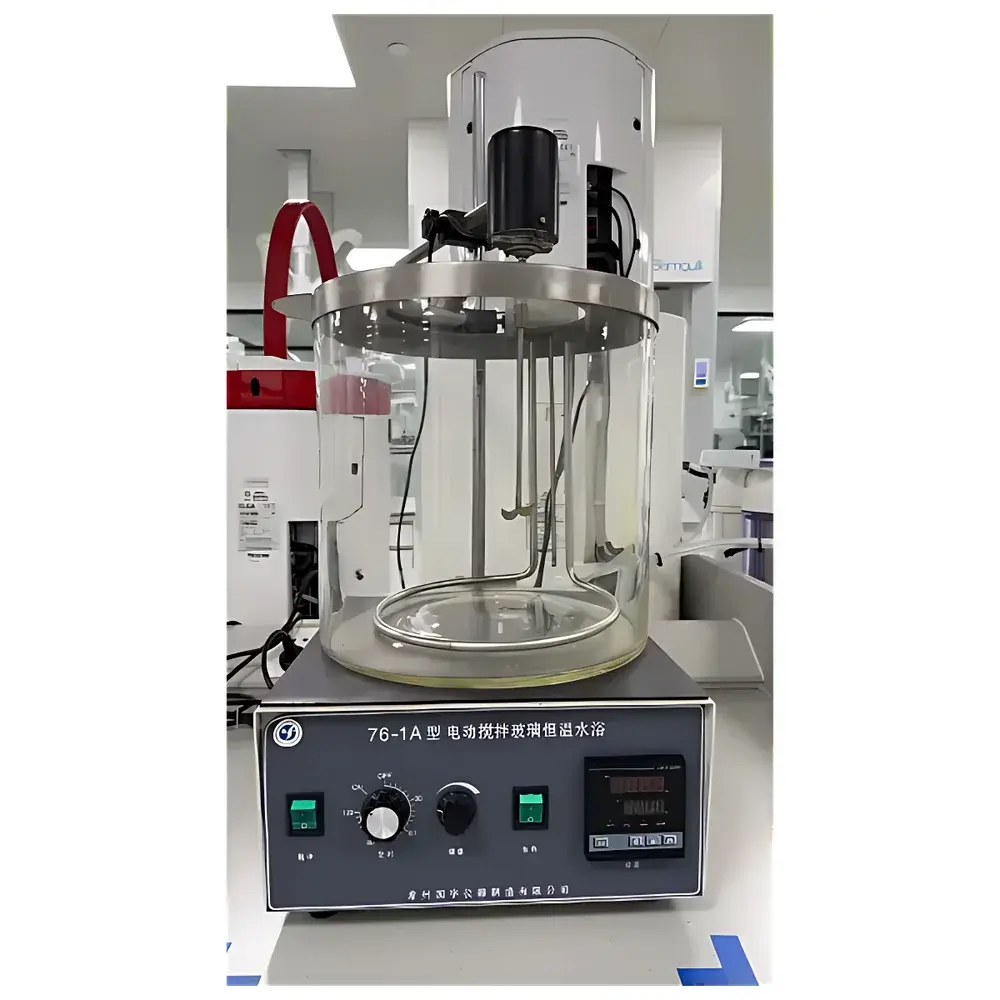
CZGY 76-1A Digital Display Glass Jacketed Water Bath
| Brand | CZGY |
|---|---|
| Origin | Jiangsu, China |
| Manufacturer Type | Direct Manufacturer |
| Product Category | Domestic |
| Model | 76-1A |
| Instrument Type | Water Bath / Oil Bath |
| Circulation Function | None |
| Temperature Control | Heating-Only |
| Bath Volume | 21 L |
| Temperature Range | Ambient +5°C to 100°C |
| Temperature Stability | ±0.5°C |
| Temperature Resolution | 0.1°C |
| Power Supply | 220 V, 50 Hz |
| Heating Power | 1000 W |
| Stirring Motor Power | 30 W |
| Stirring Speed Range | 0–2500 rpm |
| Timer Range | 0–120 min or Continuous Operation |
| Chamber Dimensions | Ø300 mm × 300 mm (H) |
Overview
The CZGY 76-1A Digital Display Glass Jacketed Water Bath is a precision-engineered laboratory thermal platform designed for consistent, controllable heating of samples in glass vessels. Unlike metal-walled baths, its transparent borosilicate glass chamber enables real-time visual monitoring of sample behavior—critical for reactions requiring optical assessment, phase transition observation, or uniform suspension maintenance. The unit operates on resistive heating with digital PID temperature regulation, delivering stable thermal environments across its full operational range (ambient +5°C to 100°C). Its non-circulating design is optimized for static immersion applications where convective flow is unnecessary or potentially disruptive—such as gentle warming of enzyme solutions, pre-heating reagents prior to chromatographic injection, or controlled evaporation in open-vessel setups. The integrated high-torque DC stirring motor (0–2500 rpm) ensures rapid thermal equilibration and homogenization without introducing air bubbles or shear-sensitive degradation—particularly advantageous for viscous biological media or polymer solutions.
Key Features
- Transparent glass bath chamber (Ø300 mm × 300 mm H) for unobstructed process visualization and ergonomic sample handling
- Digital LED display with 0.1°C resolution and ±0.5°C stability at setpoint—validated per ASTM E2209 for laboratory thermal equipment performance verification
- Independent dual-control interface: dedicated buttons for temperature setpoint adjustment (SET, ↑, ↓) and separate toggle switches for heating and stirring activation
- Adjustable mechanical timer (0–120 min) with continuous operation mode for extended thermal protocols
- Robust 1000 W heating element with overtemperature cut-off and grounded chassis—compliant with IEC 61010-1 safety requirements for laboratory electrical equipment
- Low-noise, brushless stirring motor (30 W) with analog speed control; optimized for longevity under prolonged mid-range operation (1200–1800 rpm)
- Front-panel access to advanced PID parameters (P, T, E) for fine-tuning response dynamics in demanding thermal ramping applications
Sample Compatibility & Compliance
The 76-1A accommodates standard laboratory glassware up to 2 L capacity—including round-bottom flasks, beakers, and graduated cylinders—without interference from internal fixtures. Its inert glass interior resists chemical attack from aqueous buffers, ethanol/water mixtures, and mild organic solvents (e.g., acetone, ethyl acetate), supporting ISO 17025-compliant sample preparation workflows. While not rated for oil immersion, the bath maintains dimensional stability and thermal uniformity when used with silicone or mineral oils up to 80°C. The device meets CE marking requirements for electromagnetic compatibility (EN 61326-1) and electrical safety (EN 61010-1), and its grounding terminal supports GLP/GMP audit readiness when integrated into validated lab systems. Note: Per manufacturer specification, operation below 50% fill level (≥10.5 L water) is mandatory to prevent dry-run damage and ensure sensor accuracy.
Software & Data Management
As a standalone analog-digital hybrid instrument, the 76-1A does not feature embedded data logging or computer connectivity. Temperature and stirring parameters are managed exclusively via front-panel controls, aligning with FDA 21 CFR Part 11 principles for “low-risk” instruments where manual entry suffices for batch record integrity. All parameter changes—including setpoint adjustments and timer resets—are immediately reflected on the LED display with no latency, eliminating interpretation ambiguity. For regulated environments, users may document operational settings manually in bound logbooks or integrate external USB thermocouple dataloggers (e.g., Omega OM-DAQPRO-5300) calibrated against NIST-traceable references. The hidden PID tuning interface (accessed via 3-second SET button press) allows qualified personnel to optimize control loop behavior without exposing operators to configuration risks.
Applications
- Controlled warming of cell culture media, antibody diluents, and PCR master mixes prior to use
- Constant-temperature solvent evaporation for gravimetric analysis (e.g., ASTM D2879)
- Pre-conditioning of viscometry standards and calibration oils per ISO 3104
- Hydrolysis reaction support in pharmaceutical stability testing (ICH Q1A)
- Enzyme kinetics assays requiring precise thermal initiation and sustained incubation
- Sample thawing of frozen biological specimens with minimized thermal shock
- Support heating for distillation assemblies, reflux condensers, and Soxhlet extractors
FAQ
Is the bath suitable for oil-based heating media?
Yes—provided the oil’s flash point exceeds 100°C and operating temperature remains ≤80°C to preserve glass integrity and seal longevity.
What is the minimum recommended water level?
At least 10.5 L (50% of 21 L capacity) must be maintained to protect the heater and ensure accurate RTD feedback.
Can the stirring function operate independently of heating?
Yes—stirring may be activated with heating disabled, enabling mechanical homogenization at ambient temperature.
Does the unit support remote monitoring or RS232 output?
No—this is a manually operated instrument without digital communication interfaces.
How often should the temperature sensor be recalibrated?
Annual verification against a NIST-traceable reference thermometer is recommended for GLP-compliant labs; field checks using ice-water (0.0°C) and boiling-water (100.0°C at local barometric pressure) provide interim validation.



