
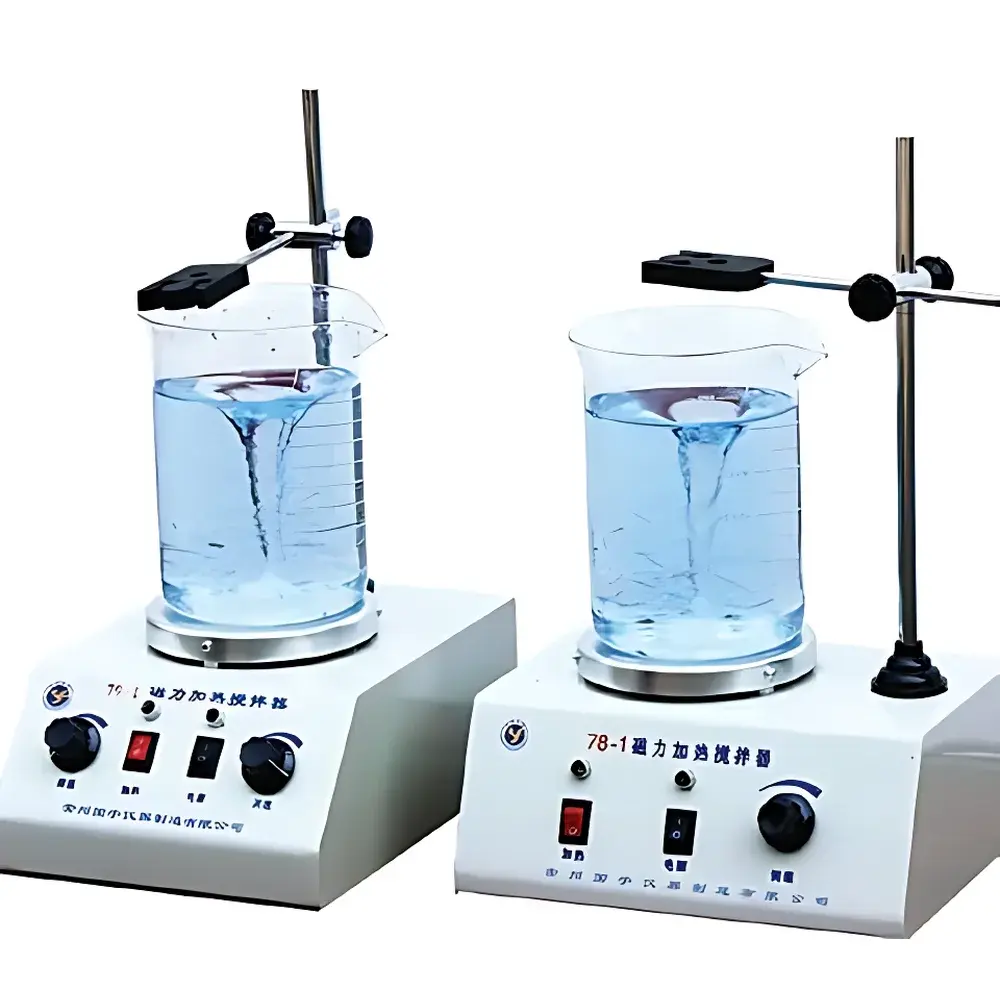
CZGY 78-1 Magnetic Hotplate Stirrer
| Brand | CZGY |
|---|---|
| Origin | Jiangsu, China |
| Manufacturer Type | Direct Manufacturer |
| Instrument Type | Magnetic Stirrer |
| Maximum Stirring Volume | 1 L |
| Speed Range | 0–1600 rpm |
| Heating Temperature Range | Ambient to 100 °C |
| Power Supply | AC 220 V ±10 V, 50 Hz |
| Motor Power | 25 W |
| Heating Power | 150 W |
| Plate Diameter | 12 cm |
| Control | On/Off heating switch + continuously variable speed control |
| Safety | Grounding terminal provided |
| Compliance | Designed for general laboratory use under standard GLP conditions |
Overview
The CZGY 78-1 Magnetic Hotplate Stirrer is a compact, benchtop laboratory instrument engineered for simultaneous magnetic stirring and conductive heating of liquid samples in glass vessels. It operates on the principle of rotating magnetic coupling: an internal permanent magnet rotor—driven by a low-noise, brushless synchronous motor—generates a time-varying magnetic field beneath a chemically resistant ceramic-coated aluminum plate. This field induces rotation in a PTFE- or glass-coated magnetic stir bar placed inside the sample container, enabling homogeneous mixing without mechanical shaft penetration. Integrated resistive heating elements provide uniform thermal distribution across the plate surface, supporting temperature-dependent reaction kinetics, dissolution studies, and solution preparation up to 100 °C. Its fixed-heating-on/off architecture and analog speed dial offer simplicity and reliability for routine applications where precise thermal ramping is not required.
Key Features
- Robust, single-unit hotplate-stirrer architecture with integrated motor and heater assembly
- Continuously variable speed control (0–1600 rpm) via precision potentiometer—enabling fine-tuned agitation from gentle suspension to vigorous homogenization
- Ceramic-coated aluminum heating plate (Ø120 mm) offering rapid thermal response and resistance to mild chemical splashes
- Low-power consumption design: 25 W motor + 150 W heater—optimized for energy efficiency and minimal ambient heat dissipation
- Grounded chassis with dedicated earth terminal—compliant with IEC 61010-1 safety requirements for laboratory electrical equipment
- No moving external parts or exposed drive mechanisms—eliminates maintenance points and ensures long-term operational stability
- Compact footprint (approx. 160 × 140 × 110 mm) suitable for crowded fume hoods or shared benchtop environments
Sample Compatibility & Compliance
The 78-1 accommodates standard borosilicate glassware including beakers (up to 1000 mL), Erlenmeyer flasks, and round-bottom flasks with flat bases. Optimal performance requires use of appropriately sized magnetic stir bars (e.g., 30 mm × 8 mm oval or cross-shaped bars). The unit is intended for non-hazardous, non-explosive aqueous and organic solutions; it is not rated for use with volatile solvents under reflux or in inert-atmosphere gloveboxes. While not certified to UL or CE standards out-of-the-box, its construction aligns with baseline safety expectations for Class I laboratory equipment per IEC 61010-1. For GLP-compliant workflows, users are advised to log usage parameters manually or integrate external temperature verification (e.g., calibrated RTD probe) when thermal accuracy is critical.
Software & Data Management
The CZGY 78-1 operates as a standalone analog instrument with no embedded microcontroller, digital display, or data output interface. All operational parameters—including speed setting and heating activation—are controlled manually via front-panel rotary dials and toggle switches. Consequently, it does not support automated protocol execution, data logging, or electronic audit trails. This design prioritizes electromagnetic compatibility (EMC), operational transparency, and immunity to firmware-related failure modes—making it suitable for environments where digital interference must be minimized (e.g., near NMR spectrometers or electrophysiology rigs). Users requiring traceable thermal or rotational data should pair the unit with external validation tools compliant with ISO/IEC 17025 calibration practices.
Applications
- Preparation of buffer solutions, culture media, and reagent dilutions in microbiology and molecular biology labs
- Accelerated dissolution testing of pharmaceutical excipients and active ingredients (per USP & Ph. Eur. guidelines)
- Homogenization of colloidal suspensions and nanoparticle dispersions prior to DLS or TEM analysis
- Supporting synthesis workflows in organic and inorganic chemistry—including Grignard reactions and metal-catalyzed couplings requiring inert atmosphere pre-equilibration
- Calibration and standardization procedures in QC laboratories where reproducible mechanical agitation is essential
- Teaching laboratories: ideal for undergraduate instruction in physical chemistry, analytical methods, and lab safety fundamentals
FAQ
Does the 78-1 support programmable temperature ramping or PID control?
No. It features a simple on/off heating switch only—temperature regulation relies on manual monitoring and external thermometry.
Can the unit be used with plastic containers?
Only if the container base is flat, thermally stable up to 100 °C, and non-magnetic; however, glass or ceramic vessels are strongly recommended for consistent coupling and thermal transfer.
What is the maximum continuous duty cycle at high speed?
Per manufacturer specifications: 4 hours at speeds above 1200 rpm; 8 hours at ≤800 rpm. Intermittent operation extends service life.
Is the heating plate surface resistant to strong acids or alkalis?
The ceramic coating provides moderate resistance to diluted reagents (e.g., 1 M HCl, 0.5 M NaOH), but prolonged exposure to concentrated corrosives will degrade the finish.
How is speed stability maintained across voltage fluctuations?
The synchronous motor design ensures consistent rotational frequency within ±5% over the specified input range (220 V ±10 V, 50 Hz); external line regulators are unnecessary under normal lab power conditions.



