
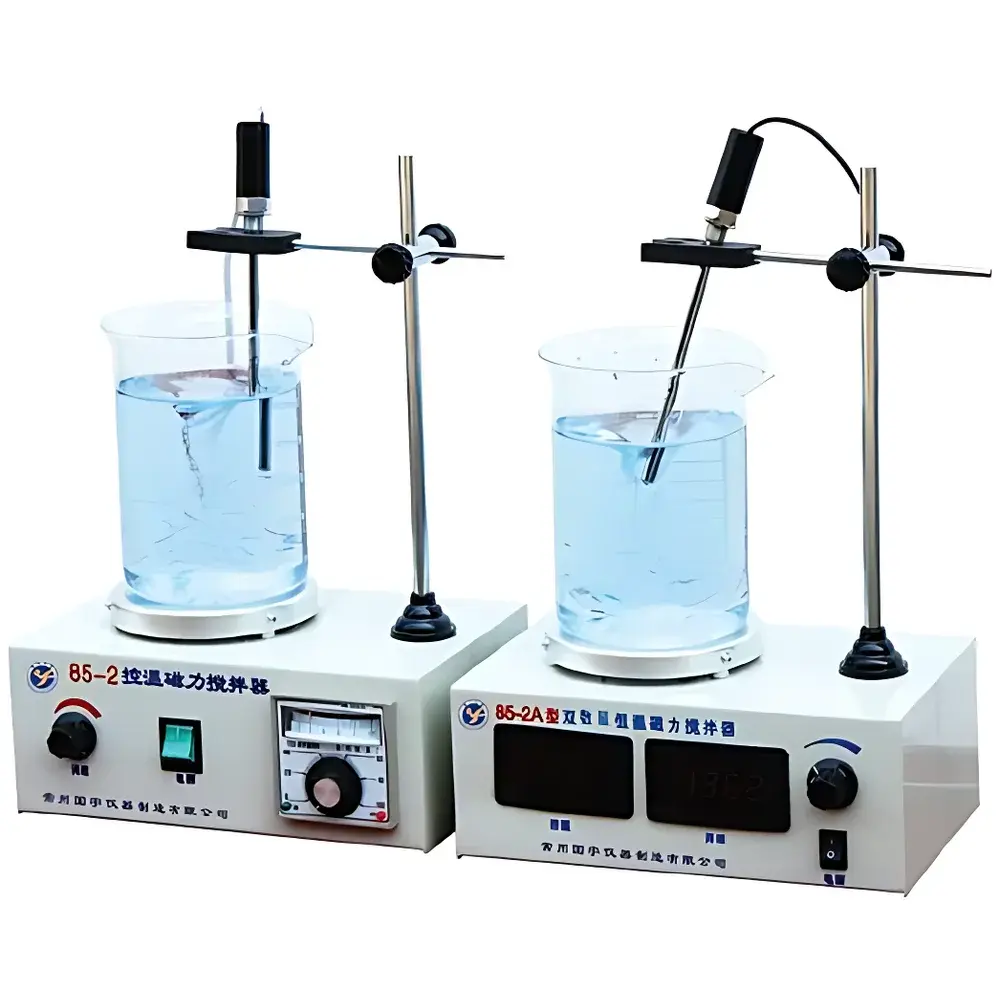
CZGY 85-2A Dual Digital Display Temperature-Controlled Magnetic Stirrer
| Brand | CZGY |
|---|---|
| Origin | Jiangsu, China |
| Manufacturer Type | Direct Manufacturer |
| Model | 85-2A |
| Instrument Type | Magnetic Stirrer |
| Max Stirring Volume | 3000 mL |
| Speed Range | 0–1600 rpm |
| Temperature Control Range | Ambient to 100 °C |
| Power Supply | AC 220 V ±10 V, 50 Hz |
| Motor Power | 30 W |
| Heating Power | 300 W |
| Temperature Accuracy | ±0.5 °C |
| Plate Diameter | Ø145 mm |
| Compliance | CE-marked design for laboratory use under general safety standards (IEC 61010-1) |
Overview
The CZGY 85-2A Dual Digital Display Temperature-Controlled Magnetic Stirrer is an engineered solution for precise, reproducible mixing and thermal regulation in routine laboratory workflows. Utilizing permanent magnet coupling and a PTC-heated ceramic plate, it delivers consistent rotational torque across its full speed range while maintaining stable temperature control via PID-regulated feedback. Designed for compatibility with standard borosilicate glassware (e.g., beakers, flasks), the unit operates on the principle of magnetic induction—rotating a PTFE-coated stir bar immersed in the sample without mechanical contact between drive mechanism and vessel. This architecture eliminates seal wear, reduces contamination risk, and supports GLP-compliant documentation when integrated with external logging systems. Its dual digital display independently monitors real-time speed (rpm) and setpoint/actual temperature (°C), enabling simultaneous optimization of hydrodynamic mixing efficiency and thermal reaction conditions.
Key Features
- Dual independent LED displays: one for rotational speed (0–1600 rpm, resolution 1 rpm), another for temperature (ambient to 100 °C, resolution 0.1 °C)
- PID-based temperature control with ±0.5 °C accuracy across the operating range; overshoot suppression algorithm minimizes thermal transient effects
- PTC ceramic heating plate (Ø145 mm) with uniform heat distribution and rapid thermal response (typical ramp rate: ~1.2 °C/s from 25 °C to 80 °C)
- Brushless DC motor drive ensuring low-noise operation (10,000 h MTBF)
- Soft-start speed ramping: prevents stir bar “jumping” during acceleration; adjustable acceleration profile via internal calibration mode
- Integrated safety circuitry: automatic thermal cutoff at 110 °C, ground-fault detection, and overcurrent protection per IEC 61010-1 Class II requirements
- Front-panel membrane keypad with tactile feedback; SET/△/▽ interface for intuitive parameter entry and real-time adjustment
Sample Compatibility & Compliance
The 85-2A accommodates vessels up to 3000 mL volume when using appropriately sized stir bars (recommended length: 30–50 mm, diameter: 6–8 mm). It supports common labware materials including borosilicate glass (e.g., Pyrex), polypropylene, and PTFE-lined containers. The unit complies with IEC 61010-1 for electrical safety in laboratory environments and meets EMC Directive 2014/30/EU for radiated and conducted emissions. While not certified to ISO/IEC 17025 or FDA 21 CFR Part 11 out-of-the-box, its analog control architecture allows integration with validated data acquisition systems supporting audit trails, electronic signatures, and instrument qualification (IQ/OQ/PQ) protocols. Calibration certificates for temperature and speed verification are available upon request.
Software & Data Management
The 85-2A operates as a standalone analog-controlled instrument with no embedded firmware or network interface. All operational parameters—including speed setpoint, temperature setpoint, actual plate temperature, and elapsed run time—are observable in real time on the dual LED displays. For regulated environments requiring traceability, third-party USB data loggers (e.g., Omega OM-DAQPRO-5300 series) may be connected via thermocouple input (Type K) and tachometer pulse output (TTL-compatible) to record time-stamped datasets compliant with ALCOA+ principles. The device supports manual calibration verification per ASTM E2479-22 (Standard Guide for Calibration of Laboratory Equipment).
Applications
This stirrer is routinely deployed in applications demanding concurrent thermal management and homogeneous mixing, including: dissolution testing of pharmaceutical tablets (aligned with USP apparatus II methodology); buffer preparation and reagent equilibration in molecular biology workflows; catalyst suspension in synthetic organic chemistry reactions; viscosity stabilization studies of polymer solutions; and media sterilization support in microbiology labs. Its robust construction and consistent torque delivery make it suitable for long-duration experiments such as enzymatic kinetics assays (8-hour continuous mid-speed operation) and accelerated stability studies under controlled thermal gradients.
FAQ
What is the maximum recommended continuous operating time at high speed?
At speeds above 1200 rpm, continuous operation should not exceed 4 hours to maintain thermal stability of the motor windings and ensure longevity of the magnetic coupling.
Can the unit be used with corrosive solvents?
Yes—provided the stir bar coating (standard PTFE) and vessel material are chemically compatible; avoid direct contact of aggressive acids (e.g., concentrated HNO₃) with the ceramic plate surface.
Is external temperature probe input supported?
No—the built-in NTC sensor measures plate surface temperature only; for solution-phase temperature monitoring, a separate calibrated probe must be used alongside the unit.
Does the device support programmable ramp-hold profiles?
No—temperature and speed are manually set and held; programmable profiles require external controller integration.
What maintenance is required for long-term reliability?
Annual inspection of stir bar integrity, cleaning of the ceramic plate with non-abrasive ethanol wipes, and verification of grounding continuity using a multimeter (resistance <1 Ω to earth).



