
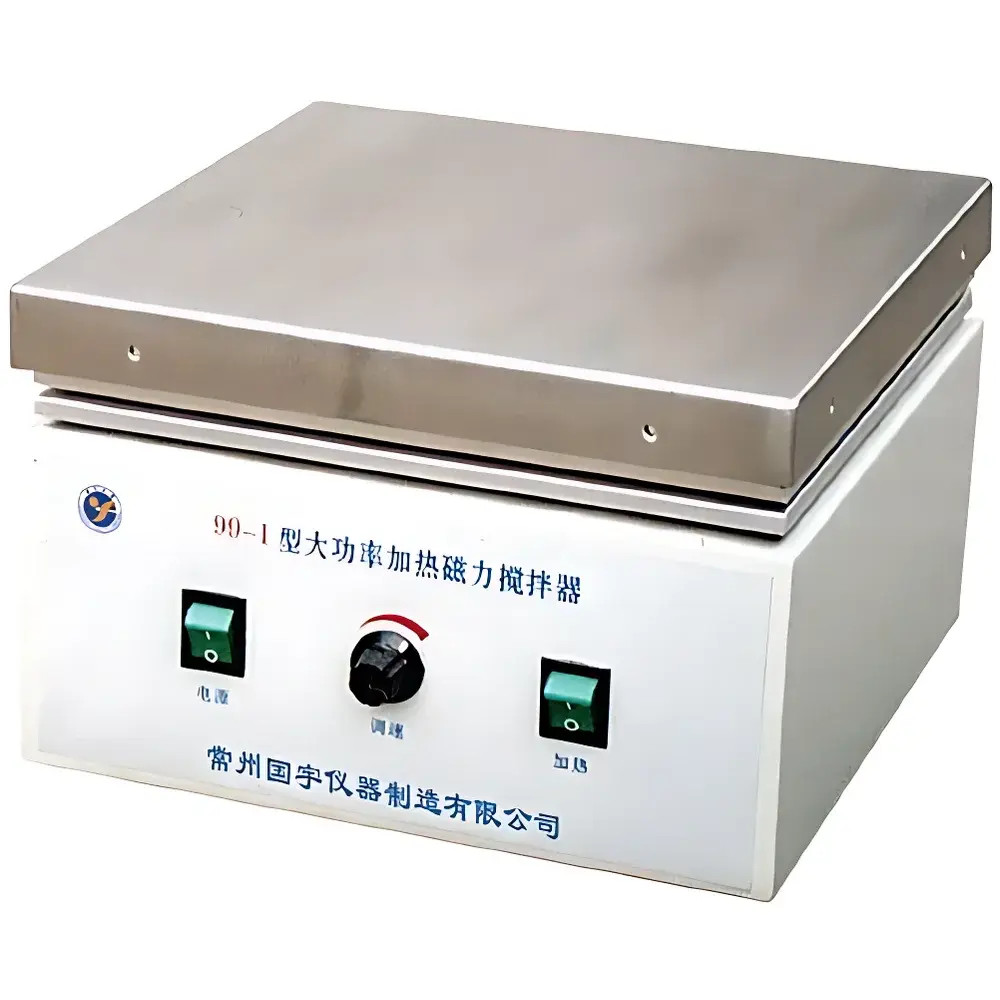
CZGY 99-1 High-Power Magnetic Hotplate Stirrer
| Brand | CZGY |
|---|---|
| Origin | Jiangsu, China |
| Manufacturer | CZGY Instrument Co., Ltd. |
| Model | 99-1 |
| Stirrer Type | Magnetic Hotplate Stirrer |
| Max. Stirring Volume | 30 L |
| Speed Range | 0–2000 rpm |
| Temperature Control Range | Ambient to 100 °C |
| Power Supply | AC 220 V ±5 V, 50 Hz |
| Motor Power | 40 W |
| Plate Dimensions | 28 × 28 cm |
| Speed Display | Digital LED |
| Speed Accuracy | ±1 rpm |
| Timer Range (Instrument) | 0–120 min |
| Timer Range (Operation Panel) | 0–999 min |
Overview
The CZGY 99-1 High-Power Magnetic Hotplate Stirrer is an engineered solution for demanding laboratory mixing and temperature-controlled homogenization tasks. Designed around a robust permanent-magnet DC motor coupled with precision electronic speed regulation, the unit delivers stable rotational torque across its full 0–2000 rpm range—enabling reproducible agitation of viscous or high-volume samples without mechanical slippage or thermal drift. Unlike traditional hotplate stirrers relying on resistive heating elements with slow thermal response, the 99-1 integrates a uniformly heated ceramic-coated aluminum plate (28 × 28 cm) capable of maintaining setpoints from ambient temperature up to 100 °C with ±2 °C stability under load. Its flameless, silent operation eliminates fire hazards and acoustic interference in analytical workspaces—making it suitable for use in fume hoods, biosafety cabinets, and GLP-compliant preparation areas.
Key Features
- High-torque 40 W permanent-magnet DC motor with integrated constant-speed feedback circuitry ensures consistent rotational output regardless of load viscosity or volume (up to 30 L)
- Dual-range digital timer system: instrument-level preset (0–120 min) for batch consistency; operational panel timer (0–999 min) for extended unattended protocols
- LED-display speed control with ±1 rpm resolution and real-time readout—calibrated at factory against NIST-traceable tachometric standards
- Ceramic-coated aluminum heating plate resists corrosion, thermal shock, and chemical etching—compatible with aqueous, organic, and mildly acidic media
- No-slip design: non-ferrous plate surface prevents magnetized stir bars from lateral displacement during high-RPM operation
- EMI-shielded power electronics meet IEC 61326-1 Class B requirements for electromagnetic compatibility in shared lab environments
Sample Compatibility & Compliance
The 99-1 accommodates standard laboratory glassware including beakers (50 mL–5000 mL), Erlenmeyer flasks, and jacketed reactors up to 30 L when paired with appropriately sized PTFE- or glass-coated stir bars (recommended diameter: 25–50 mm). It complies with general safety requirements outlined in IEC 61010-1:2010 for electrical equipment used in laboratory settings. While not certified to specific ISO/IEC 17025 metrological standards as a standalone measuring instrument, its speed and temperature control systems are designed to support method validation per ASTM E2923 (Standard Guide for Laboratory Equipment Qualification) and internal SOPs requiring documented performance verification. The unit supports traceable calibration via external thermocouple probes and optical tachometers.
Software & Data Management
As a stand-alone analog-digital hybrid instrument, the 99-1 does not feature embedded software, network connectivity, or data logging capabilities. All operational parameters—including speed setpoint, timer duration, and power-on status—are controlled via front-panel membrane keys and displayed on a dual-segment LED interface. This architecture intentionally prioritizes reliability, ease of cleaning, and resistance to liquid ingress over digital complexity—aligning with ISO 15190:2020 recommendations for low-risk, non-critical laboratory equipment in routine QC/QA workflows. For laboratories requiring audit trails, integration into LIMS or ELN systems can be achieved through optional third-party USB-to-serial adapters and custom scripting (e.g., Python-based serial polling), though such configurations fall outside the manufacturer’s warranty scope.
Applications
- Precipitation and crystallization studies requiring simultaneous heating and gentle agitation to control nucleation kinetics
- Buffer and reagent preparation in molecular biology labs—especially for phosphate- or carbonate-based solutions prone to localized pH gradients
- Pre-analytical sample conditioning prior to HPLC, ICP-MS, or titration assays where homogeneity directly impacts measurement uncertainty
- Long-duration dissolution testing (e.g., USP Apparatus II) under non-GMP conditions for formulation screening
- Chemical synthesis workflows involving exothermic reactions where precise thermal ramping and mixing synchronization reduce side-product formation
- Environmental sample digestion protocols (e.g., EPA Method 3050B) using hot nitric acid mixtures in borosilicate vessels
FAQ
What is the maximum recommended vessel diameter for optimal stirring efficiency?
For uniform magnetic coupling and vortex formation, vessels with diameters ≤20 cm are recommended when operating above 1200 rpm. Larger containers (e.g., 30 L carboys) require low-speed operation (≤600 rpm) and oversized stir bars (≥40 mm length).
Can the unit maintain temperature accuracy while stirring high-viscosity fluids like glycerol or polymer solutions?
Yes—the heating plate’s thermal mass and PID-regulated power delivery compensate for convective heat loss. However, surface temperature deviation may increase by ≤3 °C at 100 °C when stirring >10,000 cP fluids; users should validate setpoint accuracy with a calibrated immersion probe.
Is the timer function active during manual speed adjustment?
No—the timer only initiates after pressing “RUN”. Adjusting speed or time mid-operation has no effect on the active countdown; the unit requires a full STOP → RESET → RUN sequence to restart timing.
Does the device support external temperature probe feedback for closed-loop control?
No. The 99-1 uses fixed-sensor plate temperature monitoring only. External probe integration would require aftermarket PID controllers and is not supported by the OEM firmware or mechanical interface.
What maintenance intervals are recommended for long-term reliability?
Inspect stir bar alignment and plate surface integrity every 6 months; clean with isopropyl alcohol and lint-free cloth. Verify speed accuracy annually using a handheld optical tachometer. No lubrication or internal servicing is required due to brushless motor design.



