
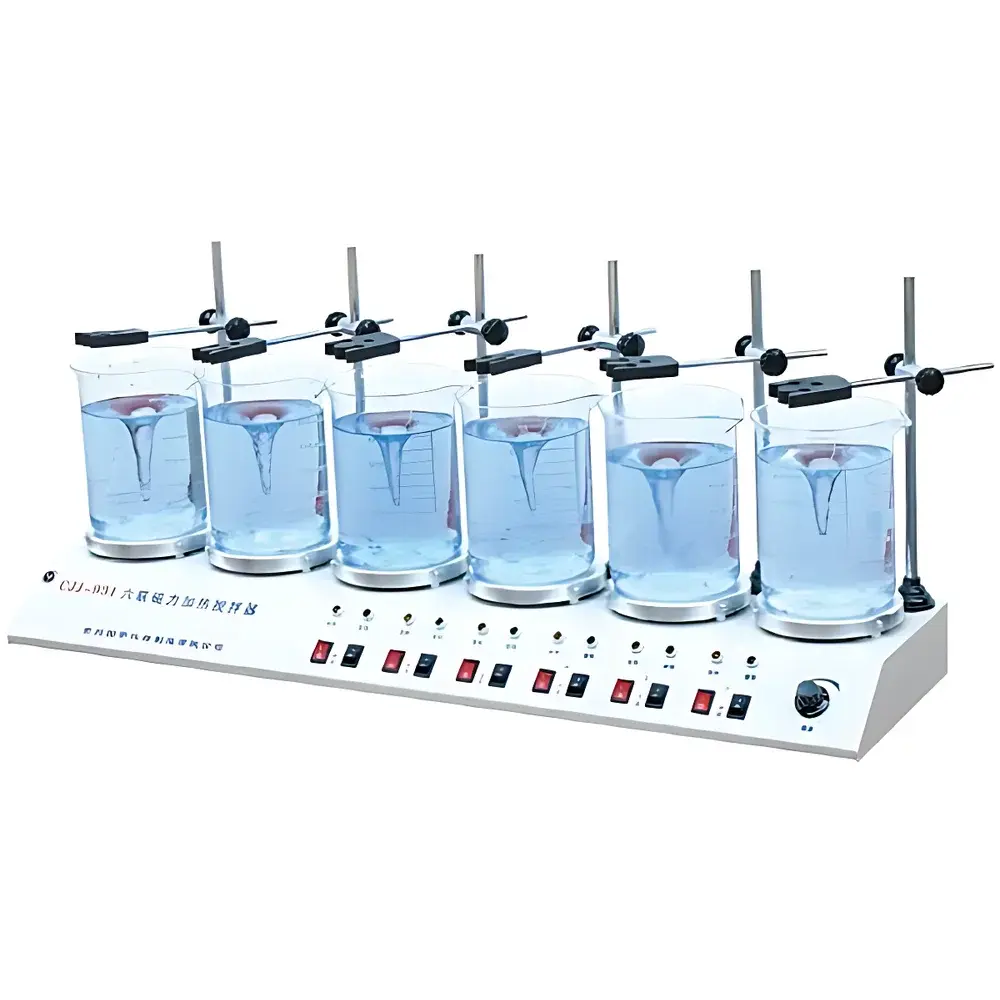
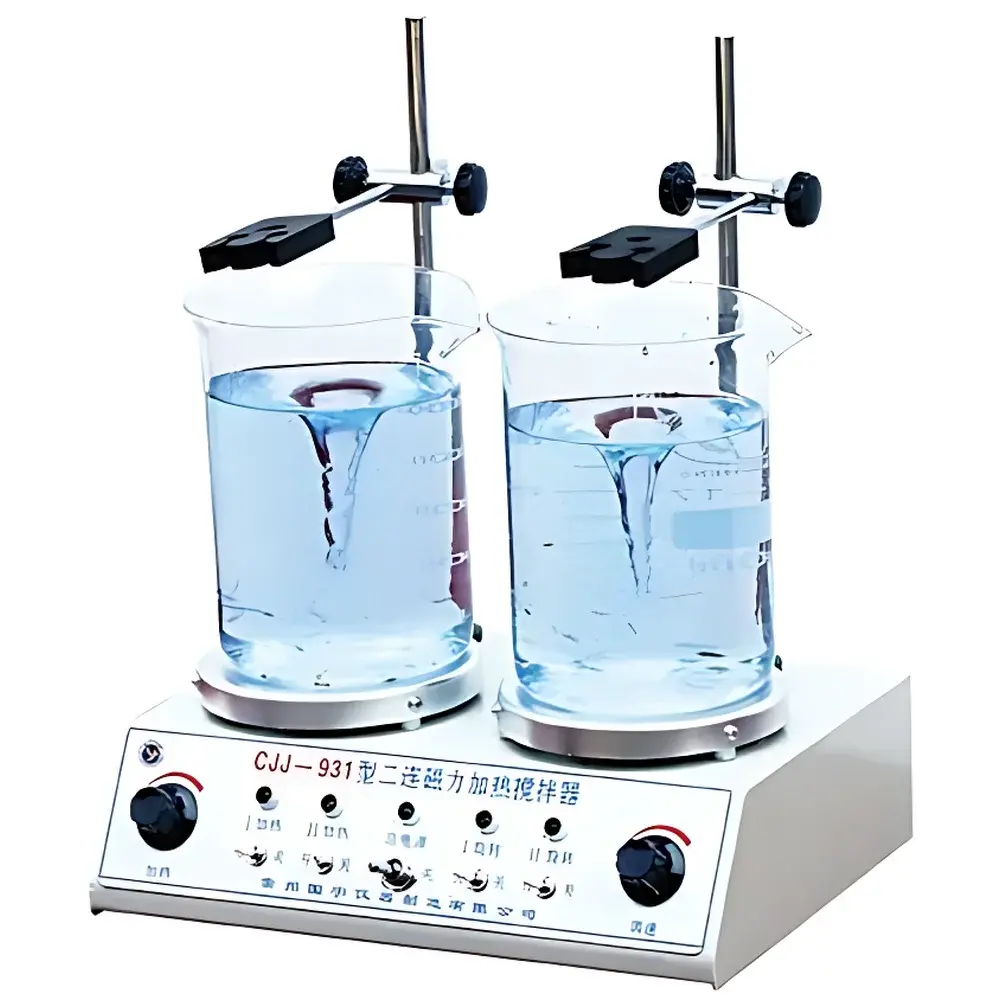
CZGY CJJ-931 Hexa-Position Magnetic Hotplate Stirrer
| Brand | CZGY |
|---|---|
| Origin | Jiangsu, China |
| Manufacturer Type | Direct Manufacturer |
| Product Category | Domestic |
| Model | CJJ-931 Hexa-Position |
| Instrument Type | Magnetic Stirrer with Heating |
| Max Stirring Volume | 1 L × 6 stations |
| Speed Range | 0–2000 rpm |
| Temperature Control Range | Ambient to 100 °C |
| Power Supply | 220 V ±10%, 50 Hz |
| Motor Power per Station | 25 W |
| Heating Element Power per Station | 150 W |
| Plate Diameter per Station | 12 cm |
| Continuous Operation | 8 h at medium speed, 4 h at high speed |
Overview
The CZGY CJJ-931 Hexa-Position Magnetic Hotplate Stirrer is an engineered solution for parallel sample processing in quality control, method development, and routine analytical laboratories. Based on the principle of magnetic coupling—where a rotating permanent magnet beneath the ceramic-coated aluminum plate induces synchronous rotation of PTFE- or glass-coated stir bars within vessels—the instrument delivers precise, contactless agitation across six independent workstations. Each station integrates a dedicated heating element and digital speed control, enabling simultaneous yet individually adjustable stirring and temperature regulation from ambient to 100 °C. Designed for reproducibility in multi-sample workflows, it supports standardized protocols requiring consistent thermal and mechanical input across replicates—such as dissolution testing, buffer preparation, reagent aging studies, and kinetic reaction monitoring under controlled thermal conditions.
Key Features
- Six fully independent stirring and heating stations, each with discrete speed and temperature controls for true parallel operation
- Digital rotary encoder interface for fine-grained speed adjustment (0–2000 rpm) and stable low-speed torque delivery down to 50 rpm
- High-emissivity aluminum hotplate with ceramic coating ensures uniform heat distribution and chemical resistance to common solvents and aqueous solutions
- Individual station power management: 25 W motor + 150 W heating element per position, minimizing thermal crosstalk between adjacent zones
- Robust mechanical architecture with vibration-damped base and precision-machined 12 cm diameter heating/stirring zones for optimal stir bar synchronization
- Compliance-ready design: grounded chassis, thermal cut-off protection, and fail-safe power interruption upon overheating or abnormal load detection
Sample Compatibility & Compliance
The CJJ-931 accommodates standard laboratory glassware—including beakers (up to 1000 mL), Erlenmeyer flasks, and round-bottom flasks—provided flat-bottomed vessels are used to ensure efficient magnetic coupling. Stir bar selection (e.g., cross-shaped, oval, or micro stir bars) is determined by viscosity, volume, and required shear profile. The unit meets general electrical safety requirements per IEC 61010-1 for laboratory equipment and incorporates grounding terminals to satisfy local lab infrastructure standards. While not certified to ISO/IEC 17025 or GLP-specific validation protocols out-of-the-box, its modular control architecture supports documented operational qualification (OQ) and performance verification (PV) procedures aligned with internal SOPs and regulatory expectations for equipment used in GMP-relevant environments (e.g., USP , ASTM E2912 for mixing uniformity assessment).
Software & Data Management
This analog-digital hybrid instrument operates via front-panel controls without embedded software or network connectivity. All parameters—speed setpoint, target temperature, and runtime—are manually configured per station using tactile knobs and LED indicators. For laboratories requiring audit trails or electronic records, external data loggers (e.g., USB-connected thermocouple arrays and tachometers) may be deployed to capture time-stamped temperature and rotational speed profiles. The absence of proprietary firmware simplifies 21 CFR Part 11 compliance when integrated into validated systems, as no electronic signature or user access control layer is present—reducing validation scope while maintaining traceability through procedural documentation and manual log entry.
Applications
- Simultaneous preparation of six calibration standards or QC samples under identical thermal and agitation conditions
- Dissolution testing per USP where multiple vessels require synchronized stirring at defined rpm and temperature
- Accelerated stability studies involving parallel thermal exposure of formulations in sealed vials or open beakers
- Buffer equilibration and pH adjustment workflows requiring gentle, prolonged mixing at elevated temperatures
- Preparative chemistry tasks such as catalyst suspension, polymerization initiation, or nanoparticle dispersion across replicate batches
- Environmental analysis workflows including soil leaching extractions, water hardness titration prep, and heavy metal digestion support
FAQ
Can the CJJ-931 operate with non-flat-bottomed vessels?
No. Efficient magnetic coupling requires direct contact between the vessel base and the heated plate surface; conical or rounded-bottom containers will impair stir bar synchronization and increase risk of jumping or stalling.
Is it possible to run fewer than six stations simultaneously?
Yes. Each station has individual ON/OFF switches for both stirring and heating functions, allowing selective activation without affecting other positions.
What maintenance is required to ensure long-term accuracy?
Regular cleaning of the ceramic plate surface with isopropyl alcohol and inspection of stir bar integrity are recommended. Avoid abrasive cleaners or immersion of the unit. Verify voltage supply stability (220 V ±10%) to prevent motor torque fluctuation.
Does the unit support external temperature probes for closed-loop feedback control?
No. Temperature regulation is based on built-in plate-sensor feedback only; external probe integration is not supported in this model.
How does the thermal cut-off protection function?
A bimetallic thermostat triggers automatic power disconnection if any station exceeds 110 °C, preventing damage to the heating element and ensuring operator safety during unattended operation.



