
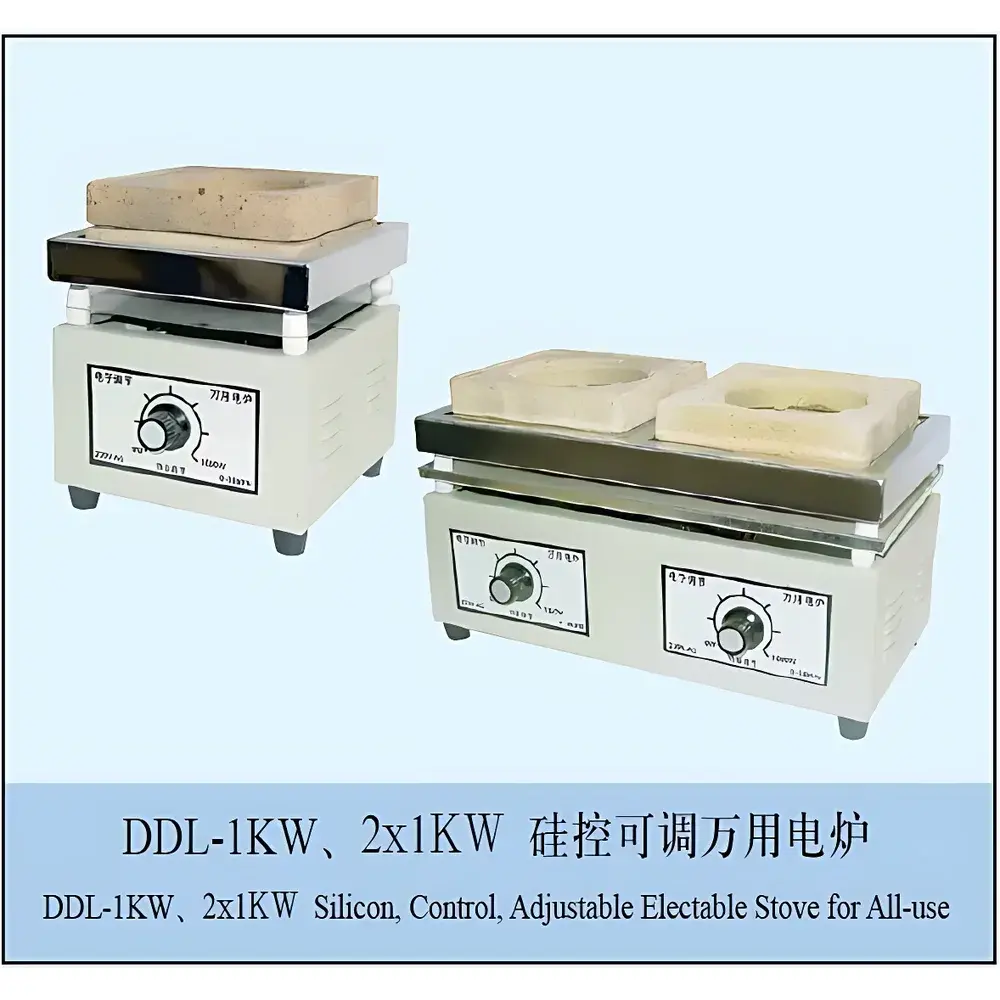
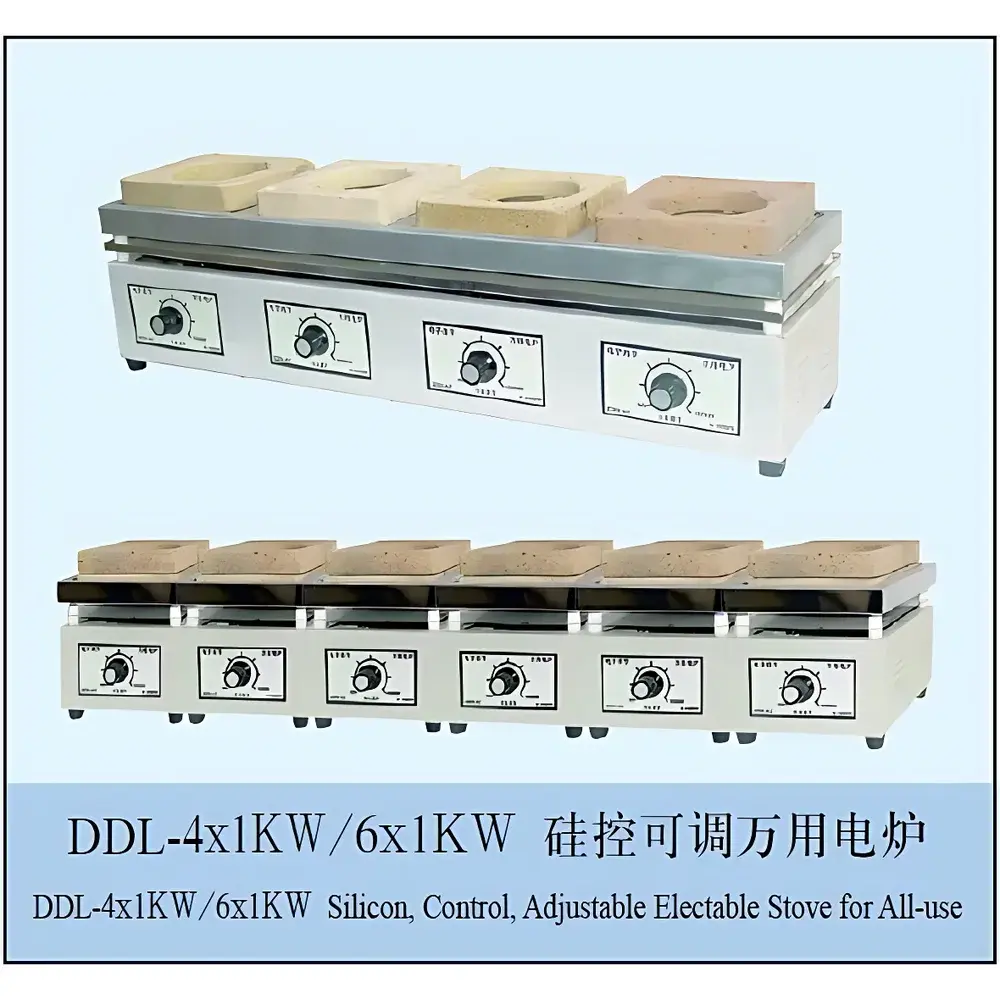
CZGY DDL-1KW Silicon-Controlled Adjustable Universal Electric Furnace
| Brand | CZGY |
|---|---|
| Origin | Jiangsu, China |
| Manufacturer Type | Direct Manufacturer |
| Product Category | Domestic |
| Model | DDL-1KW |
| Instrument Type | Crucible Furnace |
| Max Temperature | 300°C |
| Temperature Control Accuracy | ±3°C |
| Max Power | 1000 W |
| Heating Time to Max Temp | 60 min |
| Heating Method | Resistance Wire Heating |
| Internal Chamber Dimensions | 14 × 14 cm |
Overview
The CZGY DDL-1KW Silicon-Controlled Adjustable Universal Electric Furnace is a compact, benchtop resistive heating device engineered for precise, repeatable low-temperature thermal processing in academic, industrial, and quality control laboratories. Unlike high-temperature muffle furnaces operating above 500°C, this unit is purpose-built for applications requiring stable operation between ambient and 300°C—ideal for sample drying, pre-heating, controlled decomposition of organic matrices, crucible-based ashing (within thermal limits), and thermal conditioning of reagents or calibration standards. Its core thermal regulation relies on phase-angle-controlled silicon-controlled rectifier (SCR) circuitry, enabling smooth, stepless power modulation across the full 0–1000 W range. This architecture delivers superior thermal stability compared to simple on/off thermostats, minimizing overshoot and supporting consistent heat transfer profiles essential for method reproducibility under GLP-aligned workflows.
Key Features
- SCR-based continuous power regulation: Enables fine-grained temperature ramping and hold stability without mechanical switching noise or thermal cycling stress.
- Dual-layer thermal containment: Ceramic fiber insulation beneath a stainless-steel outer casing minimizes surface temperature rise and improves energy efficiency.
- Modular crucible-compatible chamber: 14 × 14 cm internal footprint accommodates standard porcelain, quartz, or nickel crucibles (up to 100 mL volume) with unobstructed access and uniform radial heat distribution.
- Robust mechanical design: Integrated ceramic insulating ring and removable aluminum alloy heating plate prevent direct contact between samples and resistance wire elements—reducing contamination risk and extending heater life.
- Safety-certified electrical architecture: Complies with IEC 61010-1 requirements for laboratory electrical equipment; includes grounded chassis, over-temperature cut-off fuse (320°C fail-safe), and insulated terminal block wiring.
Sample Compatibility & Compliance
The DDL-1KW supports inert, non-volatile, and low-vapor-pressure samples suitable for open-crucible or covered-container heating below 300°C. Compatible materials include metal oxides, silicates, pharmaceutical excipients, polymer pellets, and dried biological residues. It is not rated for flammable solvents, volatile organics, or corrosive halogenated compounds. The furnace meets general-purpose safety requirements per EN 61010-1 and is routinely deployed in environments adhering to ISO/IEC 17025 clause 6.4 (equipment validation) and USP guidelines for analytical instrument qualification. While not intrinsically certified for hazardous locations, its grounding integrity and thermal cutoff make it suitable for standard QC labs operating under GMP Annex 11 and FDA 21 CFR Part 11-compliant data management frameworks when paired with validated external loggers.
Software & Data Management
This analog-controlled furnace operates without embedded firmware or digital interface. Temperature monitoring and recording require external instrumentation—such as calibrated thermocouple-based data loggers (e.g., Omega OM-DAQPRO-5300 or Testo 176 T4) connected via K-type input. When integrated into validated workflows, users commonly pair it with LIMS or ELN systems using CSV-imported time-stamped thermal profiles. For audit readiness, laboratories document calibration history (per ISO/IEC 17025 section 6.5), including annual verification of control accuracy (±3°C at setpoints 100°C, 200°C, and 300°C) using NIST-traceable reference thermometers. No proprietary software or cloud connectivity is involved—ensuring full data ownership and simplifying 21 CFR Part 11 compliance through procedural controls.
Applications
- Pretreatment of soil and sediment samples prior to heavy metal digestion (EPA Method 3050B).
- Drying and conditioning of filter papers, weighing boats, and crucibles before gravimetric analysis (ASTM D2974, ISO 11465).
- Thermal stabilization of calibration standards for FTIR, XRF, and AAS instrumentation.
- Controlled dehydration of hygroscopic reagents (e.g., sodium carbonate, potassium hydrogen phthalate) used in primary standard preparation.
- Low-energy annealing of thin-film substrates during materials science prototyping (non-vacuum ambient air environment).
FAQ
What is the maximum recommended continuous operating temperature?
The furnace is rated for sustained operation up to 300°C. Prolonged use above this threshold may degrade the resistance wire and compromise control accuracy.
Can this unit be used for ashing organic samples?
Yes—provided the sample mass is small (500°C; consult ASTM D2974 for protocol alignment.
Is the internal chamber atmosphere controllable?
No. The DDL-1KW operates in ambient air only. It lacks gas inlet/outlet ports or vacuum sealing capability.
Does it support programmable ramp-and-soak cycles?
Not natively. Ramp profiles must be manually adjusted using the front-panel SCR control knob. For automated thermal protocols, integrate with an external programmable temperature controller (e.g., Watlow F4T) via 4–20 mA or 0–10 V analog output.
What maintenance is required for long-term reliability?
Annual visual inspection of resistance wire integrity, cleaning of ceramic insulation surfaces with dry lint-free cloth, and verification of grounding continuity (≤1 Ω resistance to earth ground) per IEC 62353.



