
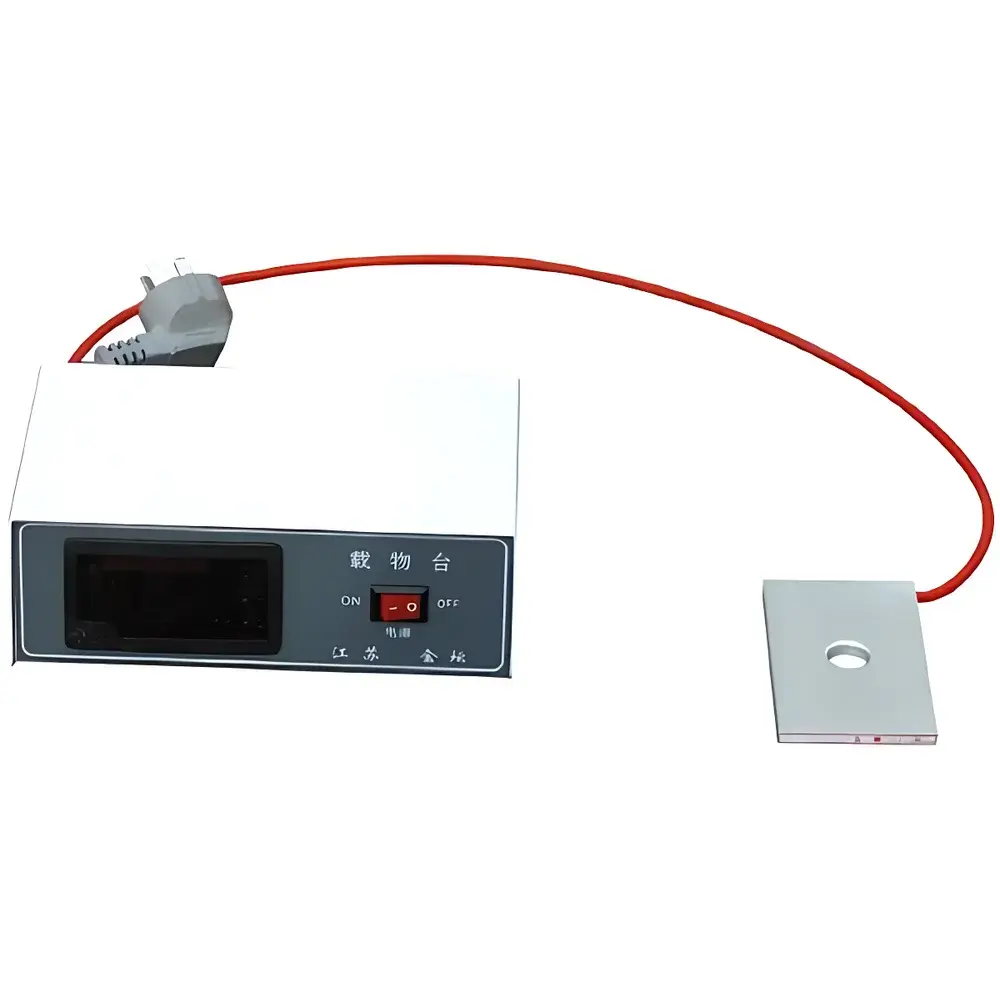
CZGY DZ-A Digital Temperature-Controlled Stage
| Brand | CZGY |
|---|---|
| Origin | Jiangsu, China |
| Manufacturer Type | Direct Manufacturer |
| Model | DZ-A |
| Power Supply | 220 V ±10%, 50 Hz |
| Heating Supply | 10 V ±10%, 50 Hz |
| Heating Power | 5 W |
| Working Surface Dimensions | 55 × 95 mm |
| Temperature Display | LED Digital Readout |
| Heating Element | Precision-Anodized Aluminum Alloy Plate |
| Compliance | CE-marked design principles (IEC 61010-1), GLP-supportive operational protocol |
Overview
The CZGY DZ-A Digital Temperature-Controlled Stage is a compact, benchtop thermal platform engineered for precise, stable, and repeatable temperature maintenance during microscopic observation, sample conditioning, or low-power thermal treatment in life science and analytical laboratories. Unlike general-purpose hotplates, the DZ-A operates on a regulated low-voltage heating circuit (10 V AC) integrated with a high-thermal-conductivity anodized aluminum alloy stage, ensuring uniform surface temperature distribution across its 55 × 95 mm working area. Its core function is passive thermal stabilization—not rapid heating or high-temperature processing—making it suitable for applications requiring gentle, sustained warmth (e.g., live-cell microscopy, solvent evaporation control, reagent pre-warming, or humidity-sensitive crystallization trials). The device complies with fundamental electrical safety architecture aligned with IEC 61010-1 for laboratory electrical equipment and supports Good Laboratory Practice (GLP) workflows through traceable digital setpoint entry and stable thermal output.
Key Features
- Digital LED temperature display with intuitive push-button interface (SET, △, ▽ keys) enabling direct setpoint adjustment and real-time readout of surface temperature;
- Low-power (5 W), low-voltage (10 V AC) heating system minimizing electromagnetic interference near sensitive optical or electronic instrumentation;
- Uniformly heated anodized aluminum alloy stage engineered for minimal thermal gradient (< ±0.8 °C across surface at steady state);
- Compact footprint (120 × 160 × 45 mm overall) optimized for integration beneath inverted microscopes, within laminar flow hoods, or on analytical balance benches;
- Robust mechanical construction with non-porous, chemically resistant surface compatible with mild aqueous and organic solvent exposure;
- No moving parts or cooling elements—designed for continuous unattended operation within ambient lab conditions (15–30 °C, <70% RH).
Sample Compatibility & Compliance
The DZ-A accommodates standard microscope slides (25 × 75 mm), Petri dishes (up to 100 mm diameter), Eppendorf tubes, glass vials, and small ceramic or stainless-steel sample holders. Its low thermal mass and controlled power delivery prevent thermal shock to biological specimens or polymer-based substrates. While not certified to ISO/IEC 17025 or FDA 21 CFR Part 11, the instrument’s deterministic setpoint behavior, absence of analog dials, and discrete digital input support audit-ready documentation when used in GLP-regulated environments. It meets essential safety design criteria per IEC 61010-1 (Edition 3) for protection against electric shock, fire hazard, and mechanical instability under normal use.
Software & Data Management
The DZ-A operates as a standalone hardware unit with no embedded firmware, cloud connectivity, or proprietary software. All user interaction occurs via front-panel controls; no drivers, USB interfaces, or data logging capabilities are included. Temperature setpoints and operational status are manually recorded by the user. This architecture ensures long-term reliability, eliminates cybersecurity concerns associated with networked lab devices, and simplifies validation protocols in regulated settings where deterministic, non-updatable instruments are preferred. For labs requiring electronic recordkeeping, external USB thermocouple loggers (e.g., Omega OM-DAQPRO-5300 series) may be deployed in parallel for independent verification.
Applications
- Live-cell imaging support: maintaining physiological temperatures (e.g., 37 °C) during time-lapse microscopy without stage-mounted heaters interfering with objective clearance;
- Controlled solvent evaporation: gradual removal of volatile solvents from thin-film samples prior to SEM or AFM analysis;
- Reagent and buffer equilibration: pre-warming diluents or enzymatic reaction mixtures to minimize thermal lag during assay initiation;
- Crystal growth studies: providing stable nucleation platforms for protein or small-molecule crystallization screening;
- Educational demonstrations: illustrating thermal conductivity, phase transitions, or enzyme kinetics under constant-temperature conditions;
- QC sample conditioning: holding reference standards at defined temperatures prior to spectroscopic or chromatographic analysis.
FAQ
What is the maximum operating temperature of the DZ-A stage?
The DZ-A does not specify a maximum setpoint in its technical documentation; however, based on its 5 W heating capacity and aluminum thermal mass, sustained operation above 60 °C is not recommended. Typical use ranges are 25–50 °C.
Can the DZ-A be used under a CO₂ incubator or glovebox?
Yes—its sealed electronics and low-voltage heater allow safe operation in controlled-atmosphere enclosures, provided ambient humidity remains below 70% RH and condensation is prevented on the stage surface.
Is calibration certificate included with shipment?
No factory calibration certificate is supplied. Users should verify accuracy using a NIST-traceable contact thermometer (e.g., Fluke 54II) placed directly on the center of the powered stage after 15 minutes of thermal stabilization.
Does the DZ-A support external temperature feedback or PID tuning?
No. It employs open-loop temperature control with fixed internal regulation; no external sensor input or algorithmic adjustment is available.
How is cleaning and maintenance performed?
Wipe the stage surface with lint-free cloth dampened with deionized water or 70% ethanol. Avoid abrasive cleaners, ultrasonic baths, or submersion. Inspect power cord integrity before each use.



