
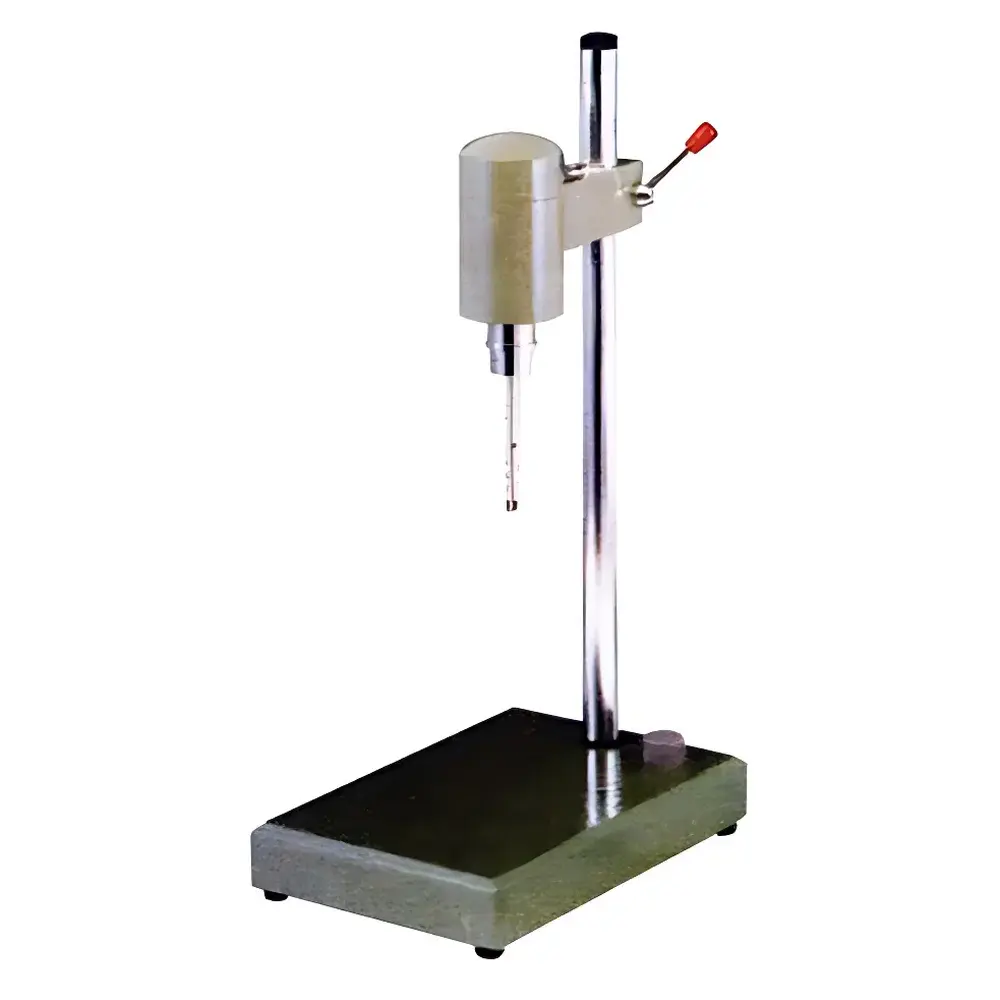
CZGY FJ-200 High-Speed Disperser & Homogenizer
| Brand | CZGY |
|---|---|
| Origin | Jiangsu, China |
| Manufacturer Type | Direct Manufacturer |
| Instrument Type | Probe-Type Rotor-Stator Homogenizer |
| Dimensions (W×D×H) | 320 × 200 × 380 mm |
| Processing Volume Range | 10–3000 mL |
| Motor Speed | 25,000 rpm |
| Small Homogenizing Probe Max Speed | 22,000 rpm |
| Large Homogenizing Probe Max Speed | 20,000 rpm |
| Continuous Operation Limit | <5 min |
| Power Rating | 185 W |
| Input Voltage | 220 V AC, 50 Hz |
| Speed Control | Thyristor-Based Analog Regulation |
| Speed Sensing | Photoelectric Tachometry |
Overview
The CZGY FJ-200 High-Speed Disperser & Homogenizer is a benchtop rotor-stator homogenization system engineered for rapid, reproducible mechanical disruption of biological and soft-material samples in research and quality control laboratories. It operates on the principle of high-shear fluid dynamics: rotation of a precision-machined stainless-steel probe within a fixed stator chamber generates intense localized turbulence, cavitation, and hydraulic shear forces—effectively lysing cells, emulsifying suspensions, dispersing nanoparticles, and homogenizing viscous or fibrous matrices. Designed for routine use in life science, pharmaceutical, food, and agricultural labs, the FJ-200 delivers consistent energy input across variable sample volumes (10–3000 mL), supporting standardized protocols for downstream applications including DNA/RNA extraction, protein solubilization, tissue homogenization, and formulation development.
Key Features
- Thyristor-controlled analog speed regulation enables smooth, stepless acceleration from low to maximum rotational velocity—minimizing thermal shock and mechanical stress during sample initiation.
- Integrated photoelectric tachometer provides real-time, non-contact speed verification with ±2% accuracy, ensuring traceable operational parameters for method validation and audit readiness.
- Dual-probe configuration supports application flexibility: a small-diameter probe (optimized for volumes ≤200 mL) achieves up to 22,000 rpm; a large-diameter probe (for volumes ≥200 mL) operates up to 20,000 rpm—both fabricated from corrosion-resistant 316 stainless steel.
- Benchtop footprint (320 × 200 × 380 mm) and lightweight aluminum-alloy housing facilitate integration into biosafety cabinets, cold rooms, or shared instrumentation suites without structural reinforcement.
- Thermal protection circuitry automatically interrupts power if internal motor temperature exceeds safe operating thresholds, extending service life and reducing unscheduled downtime.
- Compliant with IEC 61010-1 safety standards for laboratory electrical equipment, including insulation integrity, grounding continuity, and enclosure ingress protection (IP20).
Sample Compatibility & Compliance
The FJ-200 accommodates aqueous buffers, organic solvents (e.g., ethanol, chloroform), detergent-based lysis reagents, and mildly abrasive suspensions—provided chemical compatibility with 316 SS and PTFE (F4) sealing components is verified. It is routinely deployed for homogenization of mammalian tissues (liver, spleen, muscle), plant material (leaves, roots, fruit pulp), microbial pellets, and soft hydrogels. While not certified for sterile processing, its probe design allows autoclaving at 121 °C/15 psi (20 min) when disassembled per manufacturer instructions. The instrument meets general requirements for GLP-compliant environments when operated within defined procedural limits (e.g., ≤5 min continuous runtime, documented speed calibration, logbook-based usage tracking). It supports alignment with ISO/IEC 17025 clause 6.4.7 (equipment verification) and USP analytical instrument qualification (AIQ) at the Operational Qualification (OQ) level.
Software & Data Management
The FJ-200 is a stand-alone analog instrument with no embedded firmware or digital connectivity. Speed settings are manually selected via front-panel rotary potentiometer; no software installation, driver dependencies, or network configuration is required. All operational parameters—including set speed, duration, probe type, sample volume, and buffer composition—are recorded externally in laboratory notebooks or electronic lab notebooks (ELNs) to satisfy FDA 21 CFR Part 11 data integrity expectations. For laboratories requiring audit trails, integration with time-stamped video documentation or external tachometer logging systems is recommended during critical protocol steps.
Applications
- Cell lysis for nucleic acid and protein isolation from cultured cells and fresh/frozen tissues
- Preparation of uniform suspensions for particle size analysis (e.g., DLS, laser diffraction)
- Rapid dispersion of nanomaterials (e.g., graphene oxide, metal oxides) in aqueous or polymeric media
- Homogenization of food matrices (e.g., dairy emulsions, fruit purees) prior to rheological or microbiological testing
- Disruption of fungal mycelia and bacterial biofilms for antimicrobial susceptibility profiling
- Generation of reference standards for assay validation in QC laboratories
FAQ
What is the maximum recommended continuous operating time?
Continuous operation must not exceed 5 minutes at rated speed to prevent thermal degradation of motor windings and probe bearing lubrication.
Can the FJ-200 be used with corrosive or high-viscosity samples?
Yes—provided the sample’s chemical composition is compatible with 316 stainless steel and PTFE (F4) components; viscosity should remain below 5,000 mPa·s at processing temperature to maintain stable probe immersion and torque response.
Is speed calibration traceable to national standards?
The integrated photoelectric tachometer provides repeatable relative speed measurement; for absolute traceability, users may validate against an NIST-traceable handheld tachometer annually as part of their equipment maintenance program.
Does the instrument support GMP documentation requirements?
While the device itself lacks electronic data capture, its analog operation simplifies IQ/OQ documentation; full compliance depends on user-defined SOPs covering probe cleaning, speed verification, usage logs, and preventive maintenance records.
Are replacement probes and PTFE wear sleeves available separately?
Yes—CZGY supplies OEM-certified spare probes (small/large), PTFE anti-wear sleeves (F4), and stator assemblies with documented lot traceability and dimensional certification reports.
Related Products



