
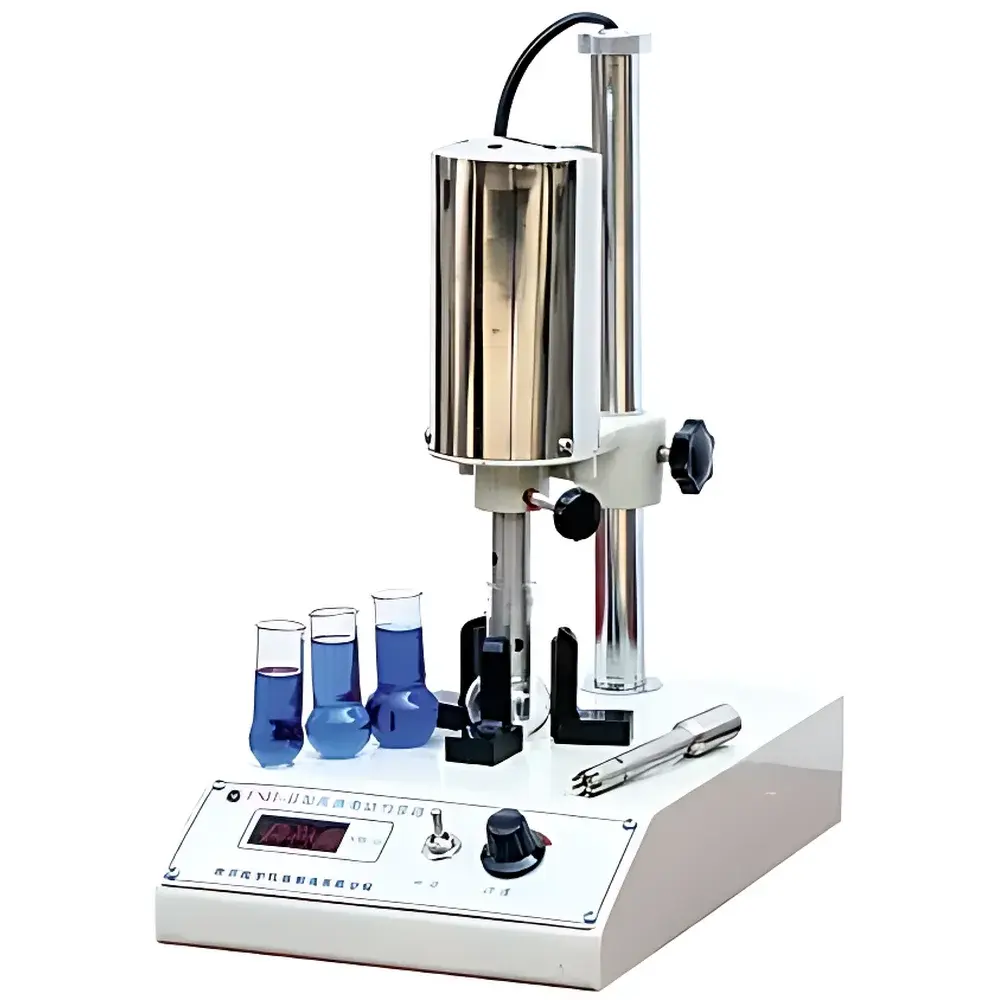
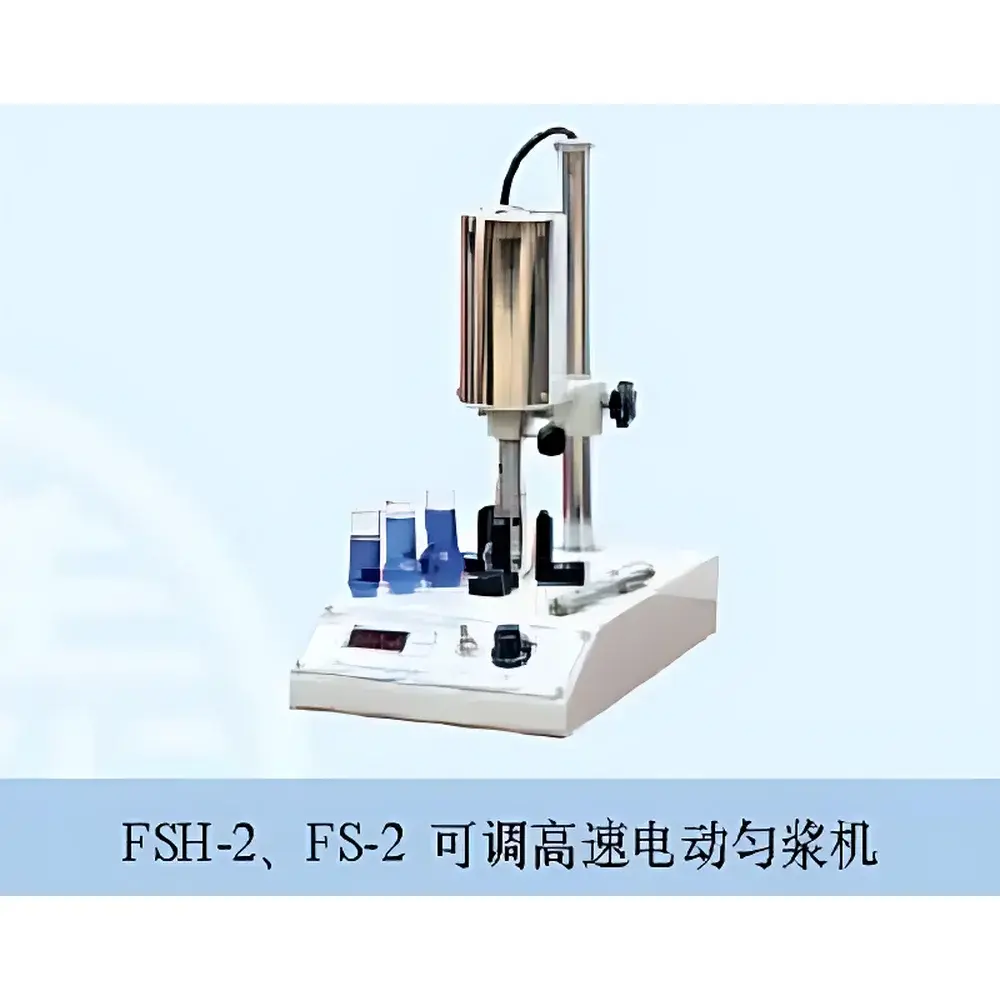
CZGY FSH-2 Adjustable High-Speed Homogenizer
| Brand | CZGY |
|---|---|
| Origin | Jiangsu, China |
| Manufacturer Type | Direct Manufacturer |
| Model | FSH-2 |
| Motor Speed | 25,000 rpm |
| Small Homogenizing Probe Max Speed | 22,000 rpm |
| Large Homogenizing Probe Max Speed | 20,000 rpm |
| Continuous Operation Limit | <5 minutes |
| Power Rating | 200 W |
| Input Voltage | 220 V ±10%, 50 Hz |
| Speed Control | Silicon Controlled Rectifier (SCR) System |
| Speed Monitoring | Photocell-based Digital Tachometry |
| Display | LED Panel with Real-Time RPM Readout |
| Compliance | Designed for GLP-aligned laboratory workflows |
Overview
The CZGY FSH-2 Adjustable High-Speed Homogenizer is an electromechanical laboratory instrument engineered for rapid, reproducible mechanical disruption of biological and soft organic samples. It operates on the principle of high-shear rotor-stator homogenization: rotational kinetic energy from a brush-type DC motor is transferred via precision-machined stainless-steel probes into localized fluid turbulence, generating intense hydrodynamic shear forces that disrupt cell membranes, emulsify suspensions, and reduce particle size in heterogeneous matrices. Unlike ultrasonic or bead-beating systems, the FSH-2 delivers controllable, scalable mechanical energy without introducing thermal or acoustic artifacts—making it especially suitable for pre-analytical sample preparation where biomolecule integrity must be preserved during lysis or homogenization. Its design targets routine use in university life science labs, clinical pathology units, and quality control environments handling plant tissues, animal organs (e.g., liver, muscle), and soft food matrices.
Key Features
- Digitally monitored speed control via integrated photocell tachometer, providing real-time RPM feedback with ±2% linearity across the full 0–25,000 rpm range
- Silicon-controlled rectifier (SCR) speed regulation circuitry enabling smooth, stepless acceleration from standstill to maximum speed—critical for preventing probe cavitation and sample splashing
- Dual-probe compatibility: interchangeable stainless-steel probes optimized for distinct applications—small-diameter probe (Ø3 mm) for micro-volume tubes (1–15 mL), large-diameter probe (Ø7 mm) for beakers and conical flasks (up to 250 mL)
- Thermally protected 200 W brushed motor with reinforced bearing assembly, rated for intermittent duty cycles per ISO 8519-1 guidelines
- LED digital display panel with high-contrast numeric readout; no analog dials or parallax-sensitive indicators
- Robust ABS + polycarbonate housing with IP20-rated enclosure, designed for benchtop stability under load and resistance to common lab solvents (e.g., ethanol, PBS, mild detergents)
Sample Compatibility & Compliance
The FSH-2 accommodates a broad spectrum of soft-to-medium consistency biological specimens—including fresh or frozen plant parenchyma, mammalian liver and skeletal muscle tissue, cultured cell pellets, and soft food products—when suspended in aqueous or buffered media. It is not intended for fibrous, calcified, or highly viscous samples (e.g., bone, collagen gels, polymer melts). All wetted components comply with USP Class VI biocompatibility standards for short-term contact. While the device itself carries no CE or UL certification, its electrical architecture adheres to IEC 61010-1:2010 safety requirements for laboratory equipment. The unit supports traceable operation within GLP-compliant laboratories when paired with external logbooks or electronic lab notebook (ELN) entries documenting probe type, speed, duration, and sample identity.
Software & Data Management
The FSH-2 is a standalone analog-digital hybrid instrument with no embedded firmware, network interface, or proprietary software. Speed calibration and operational parameters are recorded manually or entered into institutional LIMS/ELN platforms. The LED display enables direct visual verification of setpoint adherence during operation—a requirement for audit readiness under FDA 21 CFR Part 11 when combined with procedural SOPs and operator training records. Optional third-party data logging adapters (e.g., USB-RS485 converters with LabVIEW-compatible drivers) may be interfaced externally for time-stamped RPM capture, though such integration falls outside factory validation scope.
Applications
- Preparation of single-cell suspensions from excised rodent or human tissues prior to flow cytometry or RNA extraction
- Rapid homogenization of fruit pulp or leaf material for metabolite profiling and pigment quantification
- Dispersion of lipid nanoparticles or protein aggregates in buffer systems for DLS or SEC-MALS analysis
- Standardized tissue disruption in pharmacokinetic studies requiring consistent matrix breakdown across dose cohorts
- QC release testing of nutraceutical powders and botanical extracts where particle size distribution affects dissolution kinetics
FAQ
What is the recommended maximum continuous operating time at full speed?
Do not exceed 5 minutes of continuous operation at ≥18,000 rpm. Allow ≥10 minutes of cooling between high-speed cycles to prevent motor overheating and probe tip deformation.
Can the FSH-2 be used with corrosive solvents like chloroform or acetone?
No. Only aqueous buffers, saline, ethanol (≤70%), and mild detergent solutions are compatible. Organic solvents degrade the F4 (PTFE) anti-wear sleeve and compromise probe seal integrity.
Is speed calibration traceable to NIST standards?
The built-in photocell tachometer is factory calibrated against a reference optical encoder. Users may perform periodic verification using an external handheld laser tachometer traceable to national metrology institutes.
Does the unit support regulatory compliance for pharmaceutical manufacturing?
It is suitable for R&D and analytical support roles in GMP environments when operated under documented procedures, maintenance logs, and personnel qualification records—but is not qualified as process equipment for final product manufacturing.
How often should the F4 anti-wear sleeve be replaced?
Inspect visually before each use. Replace immediately if scoring, cracking, or loss of dimensional tolerance (>±0.1 mm radial clearance) is observed—typically every 200–300 operating hours under standard usage conditions.



