
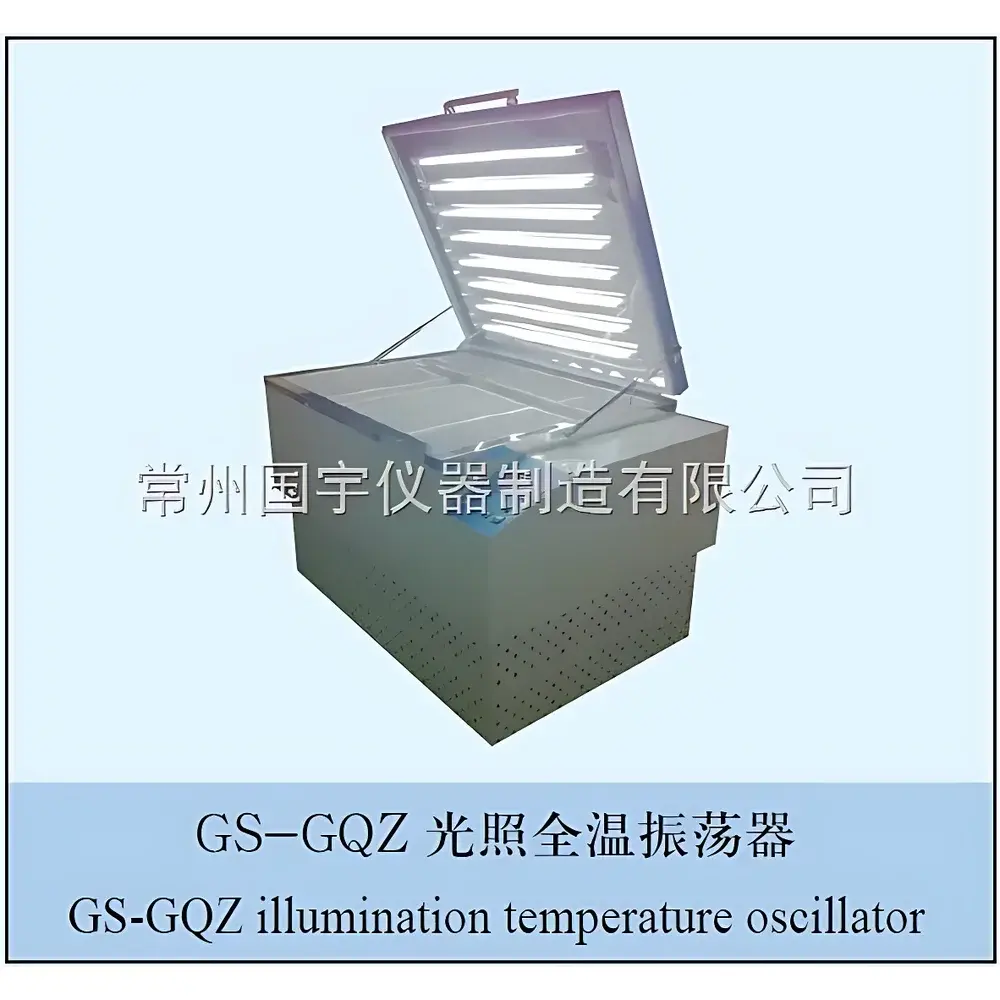
CZGY GS-GQZ Illuminated Full-Temperature Orbital Shaker
| Brand | CZGY |
|---|---|
| Origin | Jiangsu, China |
| Manufacturer Type | Direct Manufacturer |
| Instrument Type | Air-Bath Illuminated Incubator Shaker |
| Timer Range | 0–9999 min |
| Oscillation Frequency | 40–300 rpm (±1 rpm) |
| Orbit Diameter | 26 mm |
| Temperature Control Range | 10–50°C (with illumination), 5–50°C (without illumination) |
| Temperature Accuracy | ±0.5°C |
| Illumination Intensity | 3000 lux (4 independent LED lamp banks, on/off switchable) |
| Platform | Single stainless-steel shaking platform |
| Power Supply | 220 V AC, 50 Hz |
| Heating Power | 1200 W |
| Cooling Power | 200 W |
| Illumination Power | 168 W |
| Capacity | 30 × 500 mL flasks |
| Compressor Restart Delay | 140 s (configurable: 120–200 s) |
| Refrigeration Activation Threshold (AFL) | 10.0°C |
| Refrigeration Deactivation Threshold (AFH) | 35.0°C |
| PID Tuning | Auto-tuning enabled (Atu mode) |
Overview
The CZGY GS-GQZ Illuminated Full-Temperature Orbital Shaker integrates precise temperature regulation, uniform orbital agitation, and programmable white-light illumination into a single benchtop platform engineered for photobiological and microbiological cultivation under controlled environmental conditions. It operates on the principle of air-bath convection heating/cooling combined with a brushless DC motor-driven eccentric drive mechanism to deliver stable, low-vibration orbital motion (26 mm diameter). The system employs a dual-mode thermal control architecture: above 35.0°C, only resistive heating is engaged; between 10.0°C and 35.0°C, both heating and thermoelectric or compressor-based cooling (depending on configuration) are dynamically coordinated via PID algorithms; below 10.0°C, continuous refrigeration is activated to maintain setpoint stability. Illumination is provided by four independently switchable LED arrays delivering a uniform 3000 lux at the working plane—calibrated to approximate daylight spectral output suitable for photosynthetic studies, algal growth, plant tissue culture, and circadian rhythm assays.
Key Features
- Single-tier, mirror-polished 304 stainless-steel chamber interior with electrostatically coated cold-rolled steel exterior for corrosion resistance and ease of decontamination
- Brushless DC motor with closed-loop speed feedback ensures long-term rotational stability (±1 rpm accuracy) and zero maintenance over >20,000 hours of operation
- Dual-sensor thermal monitoring: PT100-grade temperature probe in chamber air stream + secondary surface sensor for redundancy and drift compensation
- Configurable refrigeration logic with AFL/AFH thresholds and adjustable compressor restart delay (120–200 s) to prevent mechanical stress and extend compressor service life
- Intuitive dual-line LED controller with dedicated keys for speed (↑/↓), time (H/M), and RUN/STOP—supports continuous operation (0:00 = infinite runtime)
- Auto-tuning PID function (Atu mode) adapts proportional band (P=10°C), integral time (I=120 s), and derivative time (D=3 s) to load-specific thermal inertia without manual calibration
- Comprehensive parameter lock (LcK=2) prevents accidental modification of critical operational settings during GLP-compliant workflows
Sample Compatibility & Compliance
The GS-GQZ accommodates standard laboratory vessels including Erlenmeyer flasks (up to 30 × 500 mL), culture tubes, petri dishes, and multi-well plates mounted on its single-platform design. Its airflow geometry and chamber volume (approx. 120 L) ensure uniform illumination distribution and minimal thermal gradient (<±0.8°C across platform surface per ASTM E2739-10). The unit complies with IEC 61010-1:2010 for electrical safety in laboratory equipment and meets EN 60335-1 requirements for temperature-controlled appliances. While not certified for GMP manufacturing environments, its audit-trail-capable controller (with timestamped parameter logs accessible via front-panel navigation) supports documentation for ISO/IEC 17025-accredited testing laboratories conducting environmental simulation, stability testing per ICH Q1, or microbial growth kinetics per USP .
Software & Data Management
The embedded microcontroller records all operational events—including start/stop timestamps, setpoint changes, temperature excursions (>±1.0°C deviation), illumination state transitions, and compressor cycling—into non-volatile memory. Data export is performed manually via front-panel menu navigation (no USB or network interface). Each log entry includes date/time stamp, parameter ID, pre-change and post-change values, and operator confirmation flag. This native logging capability satisfies basic FDA 21 CFR Part 11 requirements for electronic records when paired with institutional SOPs governing access control and record retention. For advanced data integration, third-party RS-232 or analog 4–20 mA output modules (optional add-ons) enable connection to SCADA systems or LIMS platforms.
Applications
- Photosynthetic microorganism cultivation (Chlorella, Synechocystis) under defined light:temperature:agitation regimes
- Plant callus and suspension culture propagation requiring diurnal light cycles and constant aeration
- Photoreceptor protein expression studies in E. coli or yeast under controlled irradiance
- Environmental stress response assays—e.g., UV-B exposure combined with thermal ramping and oscillatory shear
- Biodegradation kinetics of light-sensitive pollutants (e.g., PAHs, pharmaceuticals) in aqueous media
- Quality control of light-activated medical devices and photosensitizers per ISO 10993-12
FAQ
What is the maximum ambient temperature for reliable refrigeration performance?
The unit maintains specified temperature stability only when ambient room temperature remains ≤25°C below the target setpoint (e.g., do not operate at 45°C setpoint in a 30°C lab).
Can the illumination spectrum be customized?
No—the 3000 lux output uses fixed-color-white LEDs optimized for broad-spectrum photosynthetic activity (400–700 nm); spectral tuning requires external lamp modules.
Is the shaker compatible with sterile hood integration?
Yes—its front-access design, smooth surfaces, and absence of external vents allow placement inside Class II biosafety cabinets when operated in heating-only mode (refrigeration must be disabled due to airflow interference).
How is temperature uniformity validated across the platform?
Per internal QA protocol, nine-point mapping (center + eight radial positions) is conducted at 25°C and 45°C using NIST-traceable thermocouples; results are documented in the出厂 calibration certificate supplied with each unit.
Does the controller support remote monitoring or alarm notifications?
No native Ethernet/Wi-Fi capability exists; however, optional dry-contact relay outputs (available upon request) can trigger external annunciators or building management systems for high/low temperature or motor fault alerts.
Related Products




