
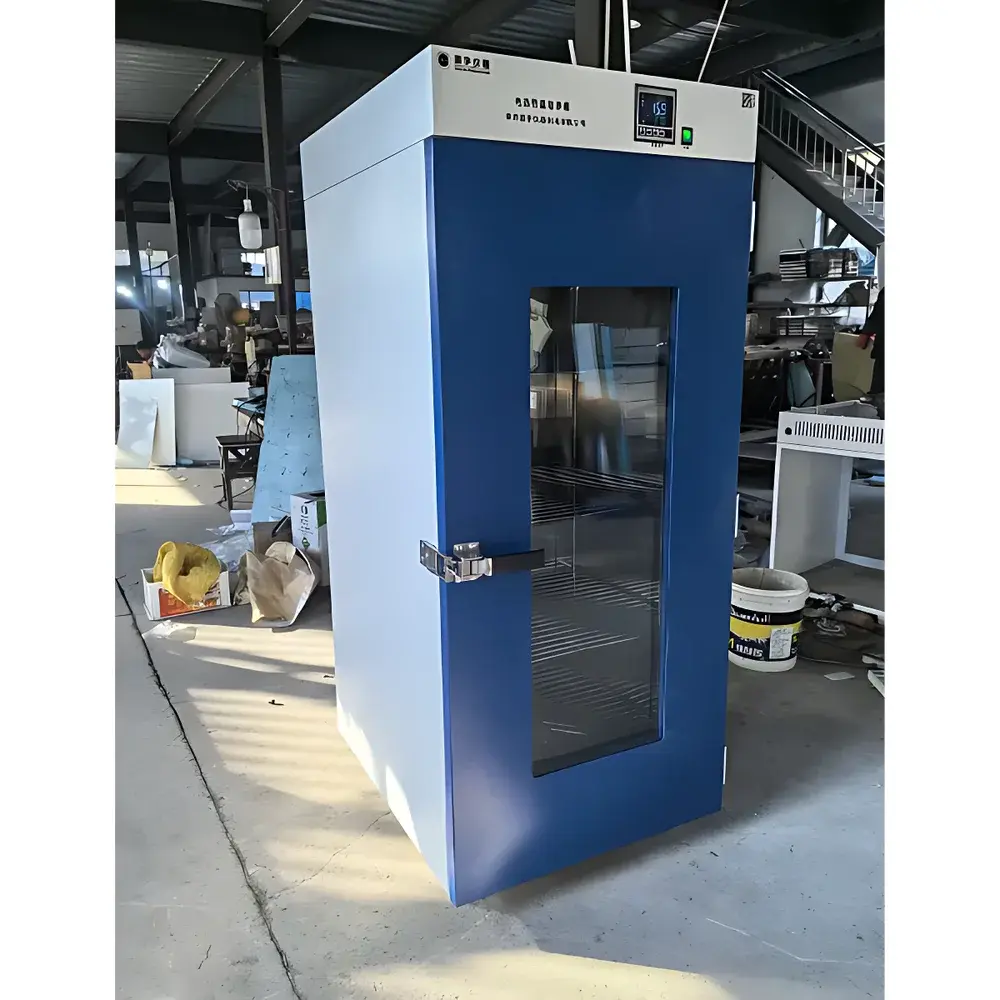
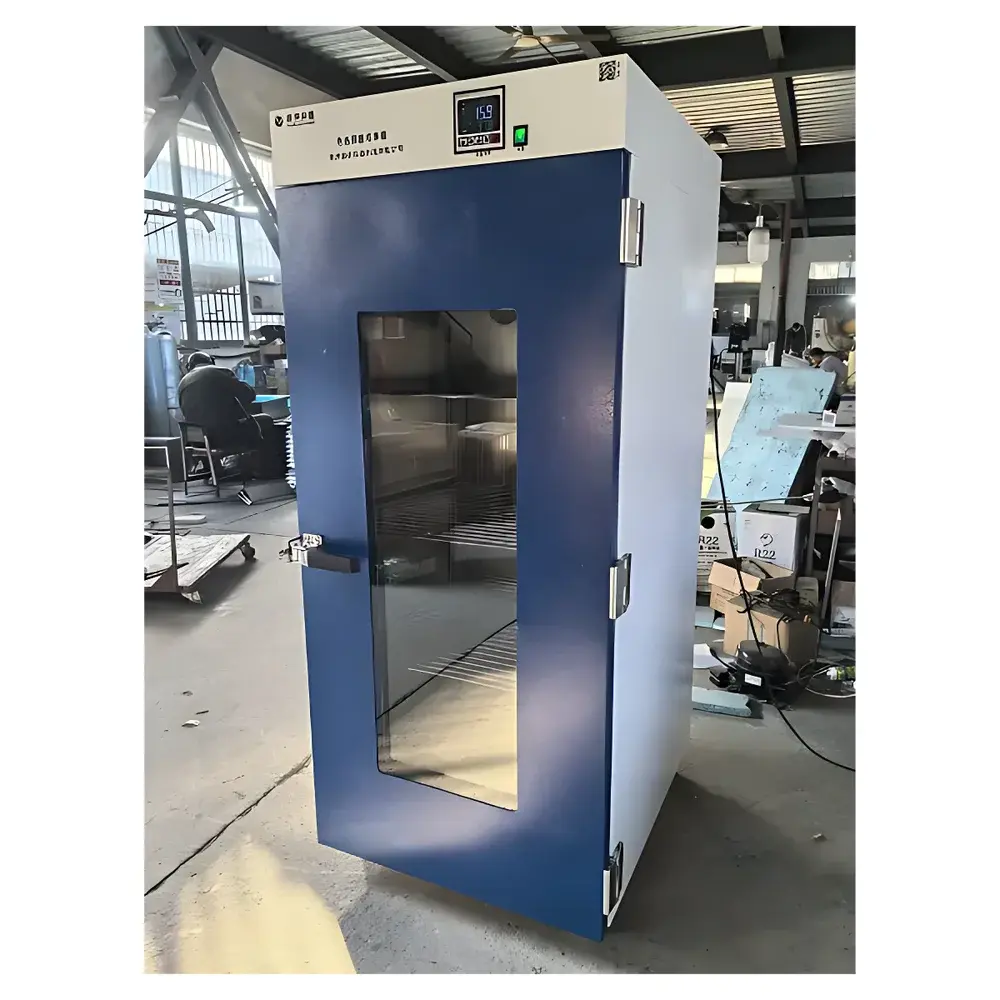
CZGY GY-DP500L Electric Constant Temperature Incubator
| Brand | CZGY |
|---|---|
| Origin | Jiangsu, China |
| Manufacturer Type | Direct Manufacturer |
| Heating Method | Six-Surface Direct Heating |
| Air Circulation | Forced Convection |
| Control System | Digital PID Microprocessor Controller |
| Temperature Range | Ambient +5°C to 65°C |
| Temperature Control Accuracy | ±0.5°C |
| Temperature Uniformity | ±1.0°C |
| Temperature Fluctuation | ±0.5°C |
| Chamber Capacity | 500 L |
| Internal Dimensions (W×D×H) | 600 × 630 × 1360 mm |
| External Dimensions (W×D×H) | 700 × 830 × 1660 mm (excluding handles and hinges) |
| Power Supply | 220 V, 50 Hz |
| Timer Range | 0–9999 minutes or hours |
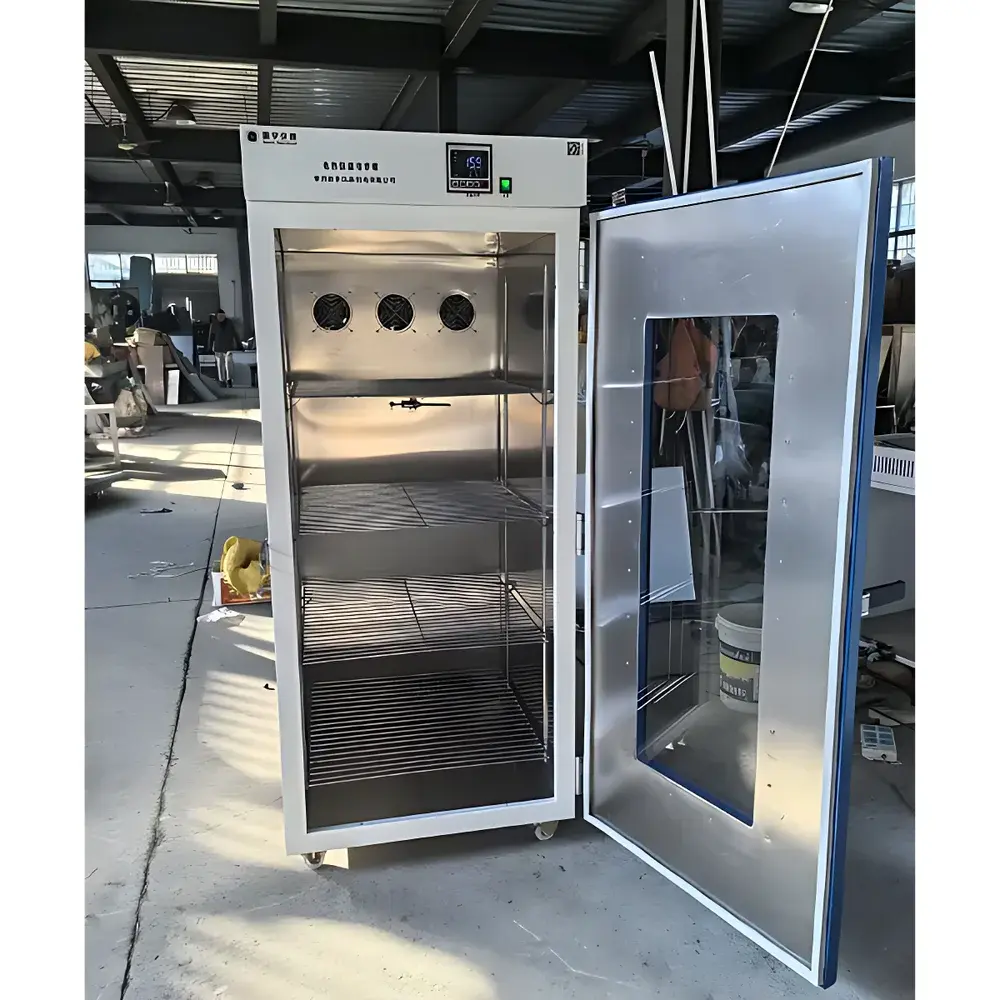
| Adjustable Shelves | 4 stainless-steel shelves with height adjustment |
Overview
The CZGY GY-DP500L Electric Constant Temperature Incubator is a precision-engineered laboratory incubation system designed for stable, uniform thermal environments required in microbiological culture, cell propagation, enzyme activity studies, and long-term sample storage. It operates on the principle of forced-air convection combined with six-surface direct heating—ensuring rapid thermal response and minimal spatial temperature gradients across the entire 500 L working chamber. Unlike natural convection units, this incubator employs an integrated axial fan and optimized internal airflow ducting to maintain consistent heat distribution, critical for reproducible biological assays and regulatory-compliant workflows. Its microprocessor-based PID controller continuously monitors and adjusts heater output in real time, delivering high stability under variable load conditions—including door openings, shelf reconfiguration, or ambient temperature shifts.
Key Features
- Six-surface direct heating architecture for accelerated warm-up and minimized thermal lag
- Forced convection system with rear-mounted centrifugal blower and calibrated air channel design, achieving ≤±1.0°C temperature uniformity (measured per ISO 15378 Annex A and ASTM E2717-20)
- Digital PID temperature controller with intuitive LED interface, offering setpoint resolution of 0.1°C and programmable ramp-hold profiles
- Robust construction: cold-rolled steel outer casing with electrostatic powder coating; 304 stainless-steel interior chamber resistant to corrosion and routine disinfectants (e.g., 70% ethanol, 1% sodium hypochlorite)
- Four adjustable stainless-steel shelves with dual-position support rails—enabling flexible configuration for flasks, Petri dishes, multiwell plates, or stacked culture vessels
- Integrated timer function supporting duration settings from 1 minute to 9999 hours, with auto-shutdown and audible alert
- Double-layer insulated door with tempered glass viewport and magnetic seal—preserving internal conditions while enabling non-invasive visual monitoring
Sample Compatibility & Compliance
The GY-DP500L accommodates standard laboratory consumables including 100–2000 mL Erlenmeyer flasks, 150 mm Petri dishes, T-175 cell culture flasks, and 96-well microplates—without impeding airflow or compromising thermal homogeneity. Its chamber geometry and airflow dynamics have been validated using thermocouple mapping per ICH Q5C and USP guidelines for incubator qualification. The unit meets general safety requirements under IEC 61010-1:2010 for electrical equipment used in laboratory environments. While not certified for Class II biosafety or CO₂ control, it is suitable for GLP-compliant applications where temperature integrity documentation is maintained via external data loggers or optional RS485/Modbus RTU interface (available upon request).
Software & Data Management
The incubator operates as a standalone instrument with embedded firmware supporting local parameter logging (setpoint, actual temperature, elapsed time) stored in non-volatile memory for up to 30 days. For audit-trail compliance, users may connect third-party validation-grade data loggers (e.g., DicksonChart, Omega OM-CP-HITEMP140) via the rear-mounted PT100 sensor port. Optional firmware upgrade supports Modbus RTU protocol over RS485, enabling integration into centralized LabVantage or Siemens Desigo CC building management systems. All temperature records generated during operation satisfy FDA 21 CFR Part 11 requirements when paired with appropriate electronic signature and access control protocols implemented at the host system level.
Applications
- Microbial cultivation (e.g., E. coli, Bacillus subtilis, yeast strains) under standardized growth conditions per ISO 8573-7 and CLSI M22-A2
- Cell line maintenance for pre-transfection expansion, especially adherent lines requiring stable 37°C environments
- Enzyme kinetics assays where thermal drift must remain below ±0.5°C over multi-hour incubations
- Stability testing of pharmaceutical excipients and diagnostic reagents per ICH Q1A(R2)
- Quality control of raw materials in food and beverage laboratories (e.g., APC, coliform enumeration)
- Environmental simulation for material aging studies in polymer and packaging R&D labs
FAQ
What is the recommended calibration frequency for this incubator?
Annual calibration using NIST-traceable reference thermometers is advised for GLP/GMP environments; quarterly verification is recommended for high-throughput academic labs.
Can the incubator be used for BSL-2 applications?
No—it lacks HEPA filtration, negative pressure containment, or decontamination cycles; it is intended for non-pathogenic or low-risk biological work only.
Is the internal chamber humidity controlled?
No—this is a dry incubator; relative humidity is unregulated and will equilibrate with ambient lab conditions (typically 30–60% RH).
Does the unit include a printer or USB export capability?
Not by default; data export requires external logging hardware or optional RS485-to-USB adapter with compatible SCADA software.
What maintenance is required to sustain temperature accuracy?
Biannual inspection of door gasket integrity, fan operation, and heater continuity; annual cleaning of air intake grilles and condenser coils (if equipped with refrigeration option, not applicable here).




