
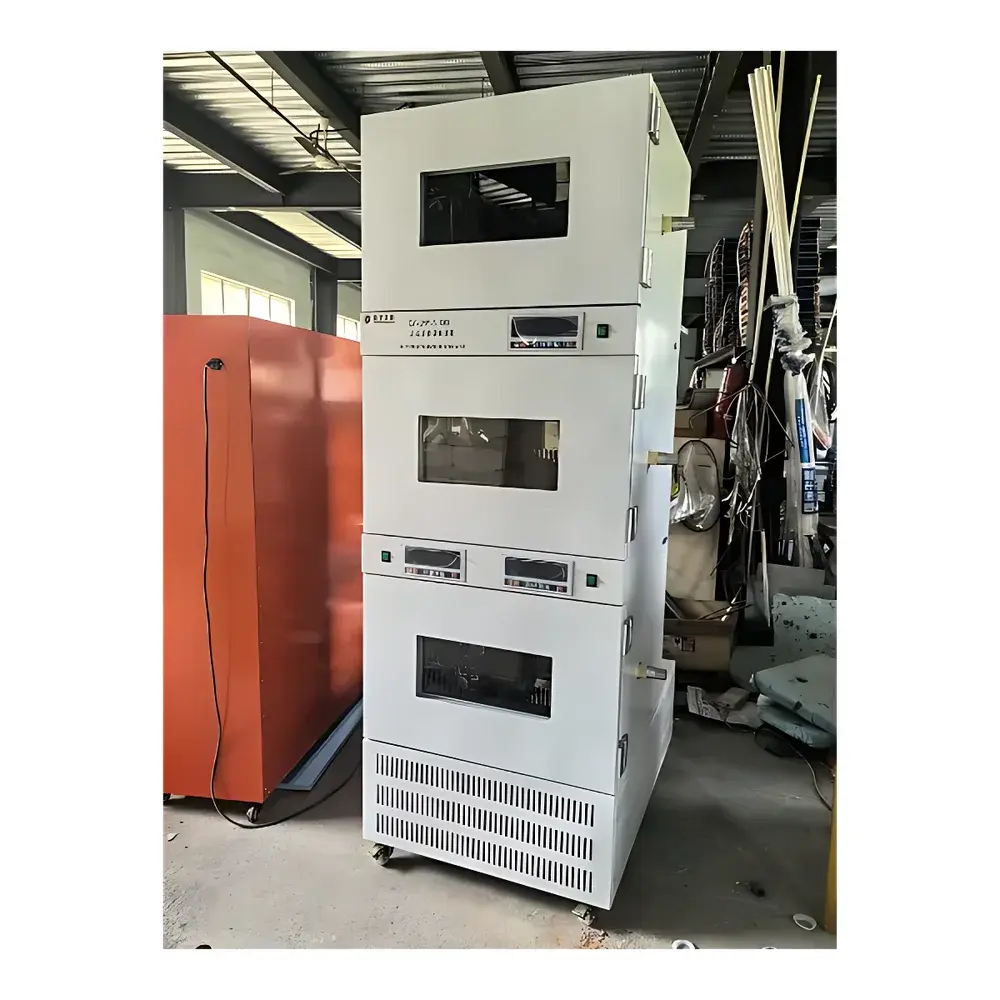
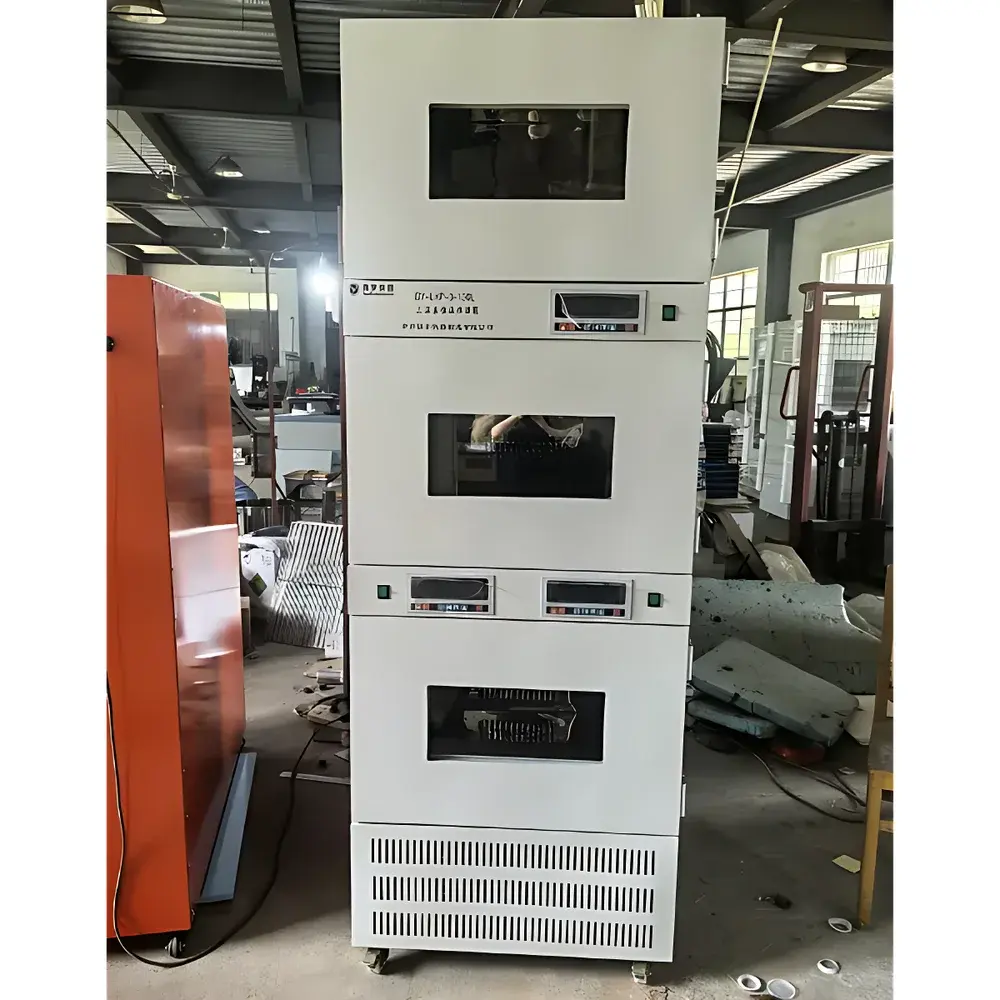
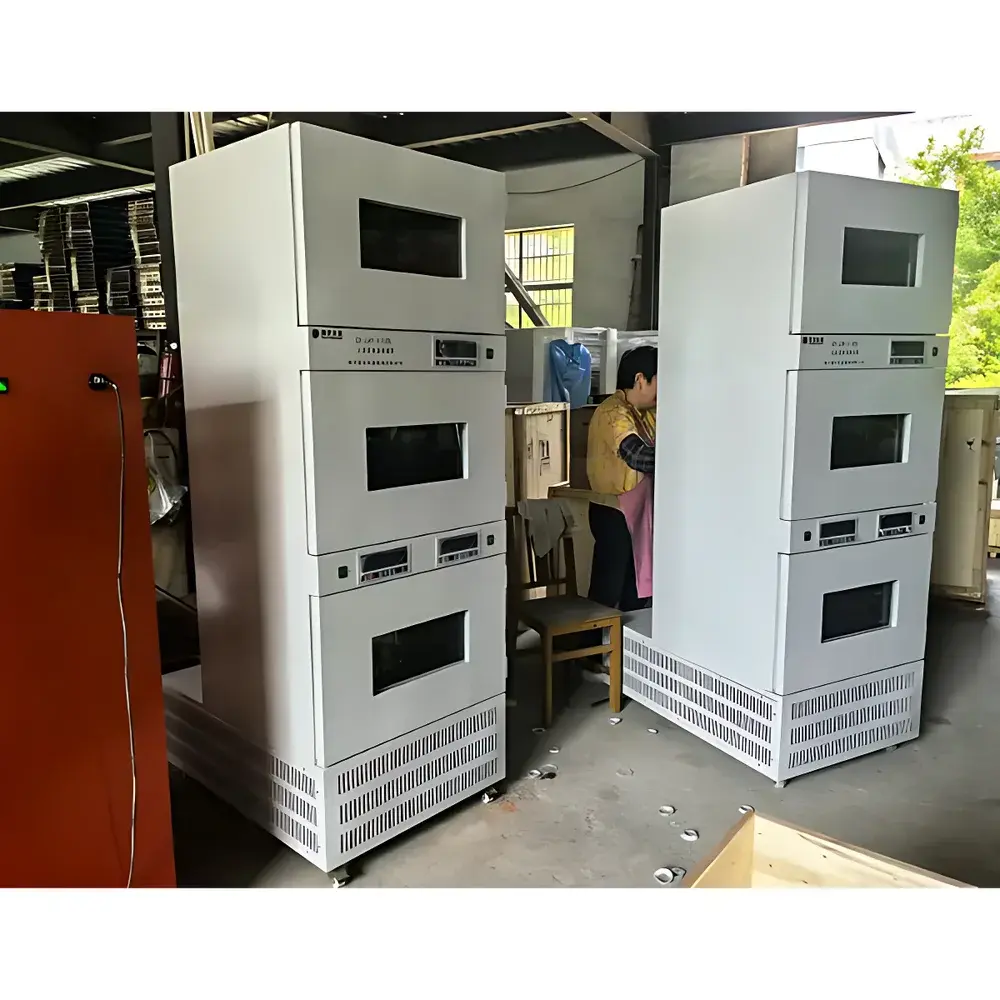
CZGY GY-LHP-3-130L Triple-Zone Temperature and Humidity Controlled Incubator
| Brand | CZGY |
|---|---|
| Origin | Jiangsu, China |
| Manufacturer Type | Direct Manufacturer |
| Model | GY-LHP-3-130L |
| Heating Method | Air-Jacketed Heating |
| Cooling Method | Compressor-Based Refrigeration |
| Humidification Water Tank | External Reservoir |
| Temperature Range (with Humidification) | 5–60 °C |
| Temperature Range (without Humidification) | 5–60 °C |
| Temperature Uniformity | ±1 °C |
| Humidity Range | 50–90 %RH |
| Humidity Accuracy | ±5 %RH |
| Capacity | 130 L × 3 Layers |
| Interior Dimensions | 650 × 500 × 400 mm × 3 Layers |
| Temperature Resolution | ±0.1 °C |
| Temperature Fluctuation | ±1.0 °C |
| Humidity Fluctuation | ±5 %RH |
| Sterilization | UV Lamp |
| Power Supply | AC 220 V, 50 Hz |
| Rated Power per Layer | 550 W |
| Timer Range | 0–9999 min/h |
| Control System | Microprocessor-Based, 30-Stage Programmable Logic |
| Display | Triple Independent LCD Panels |
| Humidifiers | Three 4 L Capacity Units |
| Operating Ambient Temperature | 5–30 °C |
Overview
The CZGY GY-LHP-3-130L Triple-Zone Temperature and Humidity Controlled Incubator is an engineered environmental simulation platform designed for reproducible, long-term stability testing and biological cultivation under precisely regulated thermal and hygroscopic conditions. Unlike single-zone incubators, this system features three physically independent, vertically stacked chambers—each with dedicated PID-controlled heating, refrigeration, humidification, and monitoring circuits—enabling simultaneous operation at distinct temperature and humidity setpoints. Its air-jacketed heating architecture ensures rapid thermal response and minimizes internal condensation, while the compressor-based cooling system maintains stable sub-ambient capability down to 5 °C. The unit operates on a dual-sensor feedback loop: high-accuracy capacitive RH sensors and PT100-grade temperature probes feed real-time data to a microprocessor controller implementing adaptive PID algorithms for dynamic compensation of load changes, door openings, or ambient drift. This architecture meets foundational requirements for ICH Q1A–Q1E stability protocol execution and supports GLP-compliant documentation when integrated with validated software systems.
Key Features
- Triple independent incubation zones (130 L each), enabling parallel experiments under divergent environmental conditions without cross-contamination or thermal crosstalk.
- Air-jacketed heating combined with forced-air convection via optimized cold/hot airflow ducts ensures ±1 °C temperature uniformity across each chamber volume.
- Three externally mounted 4 L humidification reservoirs with auto-refill detection reduce maintenance frequency and eliminate internal water spillage risks.
- Dual-layer insulated observation windows using low-emissivity double-glazed glass preserve thermal integrity while enabling non-invasive visual monitoring.
- Triple independent LCD displays (one per zone) with intuitive touch-sensitive interface support 30-stage programmable profiles, timer scheduling (0–9999 minutes/hours), and real-time deviation alerts.
- UV germicidal lamp integrated into each chamber ceiling provides routine surface decontamination between cycles—validated for log-3 reduction of common mesophilic bacteria and fungi.
- Stainless steel interior (304 grade), electrostatically coated cold-rolled steel exterior, and seamless corner welding ensure corrosion resistance and cleanability per ISO 14644-1 Class 8 cleanroom-compatible practices.
Sample Compatibility & Compliance
The GY-LHP-3-130L accommodates standard microbiological vessels (Petri dishes, multi-well plates, flasks up to 2 L), pharmaceutical stability samples (blister packs, vials, sachets), textile specimens (ASTM D751), and food packaging test units (ISO 11607). Each zone maintains independent validation traceability; temperature mapping per ASTM E2297-20 and humidity distribution studies per ISO 24353:2021 can be conducted without hardware modification. While not pre-certified to FDA 21 CFR Part 11, the controller logs timestamped setpoint changes, alarm events, and sensor outputs—providing raw audit trail data compatible with third-party electronic lab notebook (ELN) or LIMS integration. The unit complies with CE safety directives (2014/35/EU Low Voltage Directive, 2014/30/EU EMC Directive) and conforms to IEC 61000-6-2/6-3 immunity/emission standards.
Software & Data Management
The embedded controller stores up to 100 days of compressed environmental history per zone (1-min interval resolution), accessible via USB export in CSV format. Optional RS485 Modbus RTU interface enables integration with building management systems (BMS) or centralized monitoring platforms such as LabArchives or Thermo Fisher SampleManager LIMS. Firmware supports user-defined alarm thresholds (e.g., >±2 °C deviation for >5 min), email/SMS notifications via external gateway, and password-protected parameter locking for SOP enforcement. Data files include metadata headers specifying operator ID, calibration date, and sensor serial numbers—facilitating ALCOA+ principles (Attributable, Legible, Contemporaneous, Original, Accurate, Complete, Consistent, Enduring, Available).
Applications
- Pharmaceutical stability testing per ICH guidelines: long-term (25 °C/60 %RH), accelerated (40 °C/75 %RH), and intermediate condition studies across multiple batches simultaneously.
- Microbial growth kinetics under controlled hygrometric stress—critical for probiotic viability assessment, fungal sporulation studies, and antimicrobial efficacy screening.
- Packaging material aging tests (ASTM D4332, ISO 2233) evaluating seal integrity, moisture barrier performance, and degradation onset under cyclic humidity exposure.
- Seed germination and plant tissue culture requiring stratified thermal regimes—e.g., vernalization at 4 °C followed by photoperiod-triggered growth at 22 °C/70 %RH.
- Textile and polymer testing per AATCC TM186 and ISO 139: determination of equilibrium moisture content and dimensional stability under standardized atmospheric conditioning.
FAQ
Can the three zones operate at different temperature and humidity setpoints concurrently?
Yes. Each zone has fully independent control hardware, allowing simultaneous operation at any combination within the specified ranges (5–60 °C, 50–90 %RH).
Is the unit suitable for GMP-regulated environments?
It supports GMP workflows through configurable audit trails, user access levels, and deterministic alarm logging—but requires site-specific IQ/OQ/PQ validation per Annex 15 and local regulatory expectations.
What is the recommended calibration interval for temperature and humidity sensors?
Annual recalibration against NIST-traceable references is advised; field verification using calibrated portable hygrometers (e.g., Rotronic HC2-S) every 3 months is recommended for critical applications.
Does the system include overtemperature or overhumidity safety cutoffs?
Yes. Independent hardware limit switches interrupt power to heaters or humidifiers if readings exceed user-defined safety thresholds (configurable up to ±5 °C or ±15 %RH deviation).
Can external data loggers be connected for 21 CFR Part 11 compliance?
The RS485 port permits connection to validated third-party data acquisition systems that provide electronic signatures, audit trails, and secure storage—fulfilling Part 11 technical controls when properly configured and documented.





