
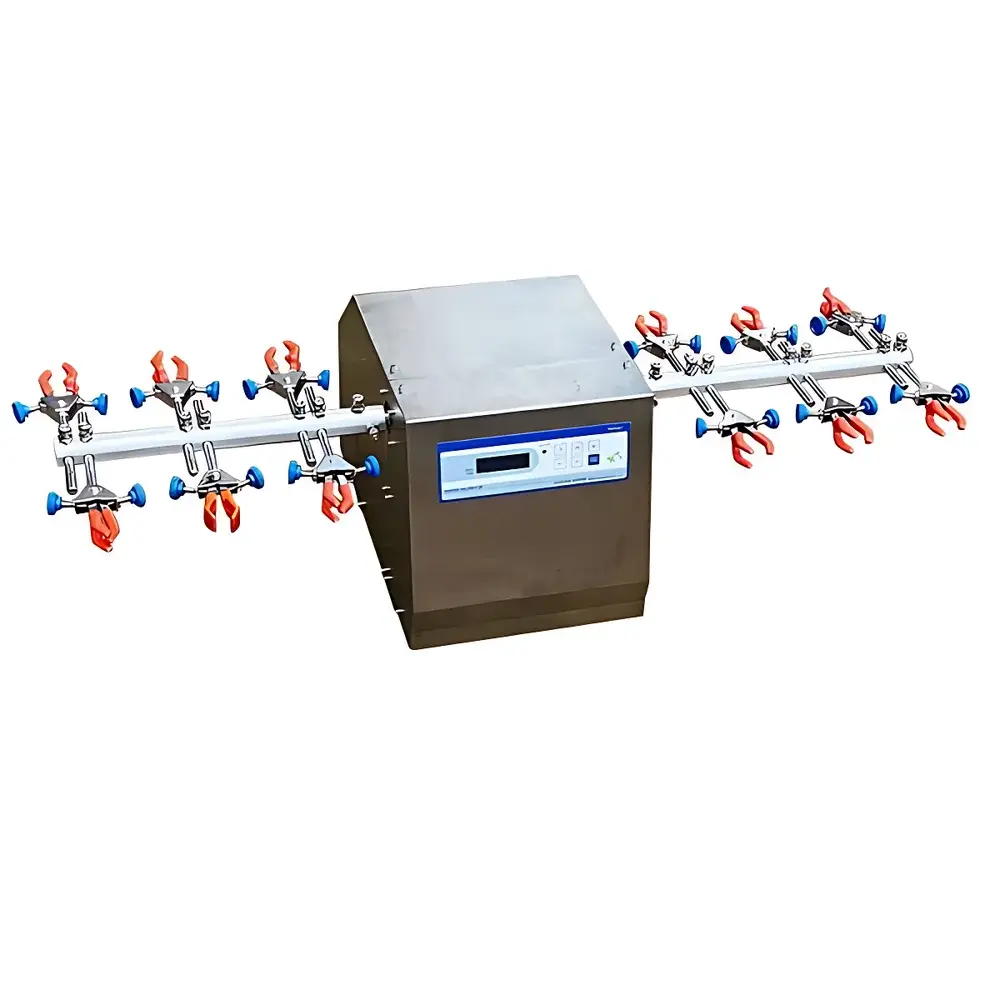
CZGY GY-ZD-810 Wrist-Action Shaker
| Brand | CZGY |
|---|---|
| Origin | Jiangsu, China |
| Manufacturer Type | Direct Manufacturer |
| Product Category | Domestic |
| Model | GY-ZD-810 |
| Instrument Type | Wrist-Action Shaker |
| Timer Range | 0–9999 min or h |
| Oscillation Frequency | 50–600 rpm |
| Oscillation Amplitude | Adjustable Tilt Angles — 3°, 6°, 9°, or 12° |
| Temperature Control | Ambient Only |
| Power Consumption | 100 W |
| Input Voltage | 220 V, 50 Hz |
| Construction | 304 Stainless Steel Housing, Anodized Aluminum Oscillating Arm, Cast Metal Base |
| Rotation Accuracy | ±1 rpm |
| Capacity | 12-position Platform |
Overview
The CZGY GY-ZD-810 Wrist-Action Shaker is an electromechanically engineered platform designed for low-shear, gentle mixing of liquid samples in a wide range of laboratory vessels. Unlike orbital or reciprocating shakers, the GY-ZD-810 replicates the natural arc motion of a human wrist—producing a smooth, elliptical tilt oscillation that minimizes foaming, cell shearing, and sample stratification. This principle of angular oscillation—governed by a precisely balanced eccentric drive mechanism—ensures consistent kinetic energy transfer across heterogeneous suspensions, making it especially suitable for delicate biological applications such as cell culture maintenance, antibody-antigen incubations, gel staining/destaining, and enzymatic reaction kinetics where mechanical stress must be minimized. The device operates exclusively at ambient temperature, eliminating thermal drift and enabling integration into temperature-controlled rooms or cold rooms without interference from internal heating elements.
Key Features
- Microprocessor-controlled PID feedback loop ensures stable, repeatable oscillation frequency across the full 50–600 rpm range, with real-time deviation compensation and ±1 rpm rotational accuracy.
- Four discrete tilt-angle settings (3°, 6°, 9°, and 12°) allow users to optimize shear profile for specific vessel geometry and viscosity—critical when handling narrow-neck flasks, separatory funnels, or tall culture tubes.
- LCD interface displays elapsed time, set parameters, current speed, and active tilt angle; supports dual timer modes (minutes or hours) up to 9999 units with auto-stop functionality.
- Dual safety architecture includes independent over-speed detection (audible/visual alarm), leakage current protection, over-current cutoff, and a hardware watchdog timer that halts operation if firmware fails to respond within predefined cycles.
- Memory retention preserves user-defined configurations—including speed, angle, and timer settings—across power interruptions; “power recovery” mode resumes operation upon grid restoration if enabled.
- Structural integrity is ensured via a 304 stainless steel chassis (corrosion-resistant, non-magnetic), precision-machined anodized aluminum oscillating arm, and vibration-damped cast metal base for long-term operational stability on standard lab benches.
Sample Compatibility & Compliance
The GY-ZD-810 accommodates diverse vessel types—including Erlenmeyer flasks (8–16 units), volumetric flasks, centrifuge tubes, serum bottles, separatory funnels, and custom glassware—without requiring adapters or clamps. Its 12-position platform provides symmetrical load distribution, supporting total mass up to 5 kg with ≤5% amplitude deviation under nominal loading. While not certified for ISO 13485 or FDA 21 CFR Part 11 out-of-the-box, the instrument’s deterministic control logic, parameter logging capability (via optional RS-232/USB data export), and audit-ready event flags (e.g., over-speed trigger, timer expiration) support alignment with GLP and GMP documentation requirements when integrated into validated laboratory workflows. It complies with IEC 61010-1:2010 for electrical safety in laboratory equipment.
Software & Data Management
The GY-ZD-810 operates via embedded firmware with no external software dependency. All operational parameters are stored in non-volatile memory and accessible through the front-panel LCD. Optional serial communication (RS-232 or USB-to-serial) enables remote command execution (e.g., START, STOP, SET_SPEED, QUERY_STATUS) and timestamped parameter logging using third-party terminal emulators or custom Python/LabVIEW scripts. Event logs—including runtime duration, speed deviations exceeding ±2 rpm, tilt-angle changes, and safety-trigger activations—are retained for up to 1000 entries and can be exported for QC review or regulatory submission. No cloud connectivity or proprietary software installation is required, preserving network security and minimizing IT validation overhead.
Applications
- Molecular biology: Hybridization buffer mixing for Southern/Northern blotting; gentle agitation during probe binding to reduce non-specific signal.
- Cell culture: Maintenance of suspension cultures (e.g., insect or mammalian cells in serum-free media) without inducing apoptosis via shear stress.
- Clinical diagnostics: Uniform mixing of immunoassay reagents prior to ELISA plate reading to prevent edge effects and improve inter-assay reproducibility.
- Environmental testing: Extraction of analytes from solid matrices (e.g., soil, sediment) using solvent-based leaching protocols compliant with EPA Method 3510C.
- Pharmaceutical R&D: Dissolution testing of extended-release formulations under low-turbulence conditions per USP guidance for modified-release dosage forms.
FAQ
Does the GY-ZD-810 support temperature control?
No. It is an ambient-only shaker. For thermostatic operation, integrate it inside a climate-controlled chamber or pair with a compatible incubator shaker model.
Can I use this shaker with heavy-walled glassware or filled separatory funnels?
Yes—provided total load remains ≤5 kg and center-of-gravity stays within the platform’s moment-of-inertia envelope. Avoid asymmetric loading; always balance opposing positions.
Is the tilt angle adjustable during operation?
No. Angle selection must be performed before initiating oscillation. Changing angle mid-run requires stopping the unit and manual reconfiguration.
What maintenance is required for long-term reliability?
Annual inspection of drive belt tension, oscillation arm pivot lubrication (using food-grade silicone grease), and verification of ground-fault circuit integrity using calibrated test equipment.
Is calibration documentation available?
Factory calibration certificate (traceable to NIM, China) is provided with each unit. On-site recalibration services are available through authorized CZGY service centers under ISO/IEC 17025-accredited procedures.
Related Products




