
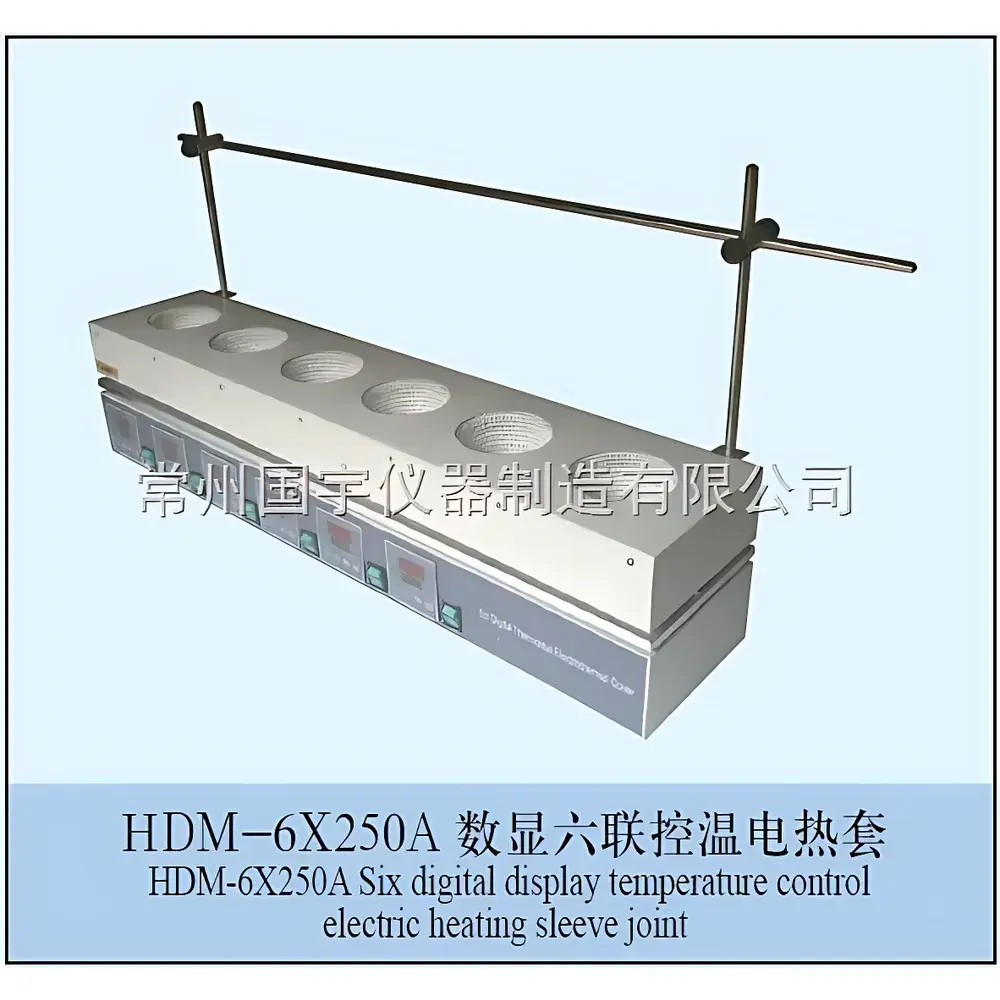
CZGY HDM-6×250A Digital Six-Station Programmable Electric Heating Mantle
| Brand | CZGY |
|---|---|
| Origin | Jiangsu, China |
| Manufacturer Type | Direct Manufacturer |
| Model | HDM-6×250A |
| Rated Voltage | 220 V ±10% |
| Rated Frequency | 50 Hz ±2 Hz |
| Temperature Range | Ambient to 300 °C (digital display, independent channel control) |
| Temperature Stability | ±1 °C |
| Capacity | 6 × 250 mL |
| Total Heating Power | 1.8 kW (6 × 300 W per station) |
| Insulation Material | High-temperature alkali-free glass fiber |
| Heating Element | Sealed Ni-Cr resistance wire woven into hemispherical mantle geometry |
Overview
The CZGY HDM-6×250A Digital Six-Station Programmable Electric Heating Mantle is an engineered solution for precise, parallel thermal management of multiple round-bottom flasks in academic, pharmaceutical, petrochemical, and environmental laboratories. Based on resistive heating principles, the unit integrates six independently controlled hemispherical mantles—each constructed with nickel-chromium alloy resistance wire fully encapsulated within alkali-free glass fiber insulation. This design eliminates open flame hazards while delivering uniform radial heat distribution across flask curvature, minimizing thermal gradients and reducing localized overheating risks common in conventional hot plates or oil baths. The digital PID temperature controller enables setpoint programming and real-time monitoring for each station, supporting reproducible heating protocols essential for reaction optimization, solvent reflux, distillation, and sample concentration workflows.
Key Features
- Six independent heating zones with individual digital PID controllers, enabling simultaneous yet differentiated thermal profiles across up to six 250 mL round-bottom flasks
- Hemispherical mantle geometry ensures maximal surface contact and thermal coupling efficiency with standard laboratory glassware
- Alkali-free glass fiber insulation provides dielectric integrity at temperatures up to 300 °C and resists degradation under repeated thermal cycling
- Digital LED display with 1 °C resolution and ±1 °C stability over full operating range (ambient to 300 °C)
- Robust mechanical construction with reinforced fiberglass housing and integrated grounding terminals compliant with IEC 61010-1 safety standards
- No exposed heating elements—eliminates ignition risk and reduces contamination potential during volatile solvent handling
Sample Compatibility & Compliance
The HDM-6×250A is designed exclusively for use with borosilicate glass vessels (e.g., Pyrex®, Kimax®) conforming to ASTM E438 Type I, Class A specifications. Each mantle accommodates standard 250 mL round-bottom flasks (24/40 or 29/32 joint sizes), with optional custom-fit mantles available for non-standard vessel geometries upon request. The device meets CE marking requirements for laboratory electrical equipment (EN 61010-1:2010 + A1:2011) and incorporates mandatory protective earthing per IEC 60364-5-54. While not certified for hazardous area use (ATEX/IECEx), its flameless operation supports safe deployment in fume hoods and general-purpose labs handling Class I flammable liquids per NFPA 30 guidelines.
Software & Data Management
This analog-digital hybrid instrument operates without embedded firmware or network connectivity; temperature setpoints and real-time readings are managed locally via front-panel push-button interface and dual-digit LED displays. For GLP/GMP-aligned environments requiring audit trails, external data logging is supported through optional 4–20 mA or 0–5 V analog outputs (available on HDM-6×250A-EX variant). Integration with third-party SCADA systems or LabVIEW-based acquisition platforms is achievable using standard signal conditioning modules. No proprietary software or driver installation is required—fully compatible with ISO/IEC 17025-accredited calibration workflows when paired with NIST-traceable reference thermometers.
Applications
- Parallel synthesis and screening of organic reactions under controlled thermal conditions
- Multi-vessel reflux setups for extraction, hydrolysis, or esterification procedures
- Simultaneous evaporation of solvent batches in environmental sample preparation (e.g., EPA Method 502.2, 525.3)
- Controlled heating of culture media or reagent solutions in microbiology and cell biology labs
- Pre-conditioning of catalysts or adsorbents prior to BET surface area analysis
- Calibration support for thermocouple validation studies requiring stable, multi-point thermal sources
FAQ
What is the recommended break-in procedure for new units?
Prior to first operational use, gradually ramp temperature to 100 °C in 20 °C increments, holding each step for 15 minutes. Observe for white smoke (residual binder volatilization); if present, power down until dissipated. Repeat until no smoke occurs—typically 3–5 cycles. This ensures complete outgassing of insulation binders and restores optimal dielectric strength.
Can this unit be used with non-round-bottom vessels?
No. The hemispherical mantle geometry is optimized for thermal transfer to spherical-bottom glassware. Flat-bottom or conical vessels will exhibit poor contact, uneven heating, and potential thermal runaway. Custom mantles for alternative geometries are available under OEM engineering support.
Is the device suitable for continuous 24/7 operation?
Yes—rated for continuous duty at ≤250 °C. At maximum setpoint (300 °C), derating to 16-hour daily cycles is advised to extend insulation service life beyond 5 years under typical lab conditions.
How is calibration verification performed?
Use a NIST-traceable immersion thermometer (e.g., Fluke 1523 with 0.05 °C uncertainty) inserted into a water-filled 250 mL flask placed inside one mantle. Compare displayed setpoint against measured bulk liquid temperature after 30 minutes of thermal equilibrium. Deviation >±1.5 °C warrants adjustment via internal potentiometer or factory recalibration.
Does the unit comply with FDA 21 CFR Part 11 requirements?
No—this is a stand-alone analog-digital instrument without electronic record generation, user authentication, or audit trail functionality. It may be deployed in Part 11 environments only as a manually operated ancillary device, with all critical process parameters recorded externally in bound logbooks or validated ELN systems.
Related Products



