
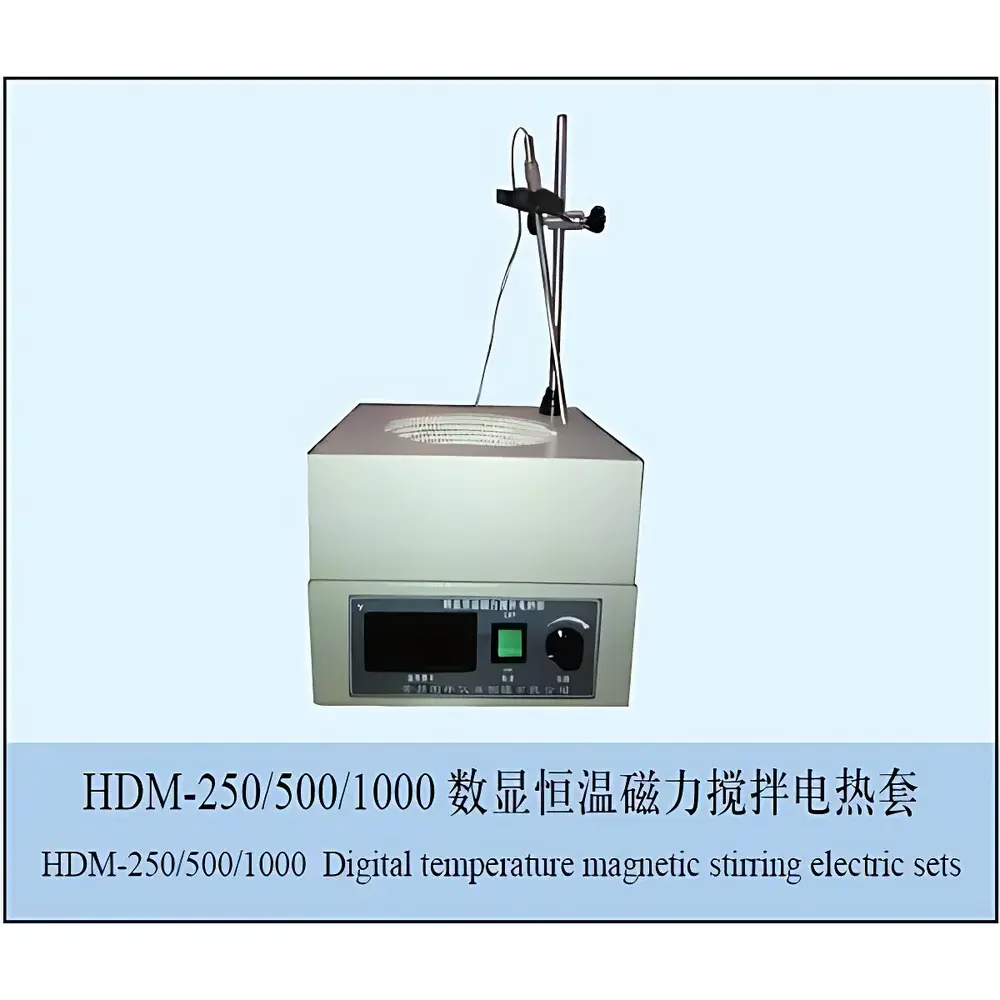
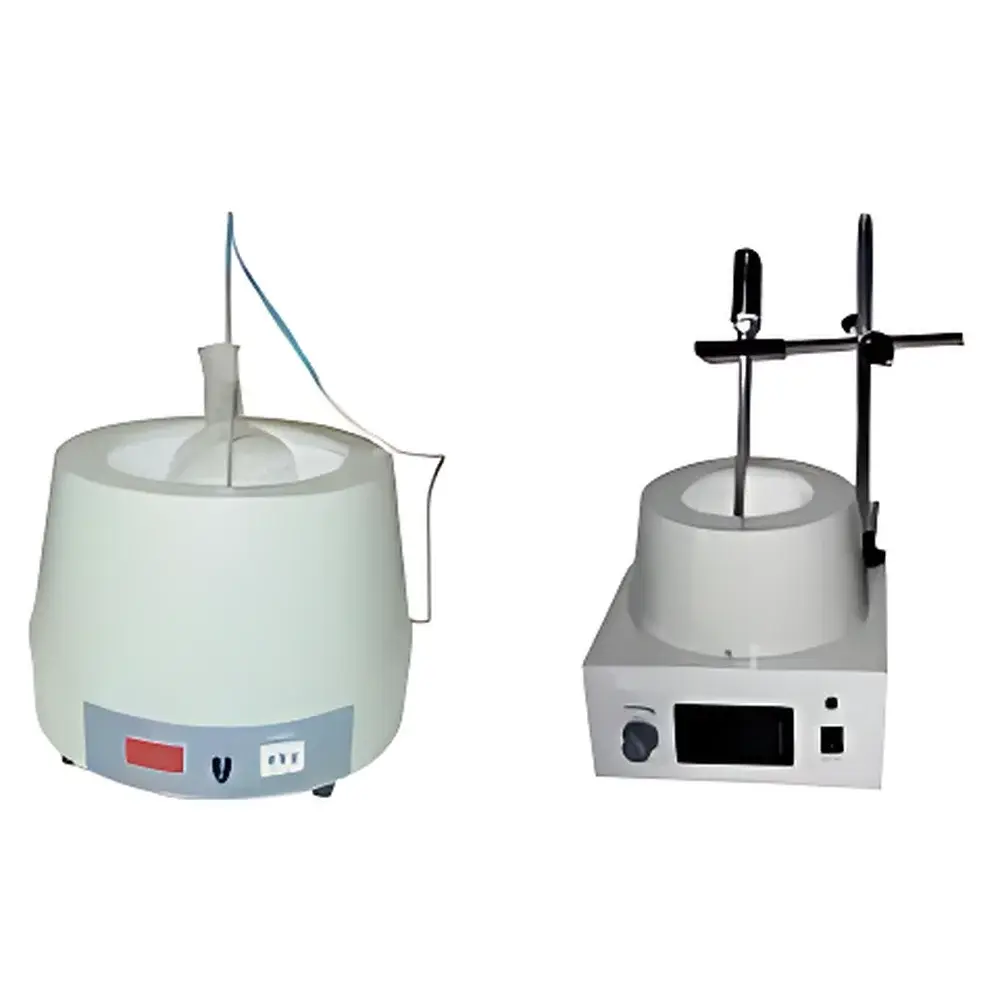
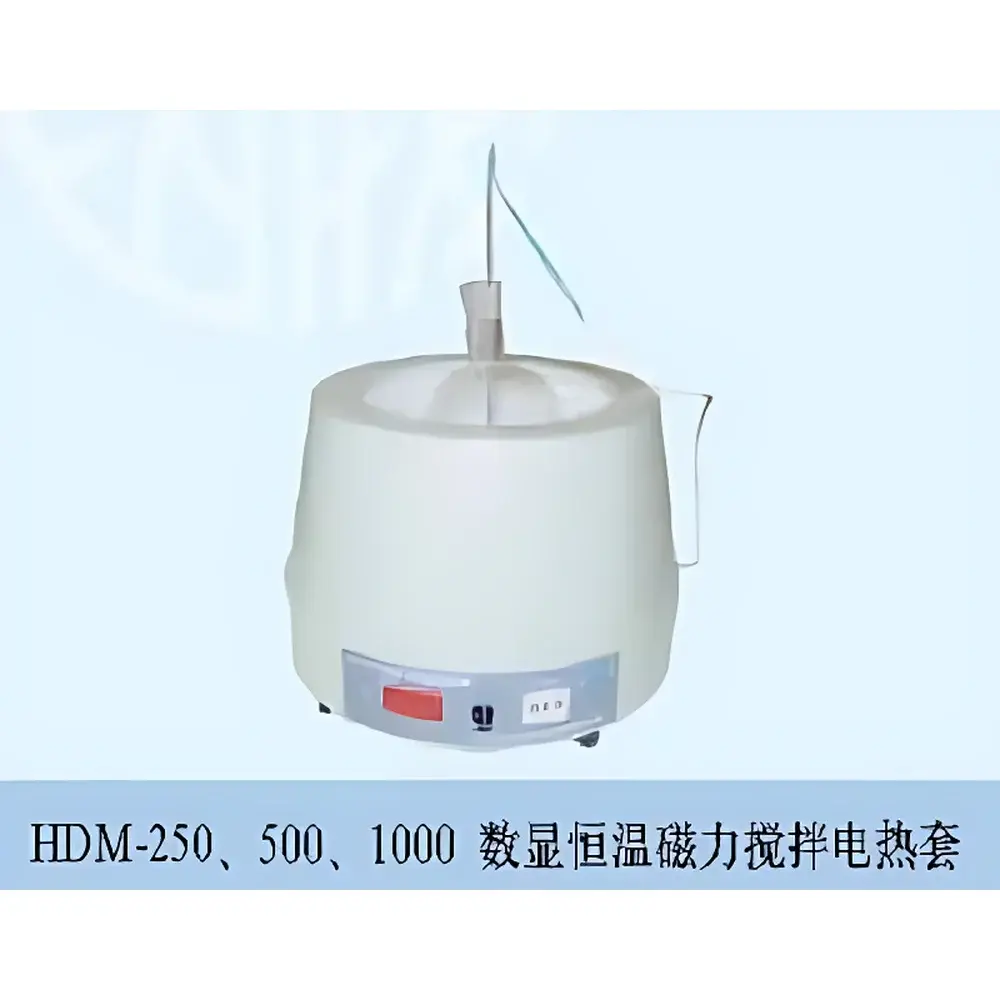
CZGY HDM Series Digital Display Constant-Temperature Magnetic Stirring Heating Mantle
| Brand | CZGY |
|---|---|
| Origin | Jiangsu, China |
| Manufacturer Type | Direct Manufacturer |
| Product Category | Domestic |
| Models | HDM-250, HDM-500, HDM-1000 |
| Price | USD 105 (HDM-250) |
| Capacity | 250 mL / 500 mL / 1000 mL |
| Heating Power | 150 W / 250 W / 450 W |
| Temperature Control Range | Ambient to 300 °C |
| Stirring Speed | 100–2000 rpm |
Overview
The CZGY HDM Series Digital Display Constant-Temperature Magnetic Stirring Heating Mantle is an integrated laboratory heating and mixing platform engineered for precision temperature control and consistent mechanical agitation in glass reaction vessels. Unlike conventional hotplates or standalone mantles, this device combines resistive heating via embedded nickel-chromium alloy elements—encapsulated within high-temperature fiberglass insulation—with a built-in magnetic stirrer motor and PID-controlled digital thermostat. The system operates on the principle of convective thermal transfer through uniform mantle-to-vessel contact, while simultaneous magnetic stirring ensures homogeneous heat distribution and prevents localized thermal degradation or sedimentation during extended reactions. Designed for routine use in synthetic chemistry, pharmaceutical formulation, environmental sample digestion, and quality control workflows, the HDM series supports reproducible thermal protocols across ambient to 300 °C, with real-time dual-display feedback (actual vs. setpoint temperature) and adjustable rotational speed from 100 to 2000 rpm.
Key Features
- Integrated dual-function design: simultaneous precise heating and magnetic stirring in a single compact unit
- PID-based digital temperature controller with ±1 °C accuracy and 0.1 °C resolution over 0–300 °C range
- Fiberglass-insulated heating element offering rapid thermal response, low thermal inertia, and energy-efficient operation
- Three standard capacity models (HDM-250, HDM-500, HDM-1000) matched to common round-bottom flask sizes (100–1000 mL)
- Adjustable stirring speed (100–2000 rpm) with soft-start function to minimize vortex instability and bumping
- Dual LED display: upper row shows real-time measured temperature; lower row displays user-set target temperature
- Over-temperature protection circuit and grounded chassis compliant with IEC 61010-1 safety standards
- Robust aluminum-alloy housing with heat-resistant silicone rubber base for stable placement and vibration damping
Sample Compatibility & Compliance
The HDM mantles are optimized for use with standard borosilicate glassware—including round-bottom flasks, boiling flasks, and digestion tubes—up to the rated volume capacity of each model. Their flexible, conformal mantle geometry ensures maximal surface contact and minimal thermal gradient across the vessel wall. All units meet CE marking requirements for electrical safety and electromagnetic compatibility (EMC Directive 2014/30/EU). While not certified for hazardous area use (e.g., ATEX), they are suitable for general-purpose laboratories operating under GLP-compliant environments when paired with validated SOPs. Temperature calibration traceability can be established using NIST-traceable thermocouples or PT100 probes per ASTM E220 or ISO/IEC 17025 guidelines.
Software & Data Management
The HDM Series operates as a stand-alone analog-digital hybrid instrument without onboard data logging or PC connectivity. However, its dual-display interface supports manual protocol documentation in laboratory notebooks or LIMS entries. For regulated environments requiring audit trails (e.g., FDA 21 CFR Part 11 compliance), external temperature and speed recording may be achieved using third-party USB data loggers (e.g., Omega OM-DAQPRO-5300) interfaced via optional analog output modules (0–5 V or 4–20 mA)—available upon request for OEM integration. Firmware updates are not applicable; calibration verification is performed manually using reference thermometers at three points (ambient, 100 °C, and 250 °C) per internal QC checklist.
Applications
- Controlled-temperature synthesis of organic intermediates and polymer precursors
- Acid digestion of soil, sludge, and biological tissue samples prior to ICP-OES or AAS analysis
- Standardization of titrant solutions under thermostatic conditions per USP and EP 2.2.47
- Extraction of active pharmaceutical ingredients (APIs) using reflux or Soxhlet-compatible setups
- Enzyme activity assays requiring stable incubation at sub-boiling temperatures (e.g., 37 °C, 60 °C)
- Preparation of calibration standards and matrix-matched reference materials in environmental labs
- Distillation support in small-scale essential oil or solvent recovery systems
FAQ
Is the HDM series compatible with Teflon-coated stir bars?
Yes—standard PTFE- or PTFE/glass-coated magnetic stir bars up to 40 mm in length operate reliably within the specified speed and temperature ranges.
What maintenance is required to ensure long-term thermal stability?
Periodic visual inspection of the fiberglass mantle for abrasion or carbonization is recommended; cleaning should be limited to dry lint-free cloths—no solvents or water contact.
Can the unit be used continuously for 24/7 operation?
Continuous operation is permissible at temperatures ≤200 °C with adequate ventilation; above 250 °C, duty cycles of ≤8 hours per day are advised to preserve insulation integrity.
Does the device support external temperature probe input for chamber monitoring?
No—temperature sensing is internal only via integrated thermistor; external probe inputs require custom modification and are not covered under warranty.
How is calibration verified during IQ/OQ qualification?
Verification follows a three-point method using a calibrated reference thermometer placed inside a water-filled flask at 25 °C, 100 °C, and 250 °C, with deviations recorded against setpoints per ISO/IEC 17025 Annex A.3.



